
If you want the short version first, here it is:
For many standard commercial low-slope projects, TPO roofing cost per square foot usually starts around $8 to $10.50 installed as a planning number. Once you add tear-off, insulation upgrades, edge metal, tougher access, or code-related work, it can climb past that pretty quickly. That’s why two buildings with the same square footage can still get very different numbers.
TPO is popular for a reason. It’s usually one of the more cost-effective thermoplastic roofing options, it works well on low-slope commercial roofs, and it checks a lot of boxes for owners who want a clean, practical system without jumping straight into higher-cost PVC territory.
Average TPO roofing cost per square foot
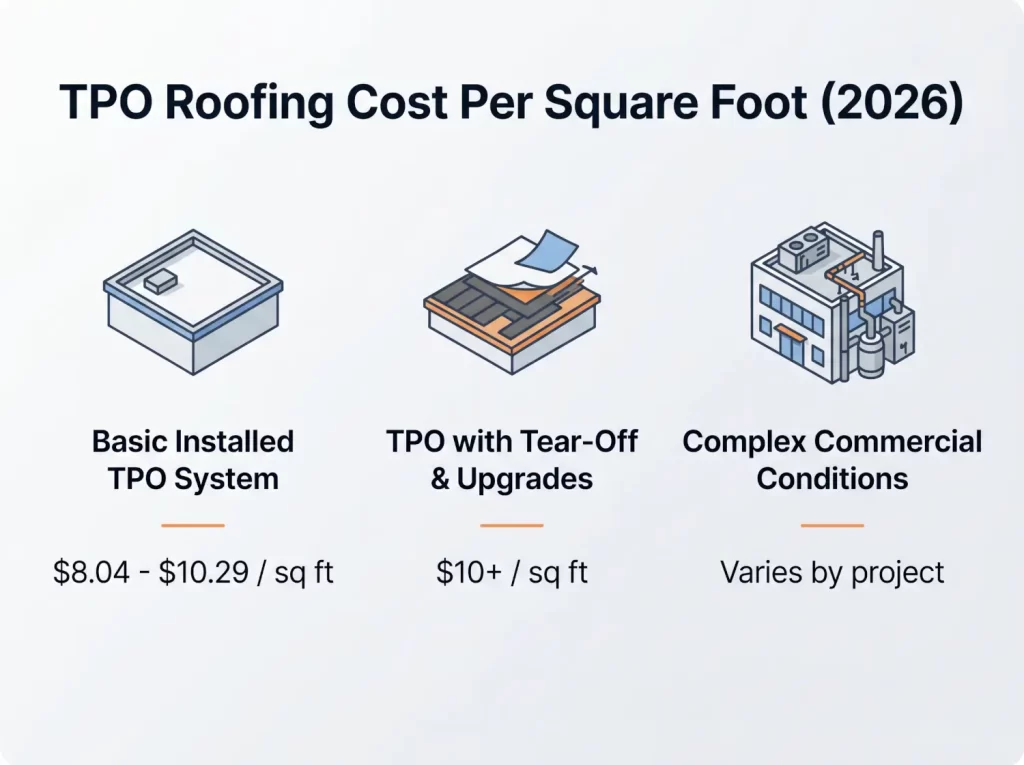
If you’re budgeting a reroof and just want a realistic starting range, this is the part that matters most.
| TPO project type | Typical planning range |
|---|---|
| Basic installed TPO system | $8.04 – $10.29 / sq ft |
| TPO with added tear-off, disposal, upgrades, or tougher conditions | $10+ / sq ft and up |
That first range is a solid baseline for a standard membrane installation in favorable conditions. It does not automatically include everything that tends to show up in real commercial projects, like removal and disposal of the old roof, structural surprises, code-related upgrades, or more difficult jobsite conditions. So if you’re estimating flat roof TPO cost per square foot, the safe move is to treat the baseline as the starting line, not the finish line.
If you’re comparing TPO against other commercial systems, our guide on commercial roof replacement cost per square foot gives a broader look at how TPO stacks up against PVC, EPDM, BUR, and metal.
The real cost to install TPO roof: what you’re actually paying for
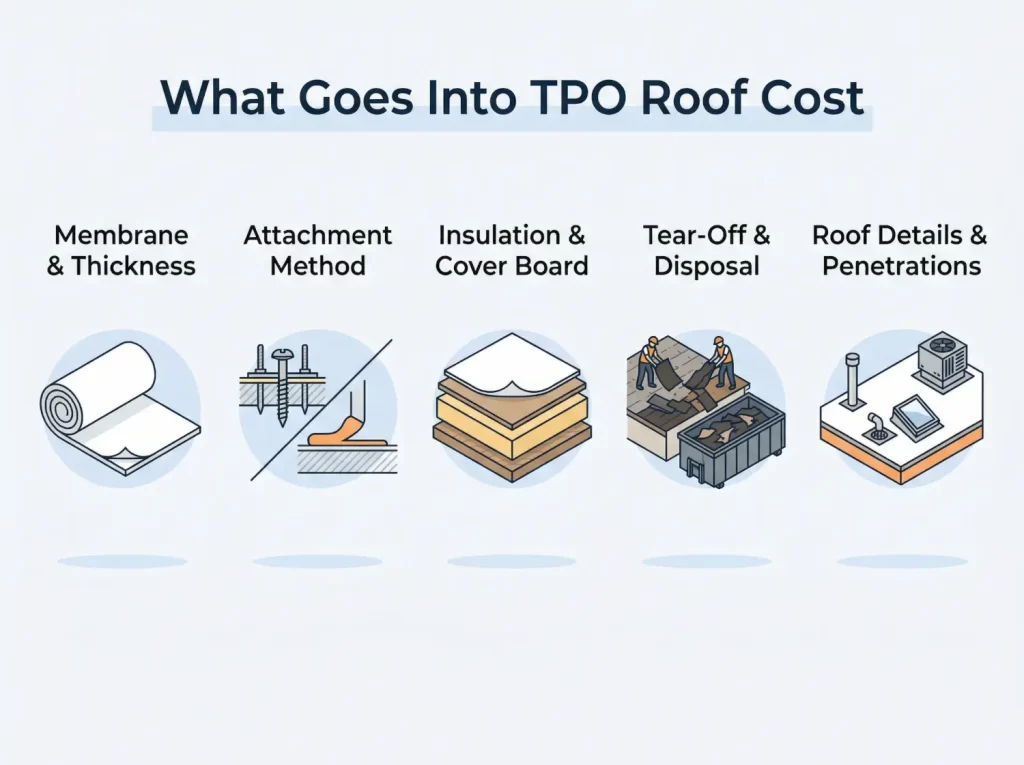
A lot of owners focus on the membrane itself, but the membrane is only one piece of the bill.
Your final cost to install TPO roof usually comes from five main buckets:
- membrane thickness and product choice
- attachment method
- insulation and cover board needs
- tear-off and disposal
- roof details like penetrations, drains, curbs, and edge metal
That’s why TPO pricing can feel weirdly slippery online. Someone says “TPO is affordable,” which is true. Then they leave out the part where the building has fifty penetrations, old wet insulation, and access that makes every material load a mini event. Suddenly “affordable” starts acting expensive.
Membrane thickness matters
Not all TPO systems are the same. Thickness changes performance, warranty options, and price. In practice, thicker membranes and more robust assemblies usually cost more up front, but they can also open the door to longer warranty coverage and better long-term durability. GAF notes that TPO systems may qualify for warranties ranging from 25 to 35 years, depending on thickness, fleece backing, attachment method, and system design.
Recover vs. tear-off changes the math fast
If the existing roof is a good candidate for a recover, pricing can stay more manageable. If the old roof has to come off, the number usually jumps because now you’re paying for labor, debris handling, disposal, and whatever gets uncovered underneath. That is one of the fastest ways a quote moves from “not great” to “okay, now this is a capital project.”
TPO roof cost per sq ft by building size
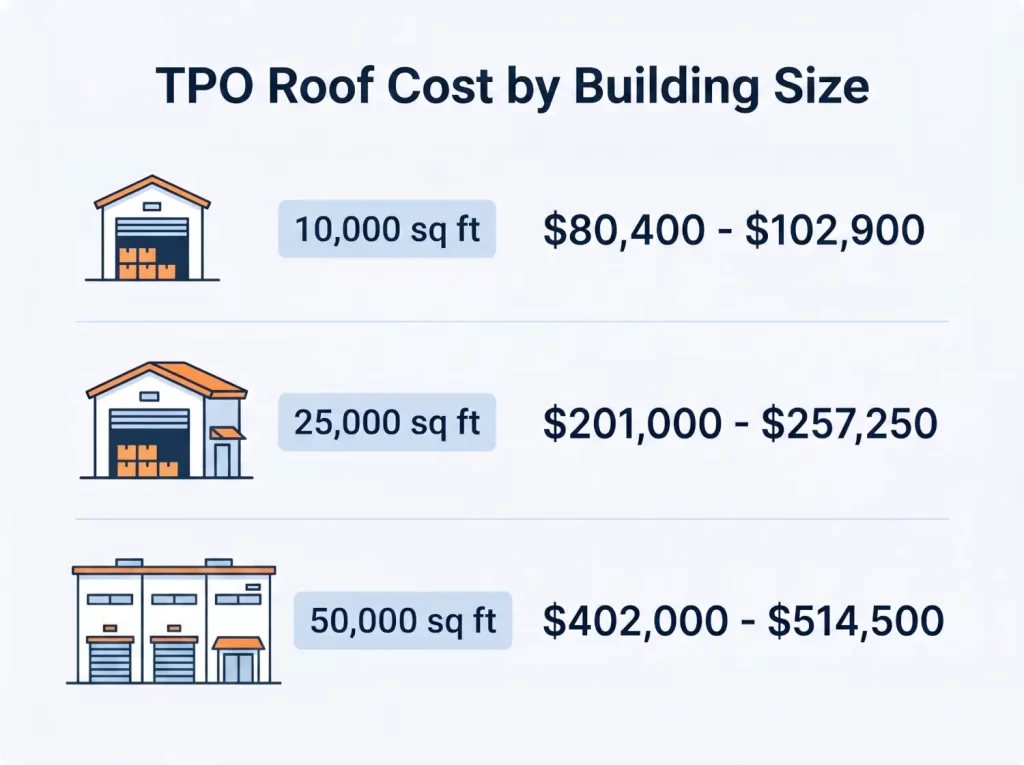
Per-square-foot pricing is useful, but most owners eventually want the total number they’ll be explaining to someone else.
Using the baseline installed range above, here’s what that looks like:
| Building size | Estimated TPO budget range |
|---|---|
| 10,000 sq ft | $80,400 – $102,900 |
| 25,000 sq ft | $201,000 – $257,250 |
| 50,000 sq ft | $402,000 – $514,500 |
These are simple baseline extensions of the standard membrane install range, so they are best used for planning, not for signing contracts in your head. Once tear-off, insulation replacement, drainage corrections, or code upgrades get involved, the total can move higher. On larger buildings, even a small change in tpo roof cost per sq ft turns into real money very quickly.
What affects TPO roofing cost the most
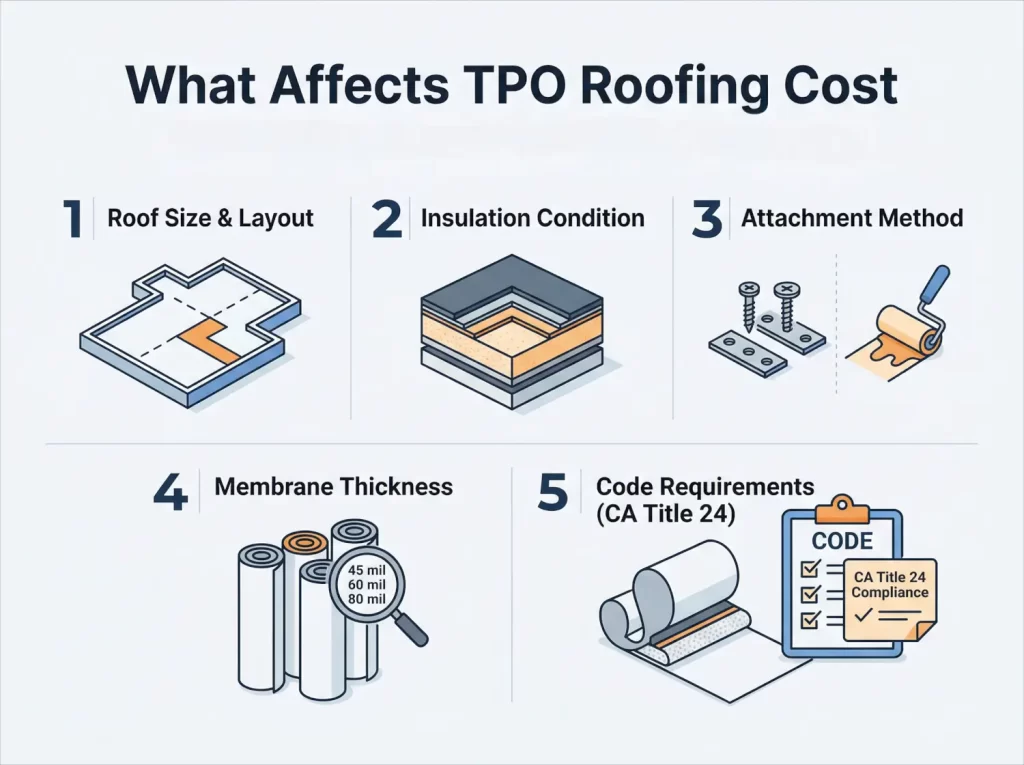
1. Roof size and layout
Bigger roofs do not always mean cheaper roofs. A wide-open box with easy access is one thing. A roof with lots of equipment, curbs, penetrations, and weird transitions is another. Complexity adds labor, detail work, and time.
2. Insulation and substrate condition
If the insulation below the membrane is wet or damaged, it often has to go. Same story if the deck needs repairs. This is one of the biggest reasons final quotes can move well above the simple online range. Homewyse’s 2026 cost notes also separate base installation from structural or code-related changes, which is an important distinction.
3. Attachment method
Mechanically attached, fully adhered, and specialized assemblies do not price out the same way. The system design changes labor, material use, and sometimes warranty options too.
4. Membrane thickness
A thinner entry-level TPO system and a thicker premium assembly are not priced the same, and they should not be judged like they are.
5. California code requirements
This one matters more than people expect. In California, new or replacement low-slope roofs generally have to meet cool roof requirements under Title 24, and the 2025 Energy Code is effective for permit applications submitted on or after January 1, 2026. That can influence product selection and scope, especially on commercial projects.
TPO vs. PVC roofing cost
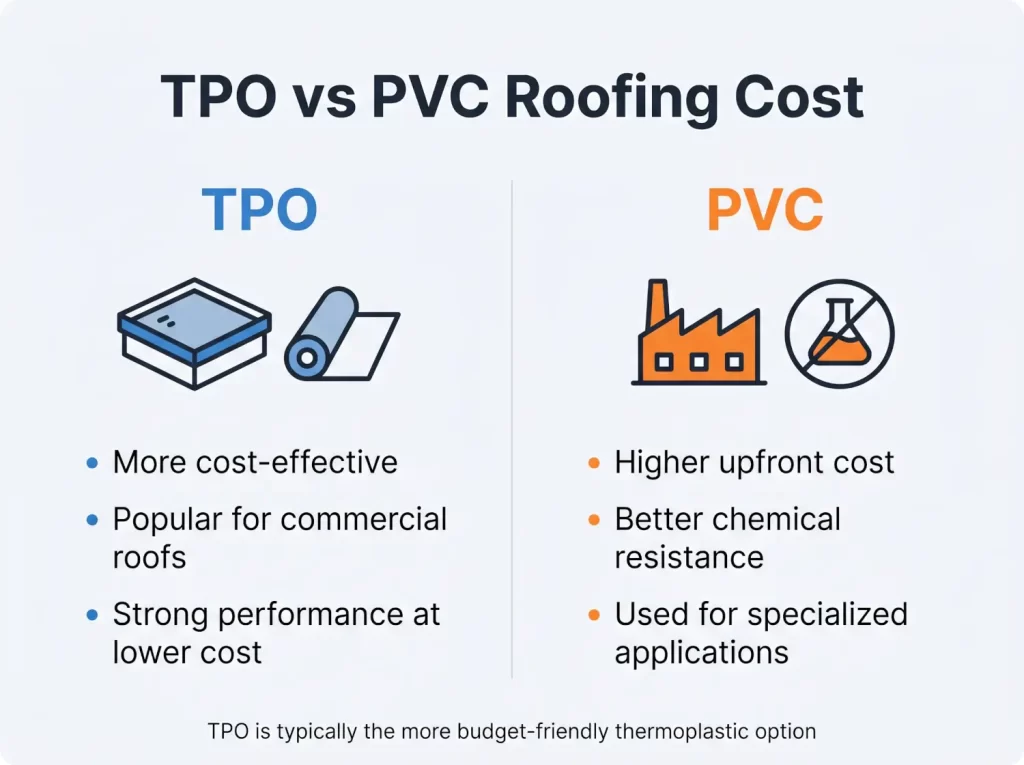
This is one of the most common comparison questions, and the answer is pretty straightforward.
If you’re comparing tpo vs pvc roofing cost, TPO is usually the more budget-friendly thermoplastic option. PVC tends to come in higher, especially when the building needs the extra chemical resistance or other performance benefits that PVC is better known for. GAF’s single-ply comparison page puts it pretty plainly: standard PVC and TPO are both generally affordable, but TPO is often the most cost-effective choice among thermoplastics.
So if the building does not have a strong reason to pay for PVC, TPO often wins the cost conversation without needing much drama.
Is TPO worth the cost?
In a lot of cases, yes.
TPO keeps showing up on commercial buildings because it hits a useful middle ground: solid performance, heat-welded seams, reflective white options, and a price point that is usually easier to live with than premium single-ply alternatives. GAF also describes TPO as cost-effective, notes its long-term heat and UV resistance, and highlights its reflective surface as an energy-saving feature.
That doesn’t mean it’s automatically the right roof for every building. It means it’s often the right place to start the conversation.
If you’re still deciding between repair, recover, and full replacement, this is where a real scope matters more than a generic calculator. On our side, that usually starts with looking at the roof as a system, not just a membrane choice. That’s also why our Roof System Replacements and Repairs & Maintenance pages are useful next steps when you’re sorting out options.
TPO roofing cost in California
California is where broad national averages start getting a little too cute.
Between code requirements, low-slope cool-roof compliance, jobsite logistics, and the usual commercial unknowns, tpo roofing cost california owners actually see can land higher than what a generic national blog suggests. And in the Bay Area, access, labor conditions, and occupied-building constraints can make a simple-looking roof much less simple once work starts. California’s cool-roof standards are a big part of that equation because replacement low-slope roofs generally need to comply with Title 24 requirements.
So if you’re pricing a warehouse, retail center, office building, or multi-building commercial property, the safest assumption is this: California pricing is rarely the bargain version of the internet estimate.
What to do next if you want a real number
If you just need a rough budget, the ranges above should help.
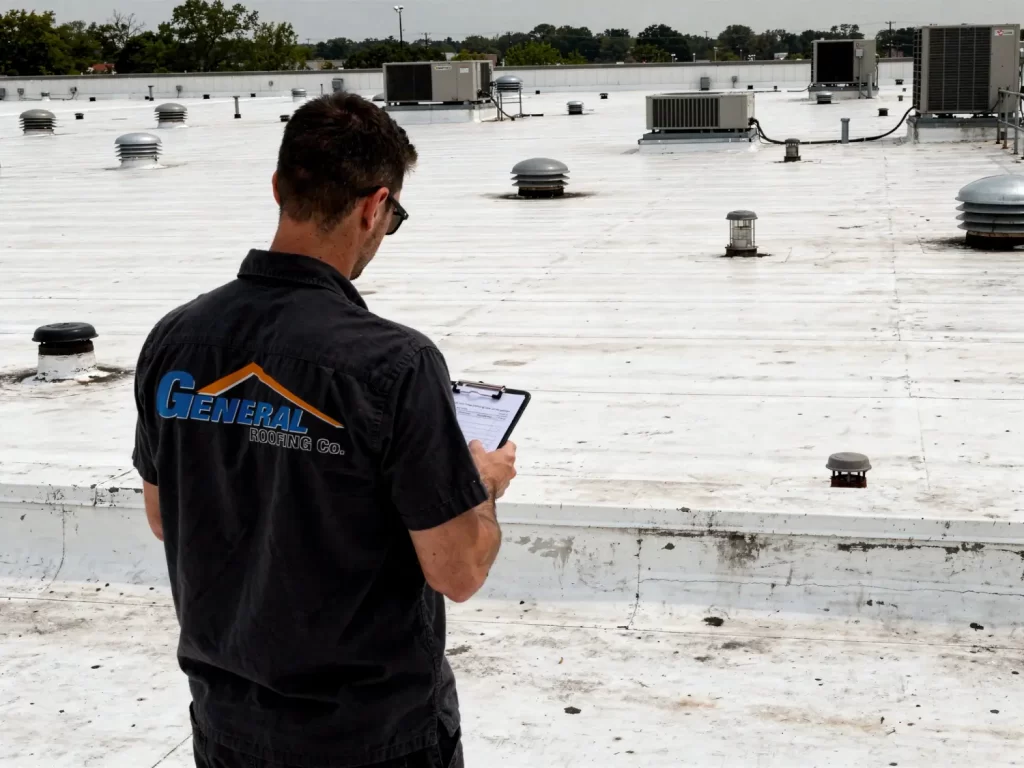
If you want a number that actually fits your building, the next step is a roof inspection and a real scope. That’s where you find out whether the roof is a straightforward TPO replacement, a recover candidate, or a larger project because the insulation, drainage, or deck has other opinions.
At General Roofing, we help commercial owners sort through exactly that. Sometimes the answer is a clean TPO replacement plan. Sometimes it’s smarter to maintain what you have a little longer. Sometimes the roof has already made up its mind.
If you’re planning beyond one immediate project, our Asset Management work is also a useful way to look at remaining roof life, maintenance timing, and replacement planning before the budget conversation gets forced on you.
FAQs
What is the average TPO roofing cost per square foot in 2026?
A practical starting range for many standard commercial low-slope projects is about $8.04 to $10.29 per square foot installed, before bigger add-ons like tear-off, code upgrades, or difficult conditions push the number higher.
Is TPO cheaper than PVC?
Usually, yes. TPO is commonly the more cost-effective thermoplastic option, while PVC typically carries a higher upfront price.
What affects commercial TPO roofing cost the most?
The biggest drivers are roof size, roof complexity, membrane thickness, attachment method, tear-off needs, insulation condition, and California code requirements. (Homewyse)
Does thicker TPO cost more?
Yes. Thicker membranes and more robust assemblies usually cost more up front, but they can also improve durability and expand warranty options.
Is TPO a good fit for California commercial roofs?
Often, yes. TPO is reflective, cost-effective, and works well on low-slope roofs, which is a big reason it stays popular on California commercial projects. (GAF)
Final Thoughts
If you’re comparing TPO roofing cost per square foot, the big takeaway is this: TPO is usually one of the more cost-effective options for commercial low-slope roofs, but the final number depends on a lot more than just membrane price.
Roof size, tear-off needs, insulation condition, roof access, and California code requirements can all move the budget around pretty quickly. That’s why online ranges are helpful for planning, but they’re never the same as a real project estimate.
For many commercial buildings, TPO makes sense because it gives owners a solid balance of performance, energy efficiency, and upfront cost. But the best choice always comes down to the building itself and what shape the existing roof is in.
And if part of your decision comes down to longevity, our guide on how long a roof lasts in California
gives a helpful bigger-picture look at service life by roof type.
If you’re trying to figure out whether your property is a good fit for TPO, or what your actual replacement cost might look like, getting a real inspection and scope is usually the smartest next move.
Recent Comments