
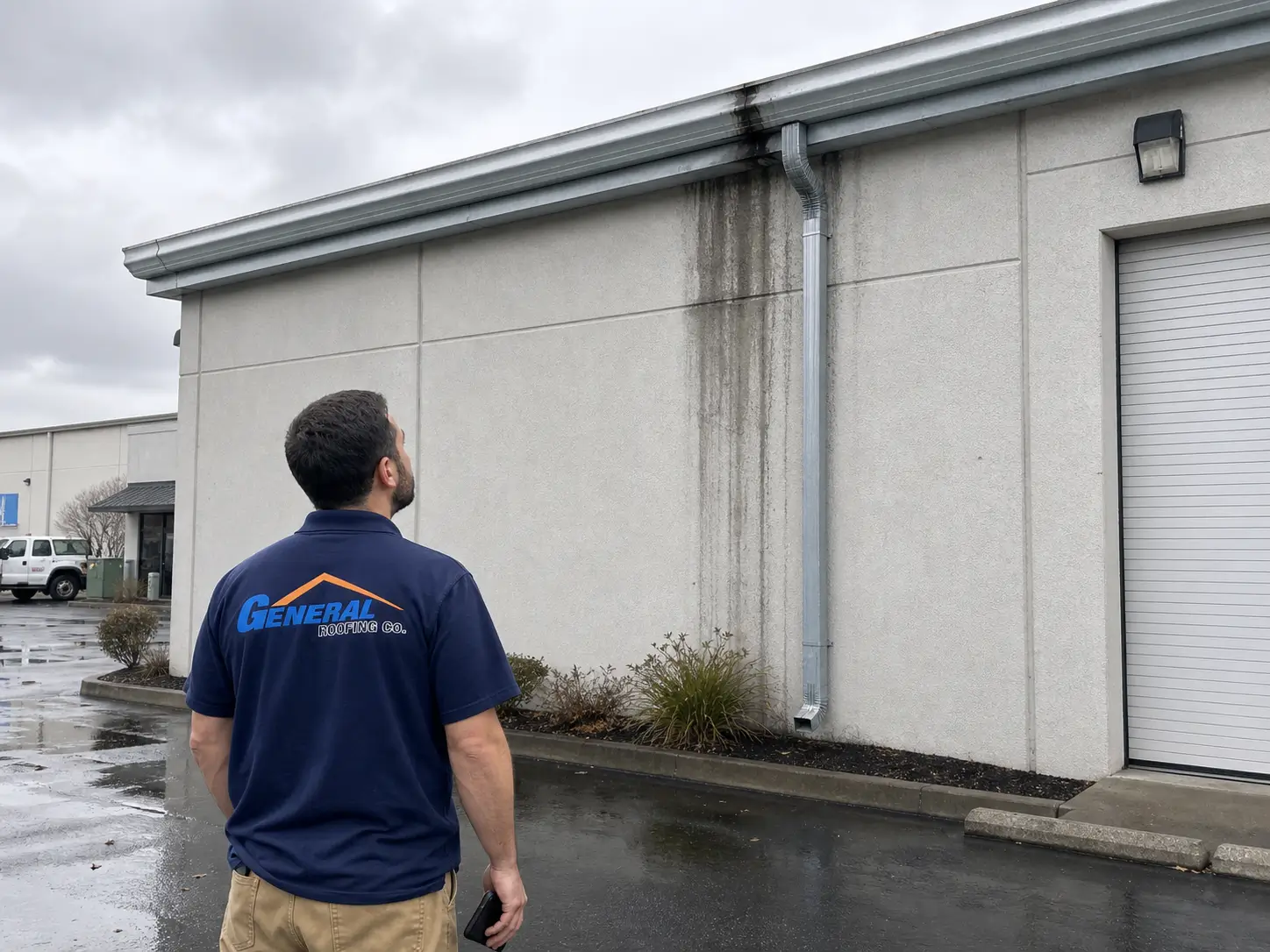
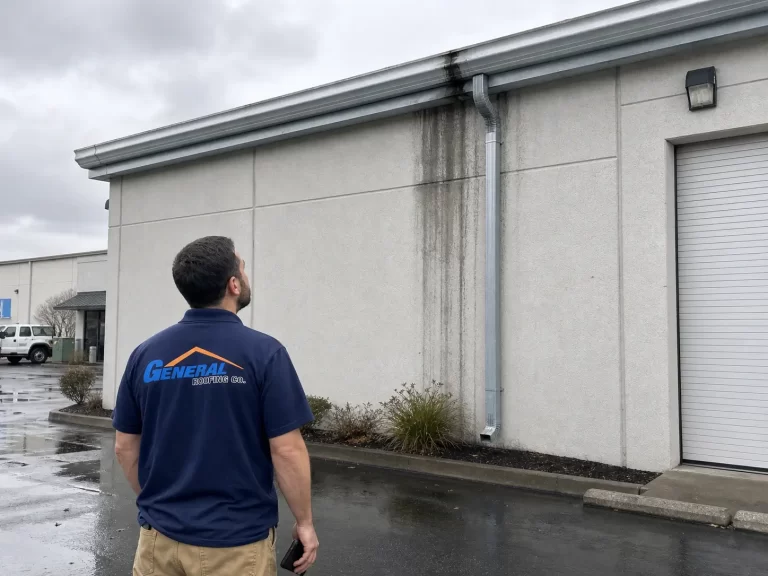
Commercial gutter repair usually starts with something easy to ignore. A small drip at the corner. Water spilling over one section during a storm. A downspout that makes a weird gurgling sound. Then a few rainy weeks go by, and suddenly there is ponding water near the roof edge, stains on exterior walls, or water showing up where it absolutely should not be.
For commercial buildings and warehouses, damaged gutters are not just a cosmetic issue. They are part of the roof drainage system. When gutters, downspouts, scuppers, or edge drainage stop moving water correctly, the building starts carrying water in places it was not designed to hold it.
Why commercial gutter repair matters
Commercial roofs move a lot of water. Flat and low slope roofs, in particular, depend on drainage paths that stay open and properly pitched. If the gutter system backs up, water can sit near roof edges, overflow behind fascia, soak exterior walls, or push into weak spots around flashing.
The 2025 California Building Code points roof drainage and overflow drainage back to structural and plumbing code requirements, and the 2025 California Plumbing Code includes storm drainage requirements for roof drainage systems. For building owners, the plain-English version is simple: water needs a safe, reliable path off the roof and away from the building.
At General Roofing, we see gutter problems show up alongside roof leak calls all the time. Clogged gutters are easy to brush off until water starts backing up behind the roof edge. We check for them during roof repair and maintenance visits because they often show up alongside the usual leak suspects: failing flashing, worn sealant, storm damage, and older roofing materials.
Signs your commercial gutters need repair
Water overflowing during rain
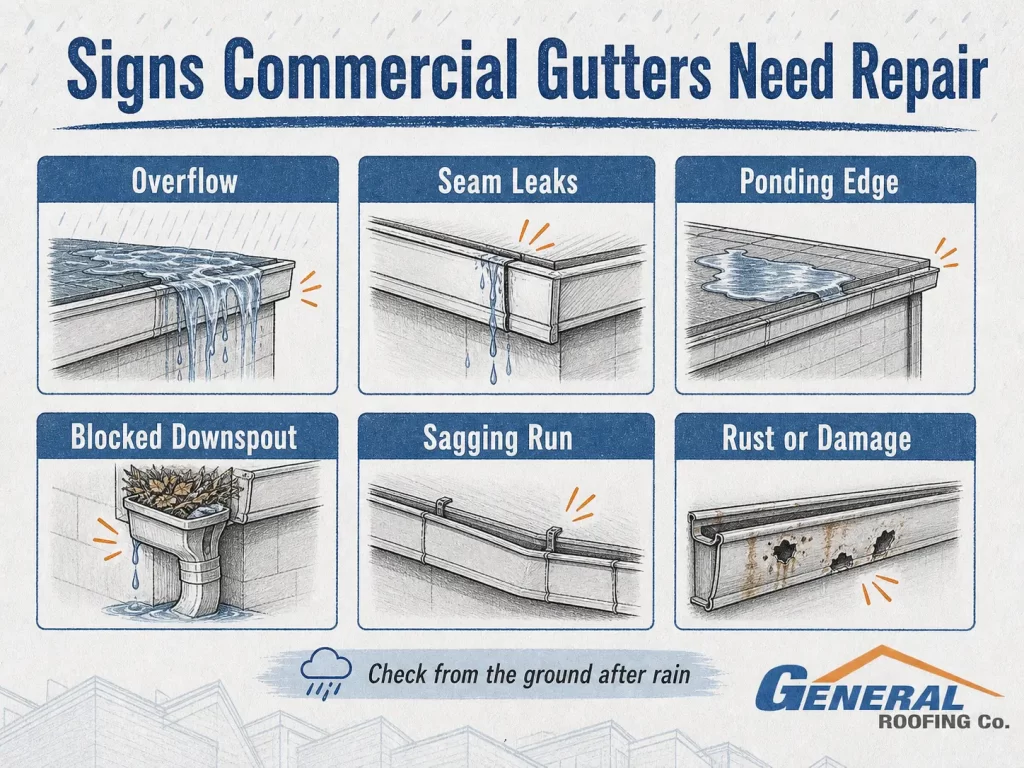
Overflow is one of the easiest signs to spot. If water pours over the front of the gutter, runs behind the gutter, or dumps from one corner like a faucet, something is wrong.
The cause might be simple, like leaves or roof debris blocking the gutter. It might also be a pitch problem, an undersized downspout, a crushed section, or a disconnected outlet. On warehouses and commercial buildings, overflow near loading areas, walkways, roll-up doors, or electrical rooms deserves quick attention.
Commercial gutter leaks at seams or corners
Commercial gutter leaks often show up at seams, miters, end caps, and downspout connections. You may see dripping after the rain has stopped, staining below a joint, corrosion around fasteners, or sealant that has cracked and pulled away.
Some leaks can be cleaned, resealed, patched, or refastened. Others keep coming back because the metal has moved, the gutter is sagging, or the system is at the end of its useful life.
Ponding water near roof edges
Ponding water near roof edges is a drainage warning sign. Water should move toward drains, scuppers, gutters, or downspouts. If it sits near the perimeter after rain, the gutter may be clogged, the edge may be poorly pitched, or the roof drainage path may not be keeping up.
GAF’s scheduled maintenance checklist calls out debris, clogged drains, weather damage, and foot traffic as roof maintenance concerns, and it specifically recommends keeping gutters, downspouts, drains, scuppers, and surrounding areas clean for proper drainage. (GAF)
Downspouts are loose, blocked, or dumping water too close to the building
Commercial downspout repair matters because gutters only do half the job. Downspouts carry the water away. If they are clogged, undersized, crushed, disconnected, or draining right against the building, the roof drainage system is not really working.
Watch for water blasting out of seams, downspouts shaking during heavy rain, staining at the base of walls, soil erosion, wet pavement that never dries, or water collecting near foundations and slab edges.
Sagging or pulled-away gutters
A commercial gutter that is pulling away from the roof edge is usually carrying too much weight or losing its support. That weight may come from standing water, heavy debris, failing hangers, damaged fascia, or old fasteners.
Do not ignore this one. A sagging gutter can dump water into the wrong area, tear loose in a storm, or hide rot behind the edge metal.
Rust, holes, splits, or crushed sections
Industrial gutter repair often involves damage from age, equipment, ladders, wind, tree debris, forklifts, or vendor work around the building. Look for rust trails, split seams, dents that trap water, open holes, and crushed downspout elbows.
A single damaged section may be repairable. Widespread corrosion usually points toward commercial gutter replacement.
Commercial gutter repair vs replacement
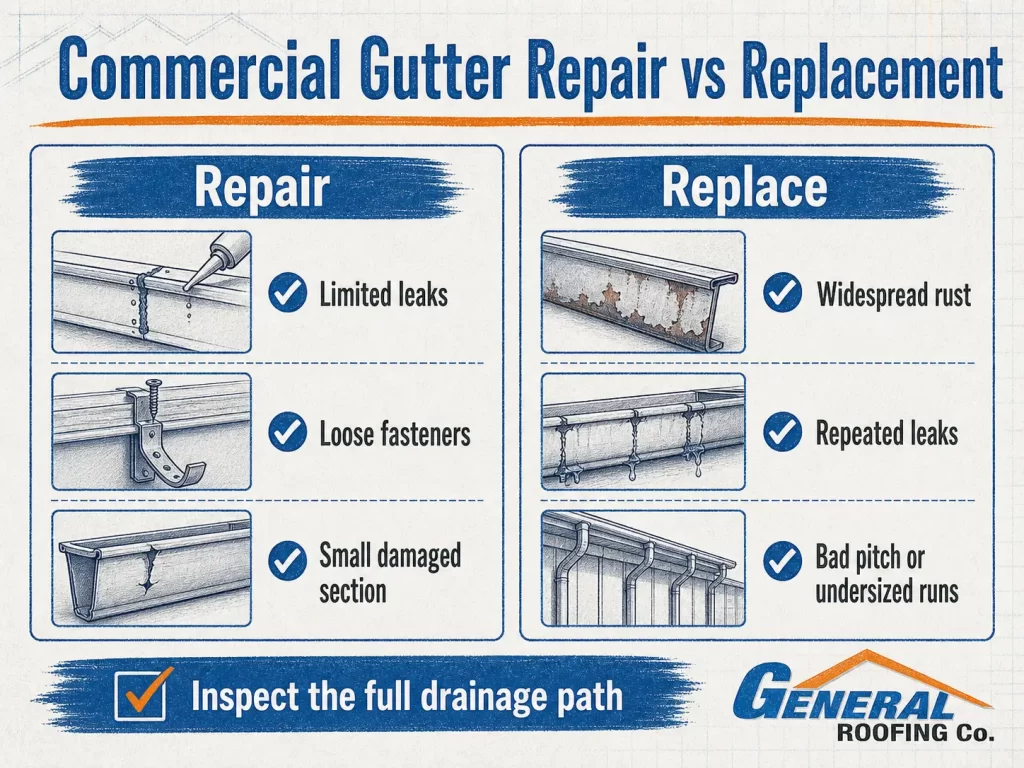
Commercial gutter repair makes sense when the damage is limited and the rest of the system still works. A roofer may be able to reseal a seam, reattach loose sections, adjust slope, replace hangers, patch small holes, clear outlets, repair downspouts, or improve drainage at a problem area.
Commercial gutter replacement makes more sense when the gutters are badly rusted, undersized, repeatedly leaking, poorly pitched across long runs, or separating in multiple areas. Replacement may also be smarter when the roof edge, fascia, or drainage layout needs correction.
We handle gutter work through our roofing accessories services, including gutter installation, seamless and seamed gutter systems, downspouts, corner joints, end caps, and hanging brackets. Our gutter systems are built around the property, not forced into a one-size-fits-all setup. (General Roofing Co.)
Commercial gutter repair cost: National average vs Bay Area pricing
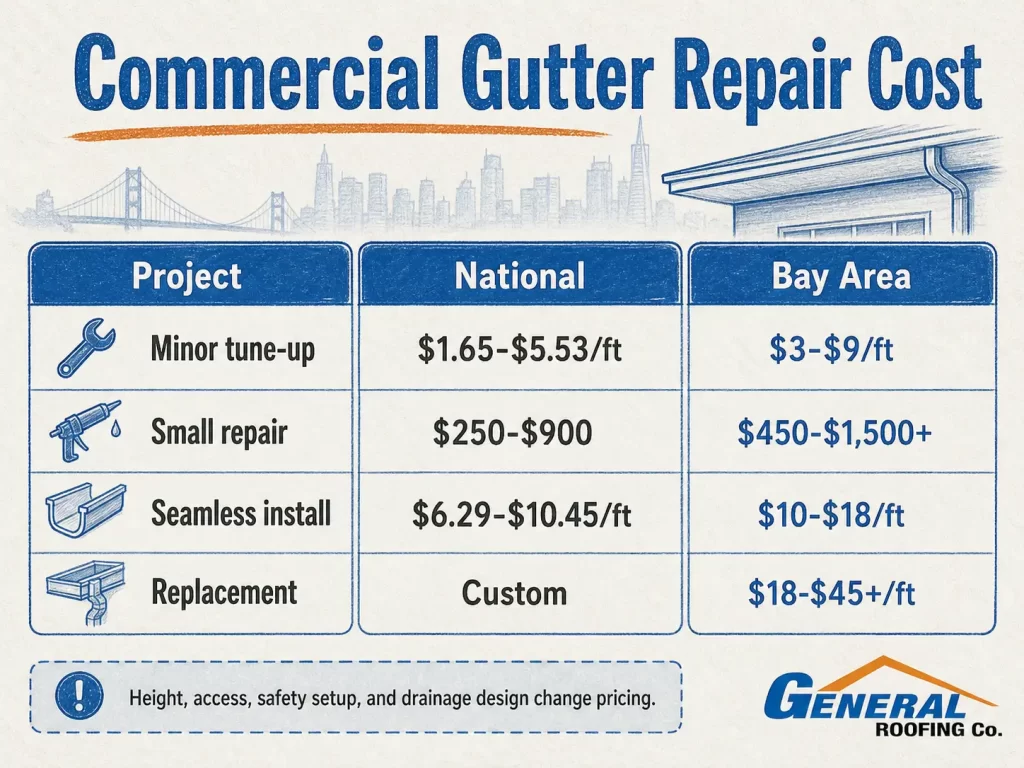
Commercial gutter repair pricing depends on the size of the building, gutter material, roof height, access, damage, downspout layout, and whether the issue is a simple leak or a bigger roof drainage problem.
For a national baseline, Homewyse’s gutter installation calculator lists basic gutter installation at $10.41 to $15.77 per linear foot in May 2026. Homewyse’s seamless gutter installation calculator lists basic seamless gutter installation at $6.29 to $10.45 per linear foot. Those numbers are useful for a starting point, but commercial buildings usually need a closer look because access, height, downspouts, safety setup, removal, materials, and drainage design can change the price fast.
| Project type | Normal national planning range | Bay Area commercial planning range |
|---|---|---|
| Basic gutter tune-up or minor maintenance | $1.65 to $5.53 per linear foot | $3 to $9 per linear foot |
| Small commercial gutter repair | $250 to $900 minimum service range | $450 to $1,500+ depending on access and height |
| Seamless gutter installation | $6.29 to $10.45 per linear foot | $10 to $18 per linear foot |
| Standard gutter installation | $10.41 to $15.77 per linear foot | $14 to $26 per linear foot |
| Commercial downspout repair | Usually custom quoted | $350 to $1,200+ per downspout area |
| Box gutter repair for commercial buildings | Usually custom quoted | $20 to $55+ per linear foot |
| Commercial gutter replacement | Usually custom quoted | $18 to $45+ per linear foot, higher for custom metal or difficult access |
Bay Area pricing runs higher because labor, access, insurance, parking, traffic, staging, safety requirements, and building height all affect the job. The BLS San Francisco-Oakland-Fremont economic data tracks the region separately for employment, construction, wages, and consumer prices, which is exactly why national calculators should not be treated as final Bay Area pricing.
For a warehouse or commercial building, the smart move is not to guess from a linear-foot number alone. A gutter leak may be a seam issue. It may also be a downspout blockage, bad pitch, undersized drainage, roof edge damage, or a larger commercial roof drainage repair issue. Our team can inspect the gutters, downspouts, roof edges, and drainage paths, then tell you whether repair or replacement makes more sense. You can start with our roof repair and maintenance services or our gutter and roof accessory services if the issue is tied to the roof edge, downspouts, or custom metal work.
What building owners should check from the ground
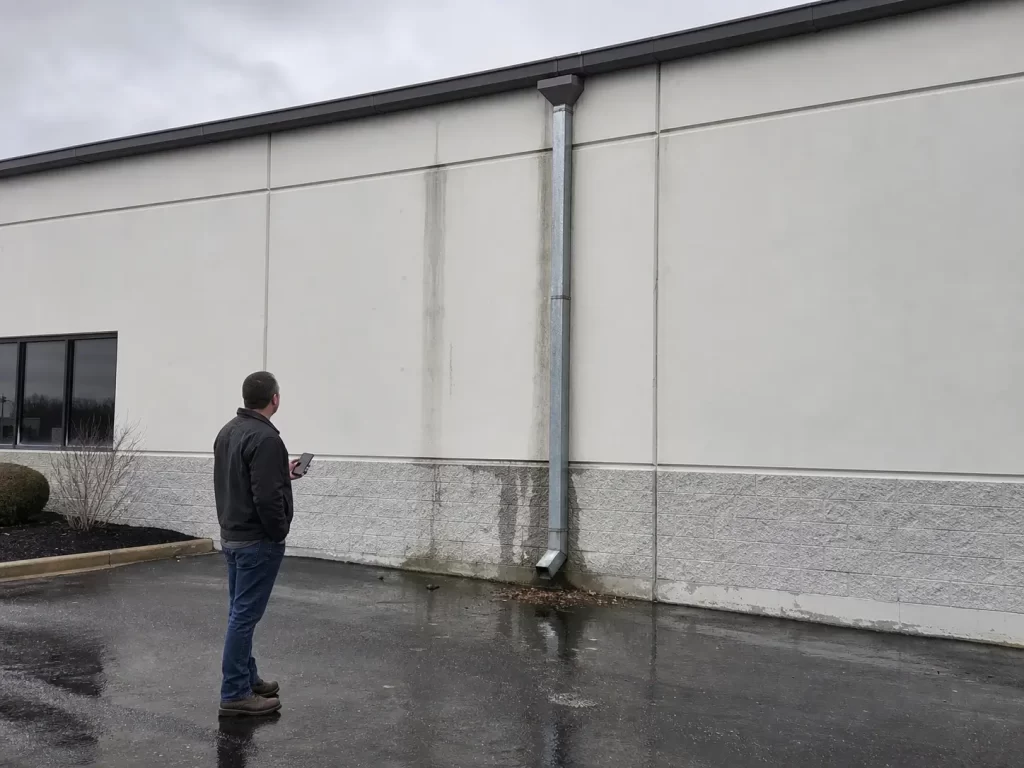
You do not need to climb onto a commercial roof to spot early gutter trouble. In fact, you should not climb onto a roof unless you have the right training, equipment, and fall protection.
From the ground, look for:
- Water stains below gutter seams
- Overflow during rain
- Downspouts dumping water against the building
- Bent, crushed, or disconnected downspout sections
- Gutters pulling away from the edge
- Rust streaks or holes
- Plants growing in gutters
- Water sitting near walls after storms
- Drips that continue long after rain stops
Our commercial roof maintenance checklist also recommends checking ponding water, drain baskets and strainers, scuppers, overflow drains, edge metal, debris after storms, ceiling stains, and wet insulation concerns.
How maintenance prevents gutter problems
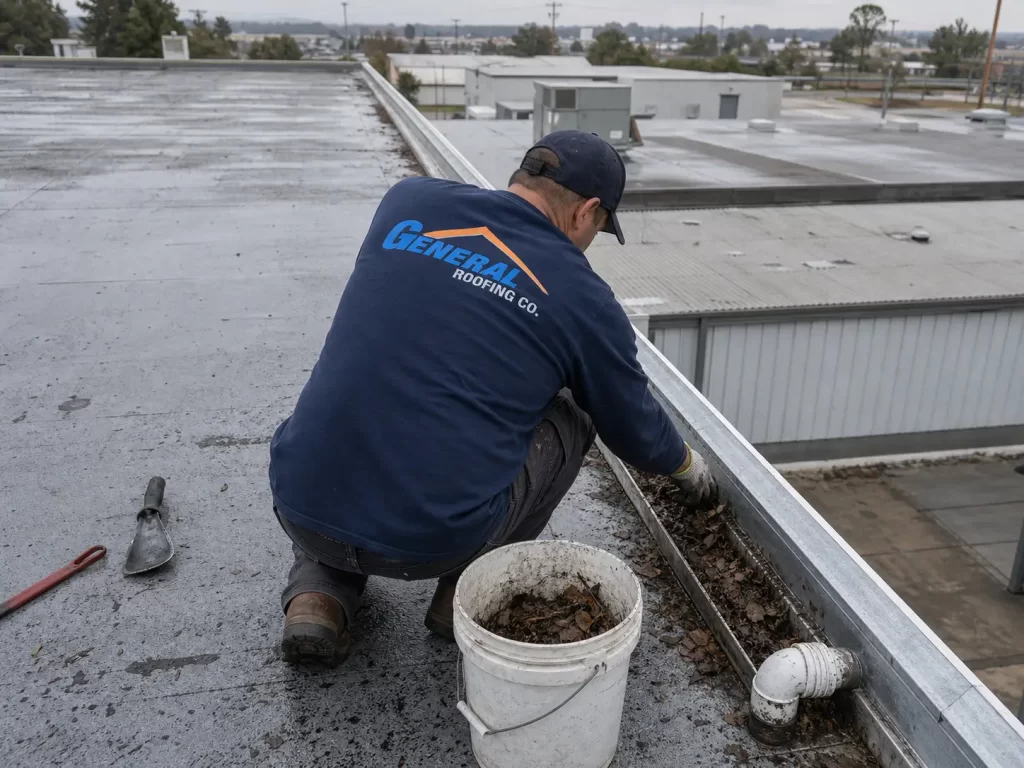
Commercial gutter maintenance is not glamorous. Good. That is kind of the point.
A maintenance visit can clear roof debris, clean gutter channels, flush downspouts, check seams, look for weak fasteners, test drainage, and document changes before they turn into leaks. For commercial buildings, that record matters. It helps you see whether the same area keeps failing after every storm.
Our roof asset management programs include review of gutters and downspouts, debris removal, cleaning gutter system components, flushing downspouts, and a roof report with photos and follow-up recommendations.
When roof drainage problems mean more than gutter repair
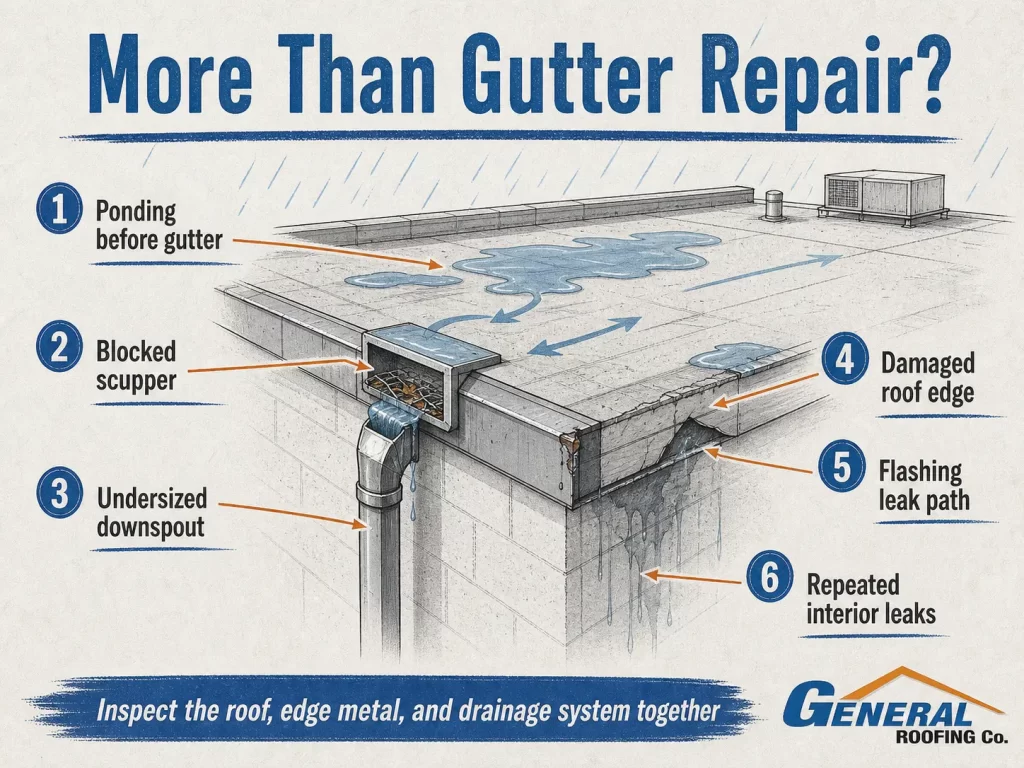
Sometimes the gutter is not the whole problem. It is just where the problem shows up.
You may need broader commercial roof drainage repair if:
- Water ponds on the roof before it ever reaches the gutter
- Scuppers are blocked or too small
- Downspouts cannot handle heavy rain
- The roof edge is damaged
- The gutter pitch is wrong across long runs
- Flashing is letting water behind the gutter
- The roof membrane is open near the perimeter
- Multiple leaks show up near the same drainage area
If the roof itself is aging out, gutter repair may only buy a little time. In that case, it may be worth comparing the repair plan with a larger roof system replacement plan, especially if the building has repeated leaks, saturated insulation, or drainage problems tied into the roof assembly.
FAQ
What is the difference between commercial gutters and residential gutters?
Commercial gutters are usually larger, stronger, and more connected to the building’s full roof drainage system. Residential gutters usually handle smaller roof areas and simpler rooflines. Commercial buildings may use larger gutters, box gutters, scuppers, conductor heads, internal drains, oversized downspouts, and custom metal details. The Copper Development Association’s gutter and downspout guide also notes that gutter and downspout design needs careful attention because leaks can damage both the inside and outside of a building.
Can damaged gutters be repaired?
Yes, damaged gutters can often be repaired when the problem is limited. Small leaks, loose fasteners, separated seams, clogged outlets, sagging sections, and some downspout issues are usually repairable. Replacement is usually the better call when the gutters are badly rusted, crushed, undersized, repeatedly leaking, or failing across long runs. For commercial buildings, our repairs and maintenance team can check whether the issue is just the gutter or part of a bigger roof drainage problem.
How much should 100 ft of seamless gutters cost?
Using Homewyse’s seamless gutter installation calculator, 100 feet of basic seamless gutters would start around $629 to $1,045 nationally. In the Bay Area, a more realistic planning range for commercial seamless gutters is often closer to $1,000 to $1,800 before extra downspouts, removal, access equipment, custom metal, or roof edge repairs.
How much is 200 linear feet of gutters?
Using Homewyse’s gutter installation calculator, 200 linear feet of basic gutter installation would start around $2,082 to $3,154 nationally. Using Homewyse’s seamless gutter installation calculator, 200 feet of basic seamless gutters would start around $1,258 to $2,090 nationally. In the Bay Area, commercial gutter installation for 200 linear feet often lands closer to $2,800 to $5,200+, depending on height, access, downspouts, materials, and removal.
What are the downsides of seamless gutters?
The main downside of seamless gutters is that they usually need professional fabrication and installation. If a long seamless section is badly damaged, you may need to replace a longer run instead of swapping out a short section. Seamless gutters also still need cleaning, downspout maintenance, proper slope, and good roof edge detailing. They are lower-seam, not zero-maintenance.
What’s better than gutters?
Nothing is automatically better than gutters. It depends on the roof and building. Some commercial roofs need gutters and downspouts. Others work better with internal roof drains, scuppers, overflow drains, conductor heads, or a mixed drainage system. The better system is the one that is properly sized, correctly installed, and maintained before rainy season. Our roof maintenance checklist covers gutters, downspouts, drains, scuppers, ponding water, and other drainage areas worth checking.
What is the little known trick for gutters?
The useful trick is to test the gutter system with water after cleaning or repair. Do not just clear debris and assume the problem is fixed. Run water through the gutter, watch whether it moves toward the downspout, check for slow spots, look for seam leaks, and confirm the downspout discharges away from the building. NC State Extension’s gutter management guidance also recommends regular cleaning, inspection, and repair because gutters only protect the building when they are properly designed and maintained.
What is a Dutch gutter?
A Dutch gutter is a built-in or concealed gutter that is integrated into the roof edge instead of hanging outside the fascia like a standard gutter. You may also hear similar systems called built-in gutters, box gutters, or concealed gutters. They can look cleaner, but repairs are usually more involved because the gutter is tied into the roof edge, trim, and drainage path.
What do roofers say about gutter guards?
Most roofers will tell you gutter guards can help, but they do not eliminate maintenance. They can reduce leaves and larger debris, but small debris, roof grit, pine needles, and dirt can still build up. On commercial buildings, gutter guards should not be installed without thinking through roof drainage, cleaning access, overflow, and downspout capacity.
Final Thoughts
Commercial gutter repair is worth taking seriously because gutter problems rarely stay in the gutter. Overflow can turn into stained walls. A clogged downspout can turn into ponding near the roof edge. A small seam leak can turn into water behind fascia or inside the building.
The best time to fix damaged commercial gutters is before the next heavy rain tests every weak spot at once. If you are seeing commercial gutter leaks, roof drainage problems, loose downspouts, or ponding water near the edge of the roof, we at General Roofing can help inspect the issue and talk through repair vs replacement without turning it into a bigger production than it needs to be.
Recent Comments