
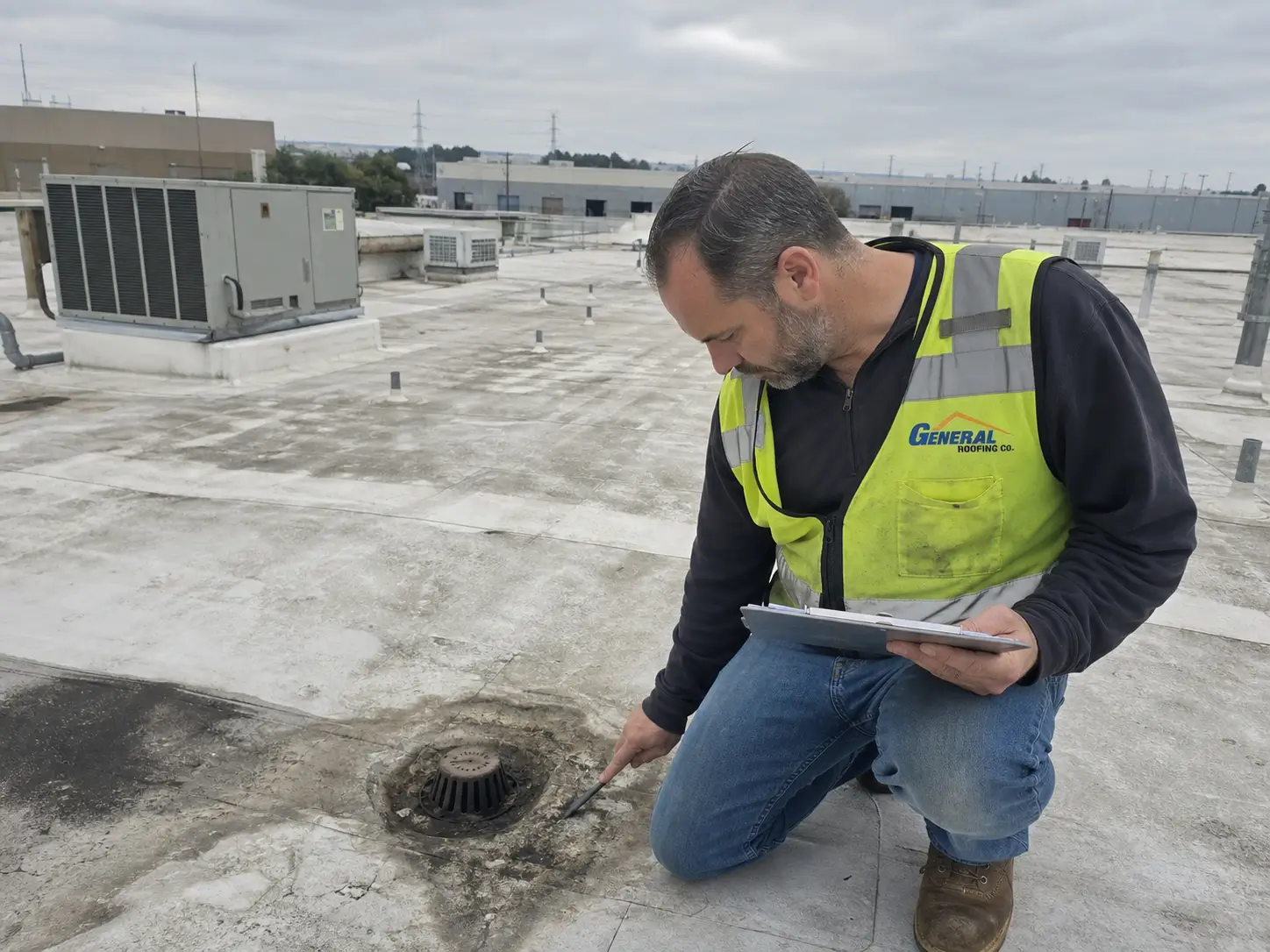
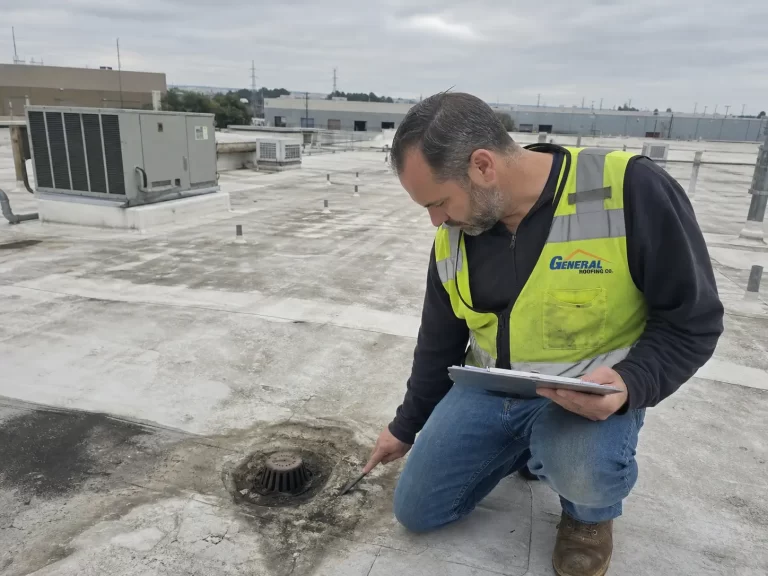
Industrial roof repair is a different animal from a basic commercial roof patch.
Warehouses, factories, manufacturing plants, and large facilities put a lot more stress on a roof. Most of these buildings have flat or low-slope roofs, long drainage runs, rooftop equipment, regular foot traffic, vents, pipes, exhaust units, service crews, and a lot of square footage for water to travel before anyone notices a leak.
That is why a quick patch is not always enough. It might stop the drip for a week, but it does not always solve the drainage problem, flashing failure, equipment damage, wet insulation, or seam issue that caused the leak in the first place.
At General Roofing, we work on residential, commercial, and industrial roofing across the Greater Bay Area. For industrial buildings, the goal is simple: stop the leak, protect the operation, and give the building owner a clear answer on whether the roof needs repair, maintenance, or replacement.
What is an industrial roof?
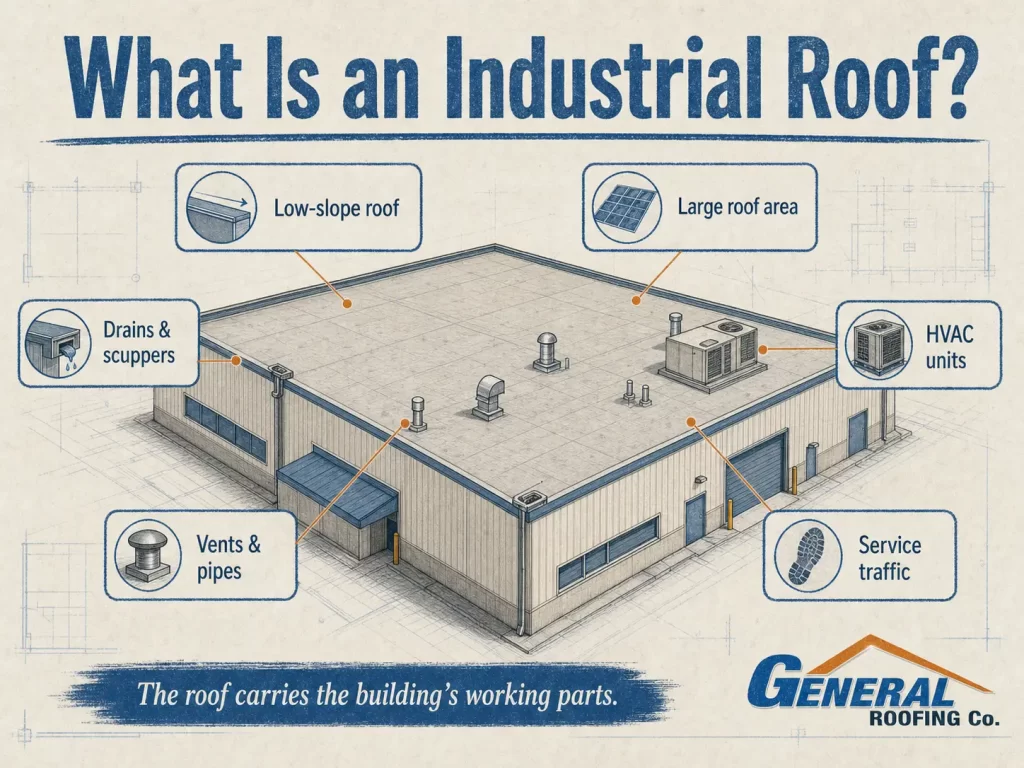
An industrial roof is the roof system on a warehouse, factory, manufacturing facility, distribution center, processing plant, storage building, or large facility. These roofs are usually flat or low-slope because the building footprint is large and the roof needs to support drains, vents, pipes, HVAC units, exhaust systems, access hatches, safety equipment, and maintenance traffic.
In other words, the roof is not just sitting there. It is carrying a lot of the building’s working parts.
Common industrial roof systems include:
| Industrial roof type | Commonly found on | Repair issues to watch |
|---|---|---|
| TPO | Warehouses, logistics buildings, light industrial facilities | Open seams, punctures, ponding water, flashing failure |
| PVC | Food processing, factories, chemical exposure areas | Seam issues, membrane damage, equipment-related wear |
| EPDM | Older flat roof warehouses and facilities | Shrinkage, punctures, seam separation |
| Modified bitumen | Low-slope industrial buildings | Cracks, blistering, split seams, surface wear |
| Built-up roofing | Older commercial industrial roofing systems | Gravel loss, trapped moisture, blisters, leaks around drains |
| Metal roofing | Factories, storage buildings, production facilities | Loose fasteners, corrosion, panel movement, leaks at penetrations |
Most industrial roof problems start small. A seam opens. A drain clogs. A service technician drags equipment across the membrane. A flashing pulls loose around an exhaust curb. Then a storm hits, and suddenly there is water near inventory, machines, electrical panels, packaging, or tenant space.
That is when industrial roofing repair becomes urgent.
Why industrial roof repair is not the same as basic commercial repair
A small office roof and a warehouse roof can both be “commercial,” but they do not behave the same way.
An industrial roof usually has more square footage, more roof penetrations, more drainage points, more rooftop equipment, and more people walking on it. The leak path can also be harder to trace. Water may enter at one seam and show up 40 feet away inside the building.
That is why industrial roof leak repair has to look beyond the visible drip.
A proper inspection should check:
- Roof drains, scuppers, gutters, and downspouts
- Ponding water areas
- Membrane seams
- Flashings around walls, curbs, and penetrations
- HVAC units, exhaust fans, pipe supports, and equipment platforms
- Walk pads and service paths
- Punctures from tools, panels, screws, or debris
- Wet insulation under the roof surface
- Old patches that may be failing
The roof needs to be treated like part of the facility, not just the top layer of the building.
Common causes of industrial roof leaks
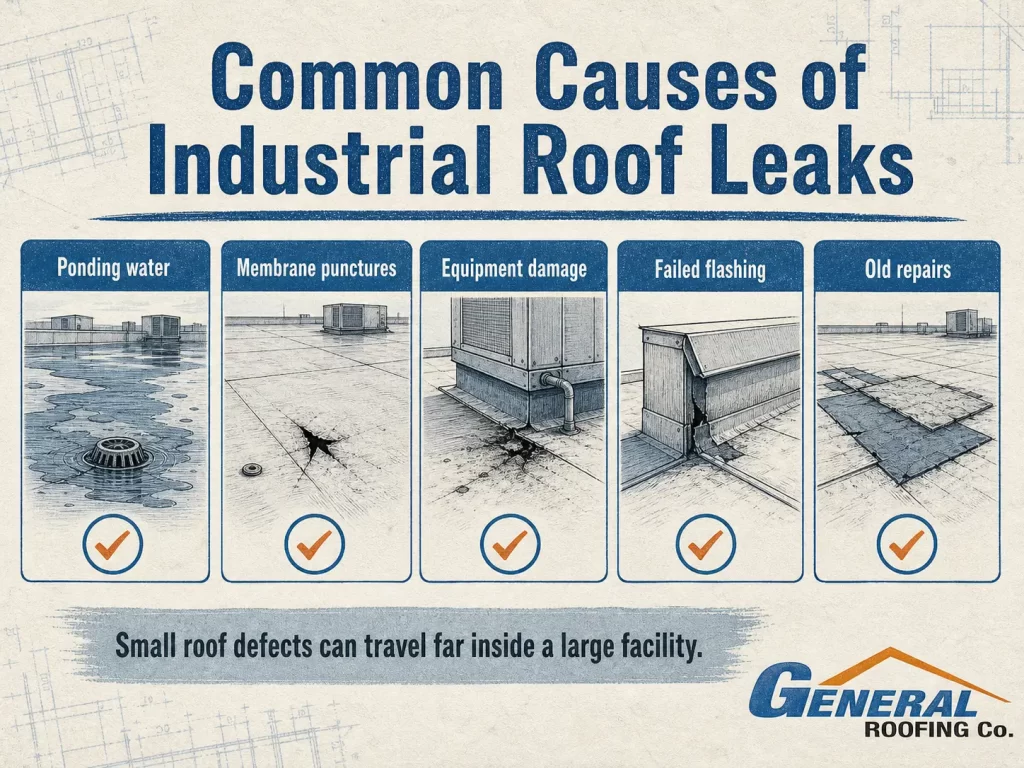
Industrial roof leaks usually come from a few repeat offenders.
Poor drainage and ponding water
Flat roofs are not supposed to hold water for long periods. They are designed with enough slope to move water toward drains, scuppers, gutters, or downspouts.
When drains clog or the roof has low spots, water starts sitting on the membrane. That can weaken seams, speed up surface wear, add weight to the roof, and push water into small defects.
This is a big issue for warehouses and factories because the roof area is often large. One blocked drain can affect a wide section of roof.
Membrane punctures
TPO, PVC, EPDM, and modified bitumen roofs can all be damaged by roof traffic. A dropped tool, loose screw, sharp metal panel, HVAC service cart, or dragged pipe support can puncture the membrane.
These punctures are often small. Sometimes they are not obvious until the next rain.
Rooftop equipment damage
Industrial facilities usually have a lot happening on the roof. HVAC units, exhaust fans, vents, skylights, hatches, pipe penetrations, and electrical conduit all create possible leak points.
Equipment is not always the problem by itself. The problem is often the flashing around it, the curb detail below it, or damage caused during maintenance work.
Failed flashing
Flashing protects the joints and transitions where the roof meets another surface. On an industrial flat roof, that includes walls, curbs, pipes, drains, vents, skylights, hatches, and equipment supports.
When flashing cracks, separates, lifts, or gets damaged, water has a direct path into the building.
Old repairs
A roof with one patch is normal. A roof covered in old patches is a warning sign.
If repairs keep failing in the same area, there may be wet insulation, movement in the deck, bad drainage, failing seams, or a roof system that is simply near the end of its service life.
Storm and emergency damage
Emergency industrial roof repair is usually needed after heavy rain, wind, flying debris, backed-up drains, fallen branches, or equipment damage. The first step is stopping active water intrusion. The second step is figuring out whether the emergency repair is temporary or permanent.
For facilities, that difference matters. A temporary dry-in can protect the building for the moment, but it should not be treated as the final fix unless the roof has been inspected properly.
What industrial roof repair usually includes
A good industrial flat roof repair is not just someone walking around with a bucket of sealant.
The repair process usually includes:
- Inspecting the leak location inside the building
- Checking the roof area above and around the leak
- Looking at nearby seams, drains, flashings, curbs, and penetrations
- Checking for ponding water or clogged drainage
- Looking for roof traffic damage
- Removing failed material
- Repairing the membrane, flashing, drain detail, or penetration
- Checking for wet insulation or hidden damage
- Documenting the repair with photos and notes
That last part matters more than people think. Industrial roofs are expensive assets. Building owners and facility managers need records, especially when they are budgeting for repairs, maintenance, or future replacement.
Our roof repair and maintenance services cover leak response, roof maintenance, and roof-related service work for buildings that need more than a one-time patch.
Industrial roof repair cost
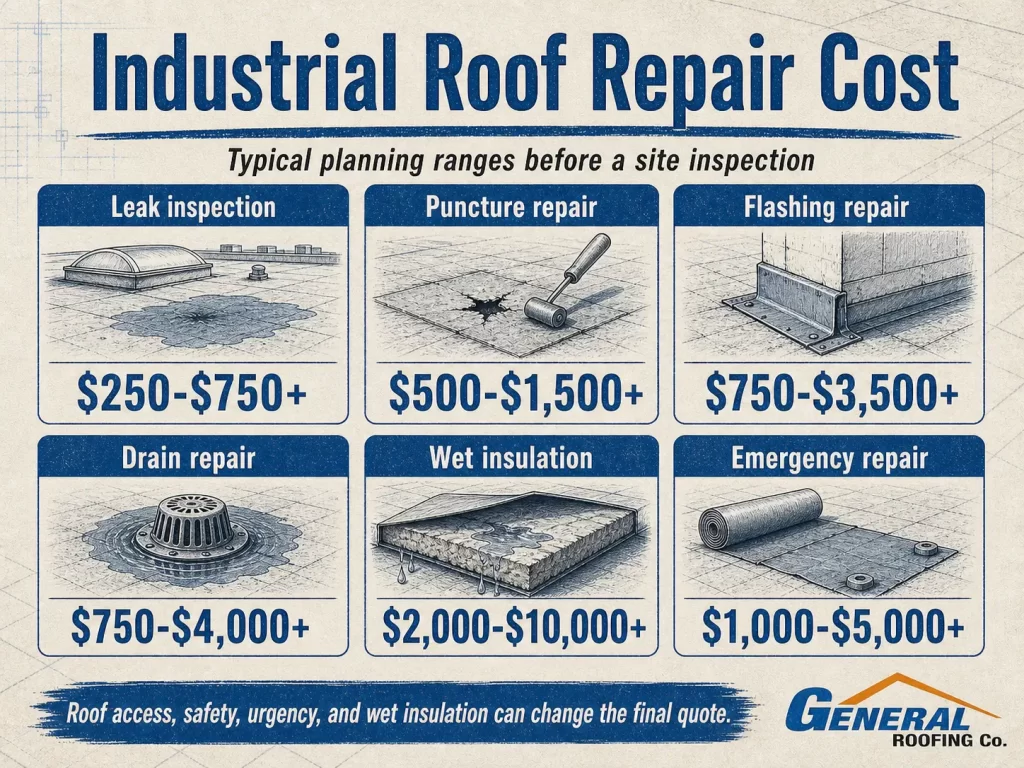
Industrial roof repair cost depends on the roof system, repair size, roof access, leak location, safety requirements, urgency, wet insulation, equipment density, and whether the work is a small repair or part of a larger roof recovery plan.
For general planning, many flat roof repair cost guides put common flat roof repairs in the hundreds to low thousands. Fixr’s flat roof repair cost guide lists a national average range of $300 to $1,100 for professional flat roof repairs, with larger repairs reaching around $4,000. HomeGuide’s flat roof repair cost guide lists flat roof repair at $2.50 to $10.00 per square foot, or $300 to $1,100 on average, depending on material and damage.
Industrial roofs often cost more than small residential flat roof repairs because the buildings are larger, access can be harder, safety setup may be more involved, and the repair may affect equipment, insulation, drainage, or operations.
Here is a practical planning range:
| Repair type | Typical planning range | What affects the price |
|---|---|---|
| Basic roof leak inspection | $250 to $750+ | Roof size, access, travel, moisture testing |
| Small membrane puncture repair | $500 to $1,500+ | Roof type, repair material, access |
| Flashing or penetration repair | $750 to $3,500+ | Curbs, vents, pipes, skylights, wall transitions |
| Drain, scupper, or gutter repair | $750 to $4,000+ | Cleaning, rebuilding, slope issues, water damage |
| Wet insulation removal and patch-back | $2,000 to $10,000+ | Size of saturated area, disposal, replacement materials |
| Emergency industrial roof leak repair | $1,000 to $5,000+ | After-hours work, temporary dry-in, storm conditions |
| Larger industrial flat roof repair area | $5,000 to $25,000+ | Multiple leaks, failed seams, equipment zones, wet insulation |
These numbers are for planning, not quoting. A small warehouse roof leak near an access hatch is a very different job from a factory roof leak above production equipment with wet insulation and blocked drains.
Bay Area industrial roof repair pricing
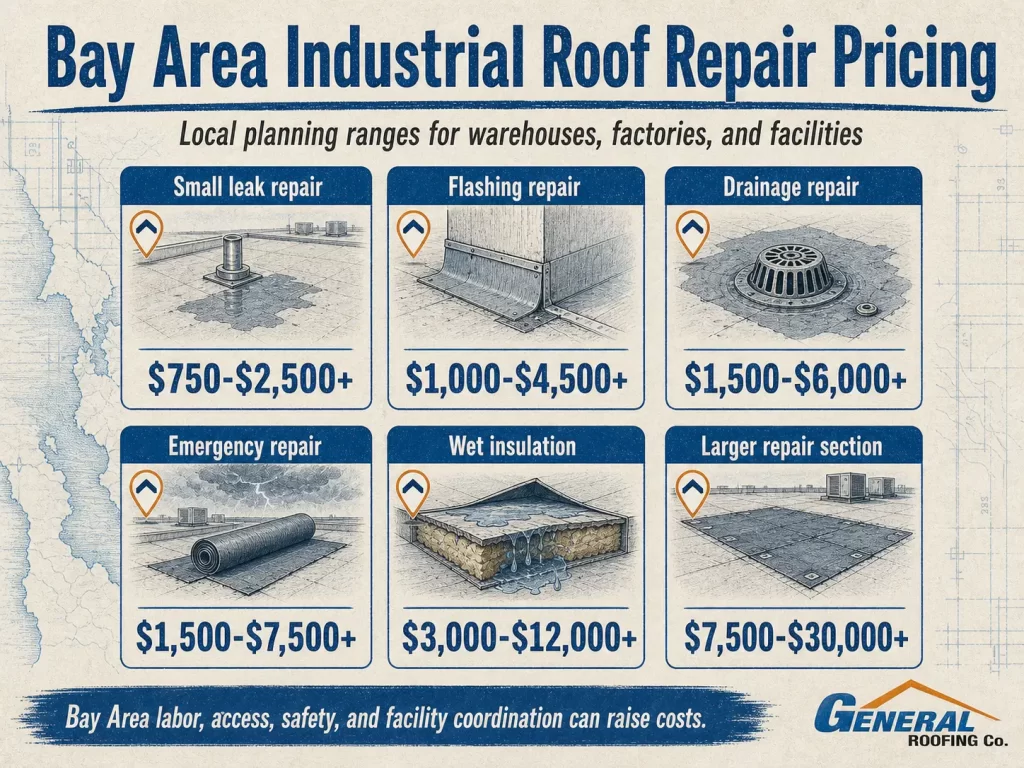
Industrial roof repair in the Bay Area usually costs more than the same repair in a lower-cost market. Labor, insurance, access, traffic, material handling, safety requirements, and general construction costs all affect the final number.
RSMeans explains that its City Cost Index is used to compare local construction costs against a national average. California’s Department of General Services also publishes a California Construction Cost Index based on construction cost data for San Francisco and Los Angeles. Those sources are useful because they show why a Bay Area repair should not be priced like a national average repair.
For Bay Area warehouses, factories, and industrial facilities, a realistic repair budget often looks more like this:
| Bay Area repair type | Bay Area planning range |
|---|---|
| Small industrial roof leak repair | $750 to $2,500+ |
| Flashing or penetration repair | $1,000 to $4,500+ |
| Drainage-related repair | $1,500 to $6,000+ |
| Emergency industrial roof repair | $1,500 to $7,500+ |
| Wet insulation removal and roof patch-back | $3,000 to $12,000+ |
| Larger facility roof repair section | $7,500 to $30,000+ |
The higher range is not because the roofers are guessing. It is because industrial buildings are rarely simple. A repair may need safety setup, roof access planning, coordination with facility staff, protection for inventory or production areas, moisture checks, traffic control, and the right material match for the existing roof system.
If the repair area keeps growing, it may be time to compare the repair cost against roof system replacement.
When industrial roof repair makes sense
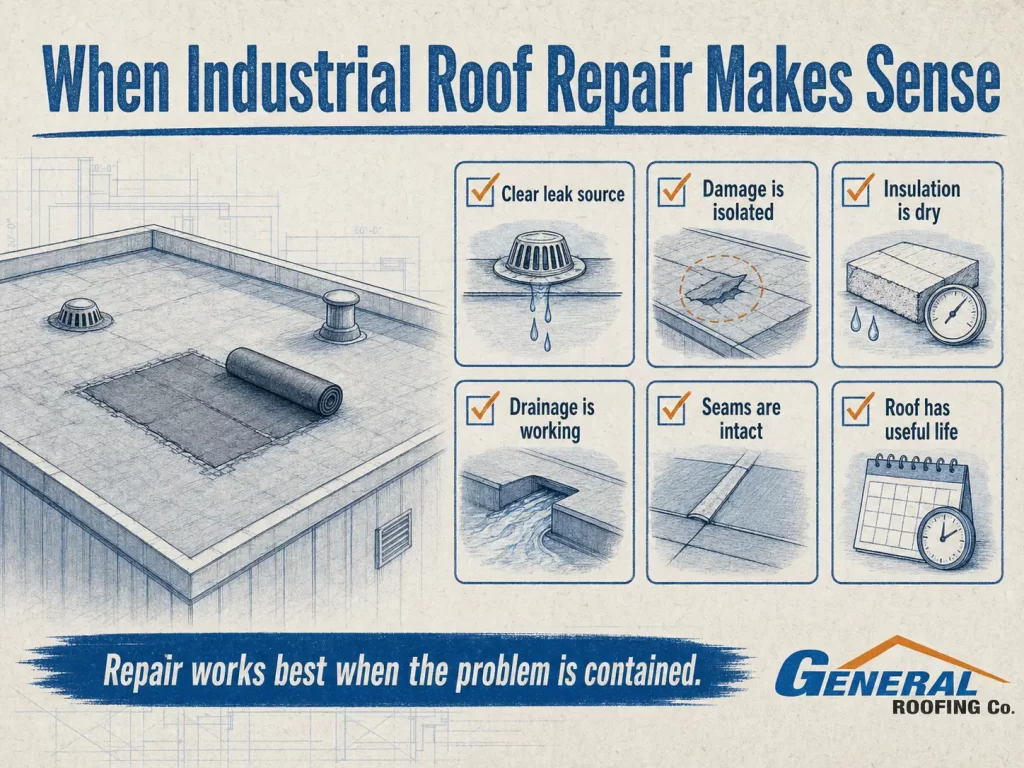
Repair usually makes sense when the damage is isolated and the rest of the roof is still in workable condition.
Industrial roof repair may be the right choice when:
- The leak source is clear
- The membrane is still flexible
- The damage is limited to one area
- The insulation is mostly dry
- Drainage is working
- Seams are mostly intact
- The roof is not near the end of its life
- The repair will not just move the leak somewhere else
This is common with punctures, isolated flashing failure, a small open seam, a damaged drain detail, or a leak around one piece of equipment.
When industrial roof replacement makes more sense
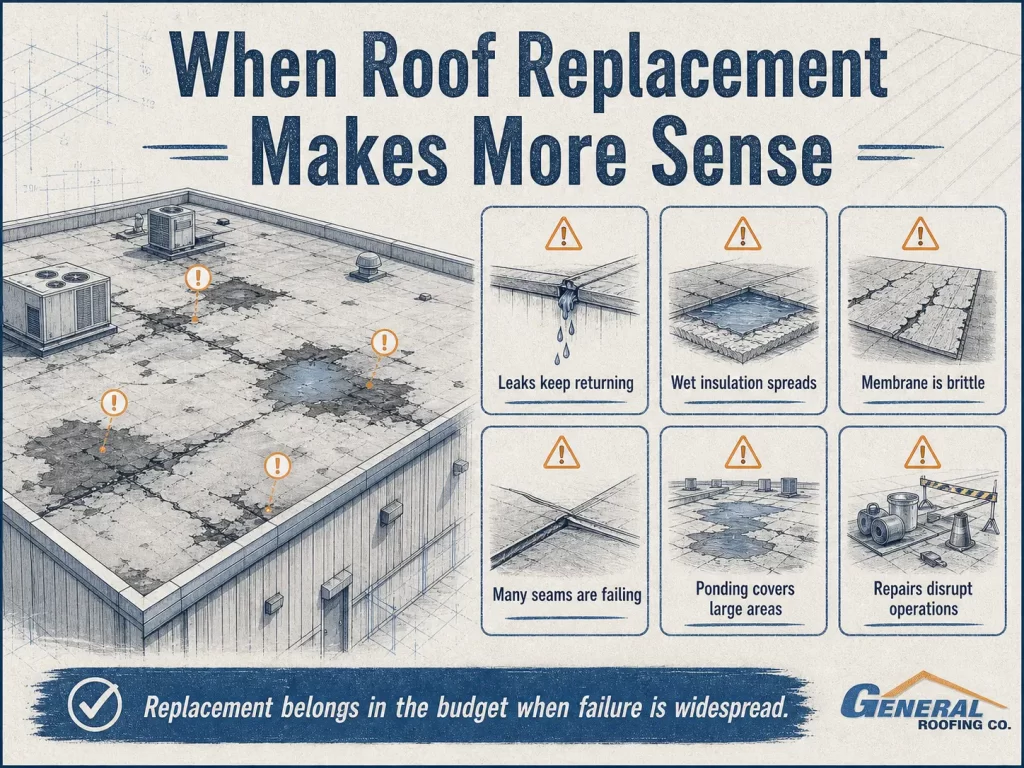
Industrial roof replacement starts to make more sense when the roof is failing across large areas.
Replacement may be the better call when:
- Leaks keep coming back
- Repairs are getting more frequent
- Large areas of insulation are wet
- The membrane is brittle, cracked, shrinking, or badly worn
- Seams are failing in multiple places
- Water ponds across several roof sections
- Roof traffic has damaged large areas
- The roof is interrupting business operations
- Repair costs are starting to feel like a payment plan for a roof you still do not trust
Sometimes the smartest move is a short-term emergency repair now, followed by a planned replacement during better weather or a slower business period.
That gives the facility time to budget, schedule around operations, and avoid making a rushed decision during a storm.
What is the 25% rule in roofing?
The 25% rule in roofing usually means that if more than 25% of the roof surface needs repair, replacement, or recovering, it may be smarter to consider replacing the roof section instead of continuing with repairs.
For industrial roofs, the 25% rule is useful as a budget and planning checkpoint. If a quarter of a warehouse or factory roof needs work, the problem may no longer be isolated. At that point, the building owner should compare repair cost, remaining roof life, disruption risk, and replacement cost.
So the short answer is yes, the 25% rule is a real roofing concept, but it should not be treated as the same rule in every city. For facility planning, once repairs approach 25% of the roof, replacement needs to be part of the conversation.
California cool roof rules can affect industrial roof replacement
Small repairs do not always trigger the same requirements as a replacement or major reroof, but larger industrial roofing projects in California may need to meet cool roof standards.
California’s cool roof guidance says all new or replacement low-slope roofs must meet Title 24 cool roof requirements. The Cool Roof Rating Council also explains that California Title 24 requirements vary by climate zone, building type, roof slope, and project type, and that products used for compliance must be CRRC-rated. California’s cool roof guidance and CRRC’s Title 24 resource are useful references for this.
This matters for industrial flat roof repair because one large repair can turn into a replacement discussion. If that happens, the roof system, reflectivity, energy requirements, drainage, insulation, and code compliance all need to be considered together.
How long does an industrial roof last?
An industrial roof usually lasts 15 to 30 years, depending on the roof system, installation quality, drainage, maintenance, foot traffic, sun exposure, rooftop equipment, and how quickly leaks are repaired.
Some metal roof systems can last longer, but they still need maintenance. Fasteners, seams, penetrations, coatings, and flashing details can fail before the panels themselves do.
Typical lifespan ranges look like this:
| Industrial roof system | Common lifespan range |
|---|---|
| TPO | 15 to 25 years |
| PVC | 20 to 30 years |
| EPDM | 20 to 30 years |
| Modified bitumen | 15 to 25 years |
| Built-up roofing | 20 to 30 years |
| Metal roofing | 30 to 50 years |
Age matters, but condition matters more. A 12-year-old flat roof with clogged drains and heavy roof traffic can be in worse shape than a 22-year-old roof that has been maintained properly.
Industrial roof inspection: what facility managers should look for
An industrial roof inspection should happen before small problems become expensive problems.
A facility manager should look for:
- Water stains inside the building
- Dripping near beams, walls, or equipment
- Soft spots on the roof
- Ponding water after storms
- Clogged drains or scuppers
- Loose flashing
- Open seams
- Blisters or bubbles
- Cracked membrane
- Debris around rooftop units
- Unprotected traffic paths
- Old patches that are peeling or splitting
A roof inspection should also include photos and notes. That helps with budgeting, maintenance planning, capital planning, tenant communication, and insurance documentation when storm damage is involved.
For ongoing planning, Our asset management service helps building owners track roof condition over time instead of reacting to every leak as a surprise.
Industrial roof maintenance helps prevent emergency repairs
Industrial roof maintenance is not exciting, but neither is shutting down part of a warehouse because water is dripping near inventory.
A good industrial roof maintenance plan should include:
- Clearing drains, gutters, scuppers, and downspouts
- Removing debris from the roof
- Checking seams and flashings
- Inspecting curbs, vents, hatches, skylights, and pipe penetrations
- Looking for punctures from roof traffic
- Checking ponding water areas
- Reviewing walk pads and service paths
- Documenting roof conditions with photos
- Handling small repairs before rainy season
Industrial roof maintenance is usually cheaper than emergency repair. It also gives the building owner time to plan instead of making a rushed decision when water is already inside the building.
To stay ahead of leaks, drainage problems, and equipment-related roof damage, you can schedule ongoing support through our roof repair and maintenance services.
FAQs
What is the typical cost of a roof repair?
The typical cost of a roof repair ranges from a few hundred dollars for a small repair to several thousand dollars for a larger repair. For flat roof repair, national cost guides often list average repairs around $300 to $1,100, while larger repairs can reach $4,000 or more. Industrial roof repair often costs more because warehouses, factories, and facilities usually have larger roofs, more equipment, more access requirements, and more complex leak paths.
What is the 25% rule in roofing?
The 25% rule in roofing means that if more than 25% of the roof surface needs repair, replacement, or recovering, it is often wiser to consider a full replacement or larger roof section replacement instead of continuing with smaller repairs. Local code requirements can vary, so the exact rule depends on the city, roof type, and project scope.
What color roof increases home value?
For homes, neutral roof colors like charcoal, gray, black, brown, and weathered wood usually have the broadest resale appeal because they match many exterior styles. For industrial flat roofs, color is usually more about performance than resale. In California, many new or replacement low-slope roofs need to meet cool roof requirements, so light, reflective roofing systems are often the better choice for industrial buildings.
What is an industrial roof?
An industrial roof is the roof system on a warehouse, factory, manufacturing facility, distribution center, storage building, or similar property. Most industrial roofs are flat or low-slope roofs designed to cover large areas and support drains, rooftop equipment, vents, pipes, penetrations, and maintenance traffic.
How long does an industrial roof last?
An industrial roofs usually lasts 15 to 30 years, depending on the roofing system, installation, drainage, maintenance, roof traffic, equipment layout, and weather exposure. Metal industrial roofs may last longer, but seams, fasteners, coatings, and flashings still need regular inspection and maintenance.
Final thoughts
Industrial roof repair needs more than a quick patch. Warehouses, factories, and facilities have flat roofs, drainage systems, rooftop equipment, roof traffic, and large interior spaces that can turn one leak into a bigger operational problem.
If the damage is isolated, repair may be the right move. If the roof has repeated leaks, wet insulation, widespread seam failure, ponding water, or too many old patches, replacement may be the better long-term decision.
For Bay Area industrial buildings, the best first step is a roof inspection. Find the leak source, check the surrounding roof conditions, review drainage and equipment areas, then decide whether repair, maintenance, or replacement makes the most sense.
For help with an active leak or facility roof issue, start with our roof repairs and maintenance service or contact our team.
Recent Comments