
Modified bitumen roof cost usually lands between $8 and $16 per square foot for many installations and replacements. In the Bay Area, a more realistic starting range is often $10 to $20 per square foot.
That is a wide spread, but modified bitumen roofing cost depends on far more than the membrane sitting on top. Tear-off, insulation, drainage, roof access, flashing, and the condition of the deck can move the final number quickly.
A clean, open roof with dry insulation is one job. An older roof with three decades of patches and a suspicious soft spot near every drain is another.
Modified bitumen roof cost per square foot
These are useful 2026 planning ranges for low-slope residential and commercial roofs:
| Project type | Typical U.S. planning range | Bay Area planning range |
|---|---|---|
| Basic installation or recover | $8 to $12 per sq. ft. | $10 to $15 per sq. ft. |
| Standard roof replacement | $10 to $16 per sq. ft. | $13 to $20 per sq. ft. |
| Complex replacement with insulation or deck work | $15 to $22+ per sq. ft. | $18 to $28+ per sq. ft. |
These are budgeting numbers, not universal averages or fixed quotes. They are based on current membrane prices, the labor involved in multi-layer installations, disposal costs, and the additional materials needed to build a complete roof assembly.
For some context, current SBS modified bitumen roll listings at The Home Depot include 100-square-foot cap sheets priced around $119 to $139, along with base-sheet products priced from roughly $75 to $150 depending on coverage. A finished roof needs much more than one roll per 100 square feet.
The estimate may also include a base sheet, cap sheet, primer, adhesive or fasteners, insulation, cover board, flashing material, edge metal, drains, disposal, permits, and labor.
What affects modified bitumen roof installation cost?
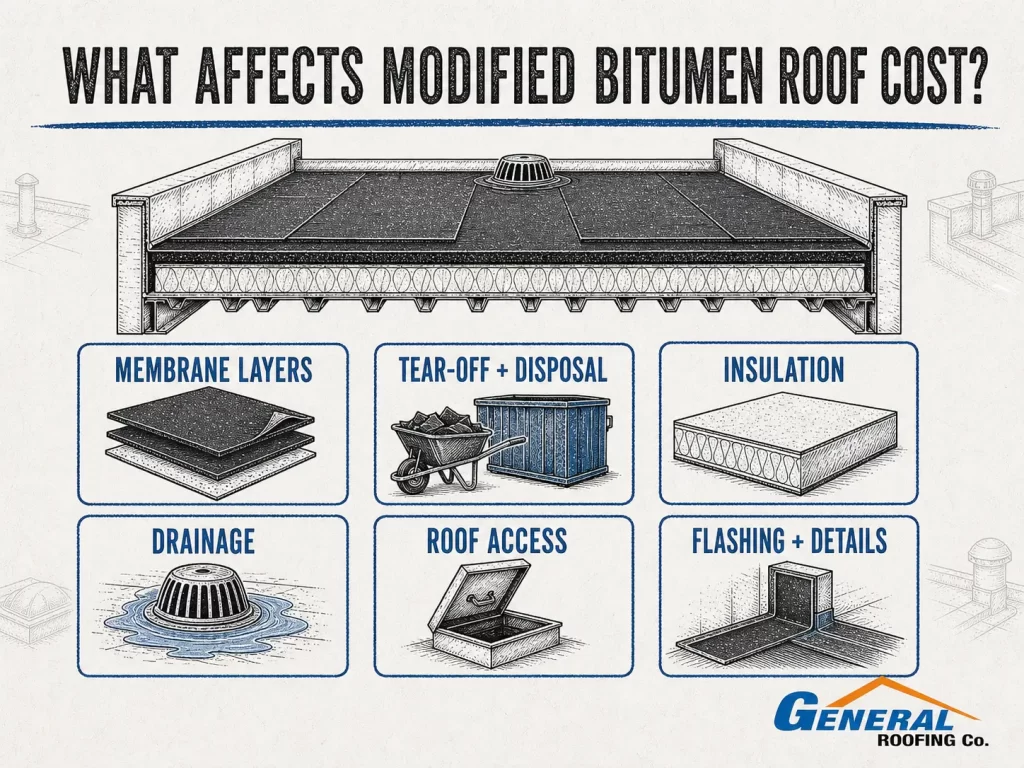
Two roofs with identical square footage can receive very different estimates. The surface area gives us a starting point, but the existing roof usually decides where the price goes from there.
The number of membrane layers
Modified bitumen is commonly installed as a two-ply or multi-ply system. The extra layers provide redundancy, but they also add material and labor.
The Asphalt Roofing Manufacturers Association’s low-slope roofing guide explains how SBS and APP polymers are added to asphalt membranes to improve flexibility and performance. These systems may be applied with heat, asphalt, cold adhesive, mechanical fastening, or self-adhering products.
A heavier system with a base sheet and granulated cap sheet will cost more than a basic installation. It may also make more sense on a roof where puncture resistance and repairability matter.
Tear-off and disposal
Installing over an existing roof can keep costs down, but only when the old assembly is dry, stable, and suitable for a recover.
If the existing system must be removed, the modified bitumen roof replacement cost has to cover tear-off labor, hauling, disposal fees, and preparation of the exposed surface.
Tear-off also tends to reveal the things nobody could see during the initial walkthrough. Wet insulation, deteriorated wood, rusted metal decking, and old repairs can all add to the scope.
Our guide to roof repair versus replacement explains why repeated leaks, widespread damage, and wet insulation often make replacement more practical than another round of patches.
Insulation and drainage
Insulation can be one of the biggest line items in a flat roof estimate. Some projects need a cover board over existing insulation. Others need new polyiso, tapered insulation, or replacement of large wet areas.
Tapered insulation costs more, but it may be necessary when the roof does not drain correctly. Water that remains on a roof for extended periods can shorten its useful life. The Asphalt Roofing Manufacturers Association’s guidance on ponding water recommends eliminating or reducing recurring ponding wherever possible.
Paying for drainage work during replacement is rarely fun. Paying for a new membrane that still sits under water is worse.
Roof access and details
An open warehouse roof is usually faster to work on than a small roof crowded with HVAC units, pipes, curbs, skylights, drains, and parapet walls.
Every penetration needs careful flashing. Tight access can require lifts, cranes, additional safety equipment, street-use planning, or material staging in a very limited area.
This is one reason commercial flat roof cost does not always fall as neatly as owners expect when they divide a quote by the building’s square footage.
Bay Area modified bitumen roofing cost
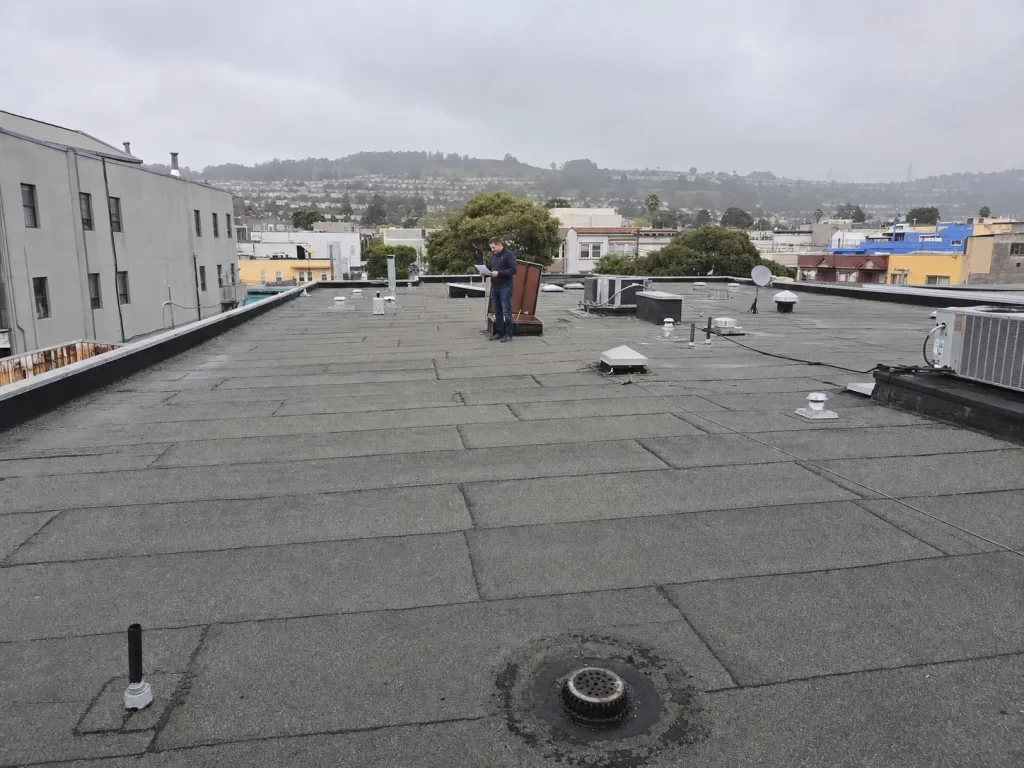
Bay Area modified bitumen flat roof cost generally runs higher than pricing in lower-cost parts of the country.
For a standard replacement, a reasonable starting budget is around $13 to $20 per square foot. A relatively simple recover may fall closer to $10 to $15. Roofs with wet insulation, poor drainage, difficult access, or substantial deck repairs can reach $18 to $28 per square foot or more.
For a 5,000-square-foot commercial roof, that could put a standard Bay Area replacement around $65,000 to $100,000 before unusually expensive repairs or major insulation upgrades.
Labor is part of the difference. The California Department of Industrial Relations prevailing-wage schedule listed total straight-time roofer compensation in Alameda County at more than $80 per hour during its 2026 schedule period. Public-works rates are not the same as every private roofing rate, but they show how expensive skilled construction labor can be in this market.
The state’s California Construction Cost Index also tracks labor and material trends using San Francisco and Los Angeles construction data.
California energy requirements can affect the specification too. The 2025 Building Energy Efficiency Standards apply to permit applications filed on or after January 1, 2026. Roof reflectance, insulation, and assembly requirements may affect which products can be used and how the roof is built.
How much does modified bitumen membrane cost?
The modified bitumen membrane cost is only one part of the finished roof price.
A single roll may cost roughly $75 to $150 or more, depending on whether it is a base sheet or cap sheet, the product line, and the amount of coverage in the roll.
For example, a 100-square-foot granulated cap sheet may cost around $119 to $139 at retail. A base sheet may cover 200 or 300 square feet, so comparing roll prices without checking coverage can be misleading.
There is also overlap and waste. A roll labeled for 100 square feet does not always produce exactly 100 square feet of finished coverage after side laps, end laps, flashing details, and cuts are accounted for.
The roof still needs the rest of the assembly. Buying 20 cap-sheet rolls does not give you a finished 2,000-square-foot roof any more than buying flooring gives you a finished kitchen.
Commercial modified bitumen roof cost
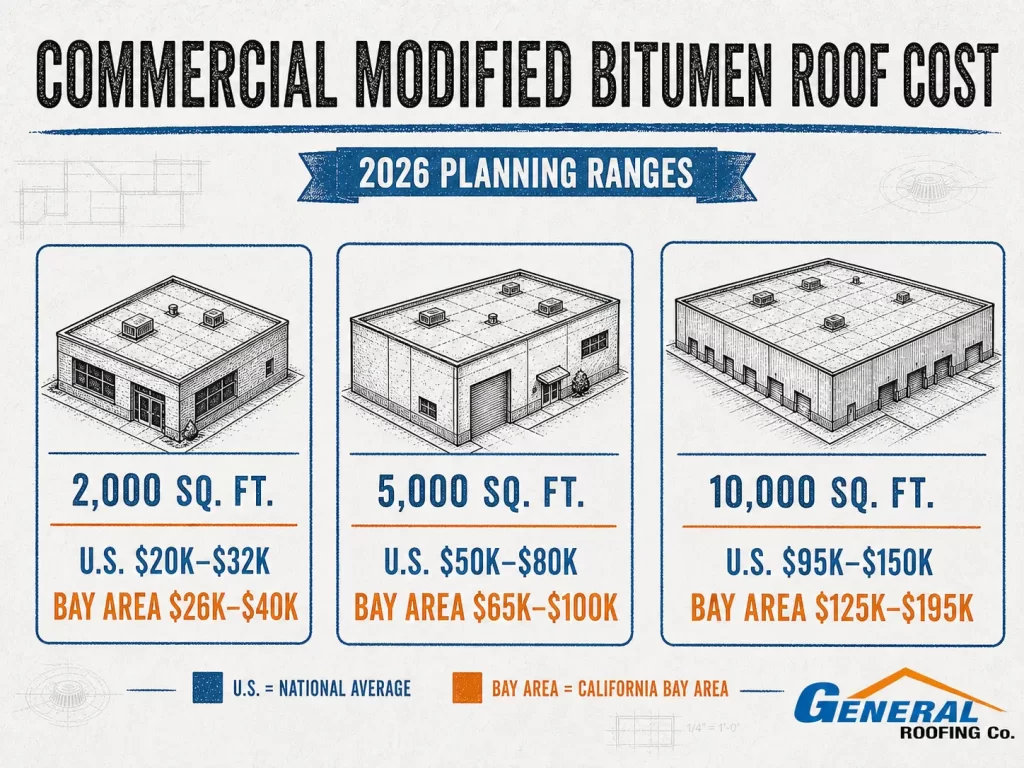
Commercial modified bitumen roof cost can be lower per square foot on a large, open building because setup expenses are spread across more area. Size does not always produce savings, though.
A commercial roof may include dozens of penetrations, mechanical units, internal drains, gas lines, walkways, and occupied areas that must stay open during construction. Material staging and noise restrictions can affect the schedule too.
For early budgeting, these totals are reasonable:
| Commercial roof size | Standard U.S. replacement | Typical Bay Area replacement |
|---|---|---|
| 2,000 sq. ft. | $20,000 to $32,000 | $26,000 to $40,000 |
| 5,000 sq. ft. | $50,000 to $80,000 | $65,000 to $100,000 |
| 10,000 sq. ft. | $95,000 to $150,000 | $125,000 to $195,000 |
Larger roofs may receive better unit pricing when the layout is open and uncomplicated. A smaller roof packed with equipment can cost more per square foot than a much larger warehouse.
Our commercial roof replacement cost guide covers the broader pricing differences between membrane, built-up, and metal systems.
A commercial roof inspection can also help identify wet areas, drainage problems, failing flashing, and older repairs before the replacement scope is finalized.
Modified bitumen vs TPO cost
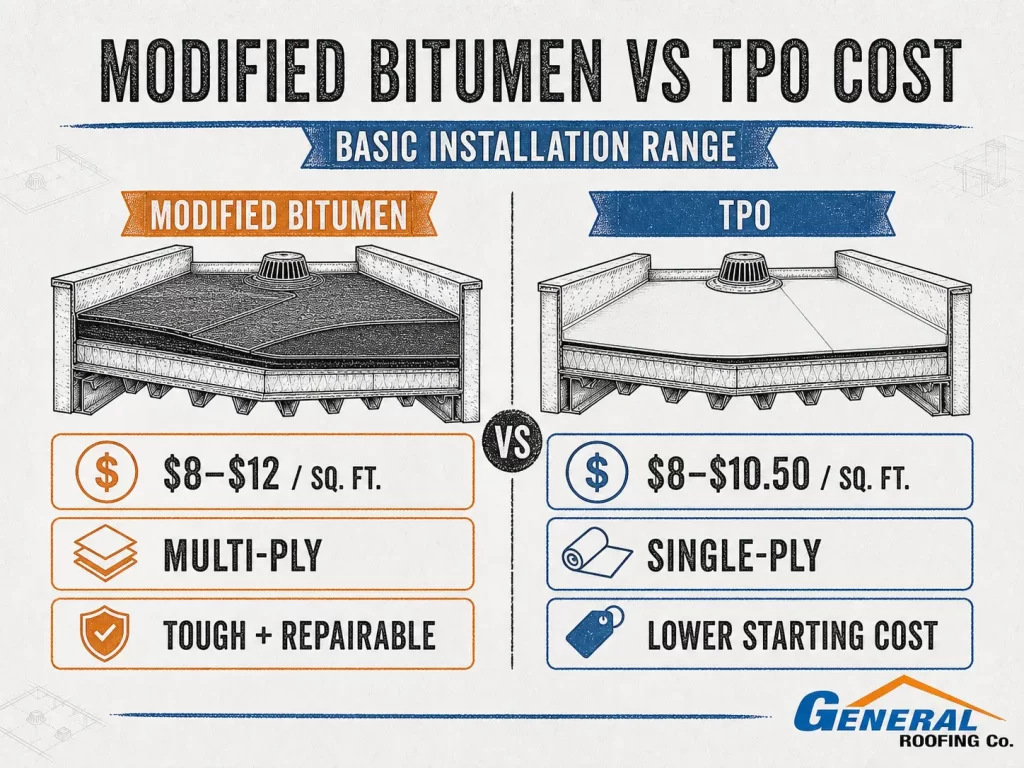
Modified bitumen and TPO often end up on the same shortlist for commercial flat roofs.
TPO is a single-ply membrane, so installation may require less material and fewer layers. On a wide-open commercial roof, TPO often has a lower starting cost.
Modified bitumen typically uses a base layer and cap layer. That extra material and labor can make it slightly more expensive, but the layered assembly offers redundancy and can be easier to repair in localized areas.
Our current TPO roofing cost guide puts many standard TPO installations around $8 to $10.50 per square foot before major tear-off, insulation, or access costs are added.
A modified bitumen system may start closer to $8 to $12 per square foot under similar basic conditions. The difference gets smaller once both estimates include the same insulation, edge metal, drainage work, and tear-off.
Modified bitumen vs EPDM cost
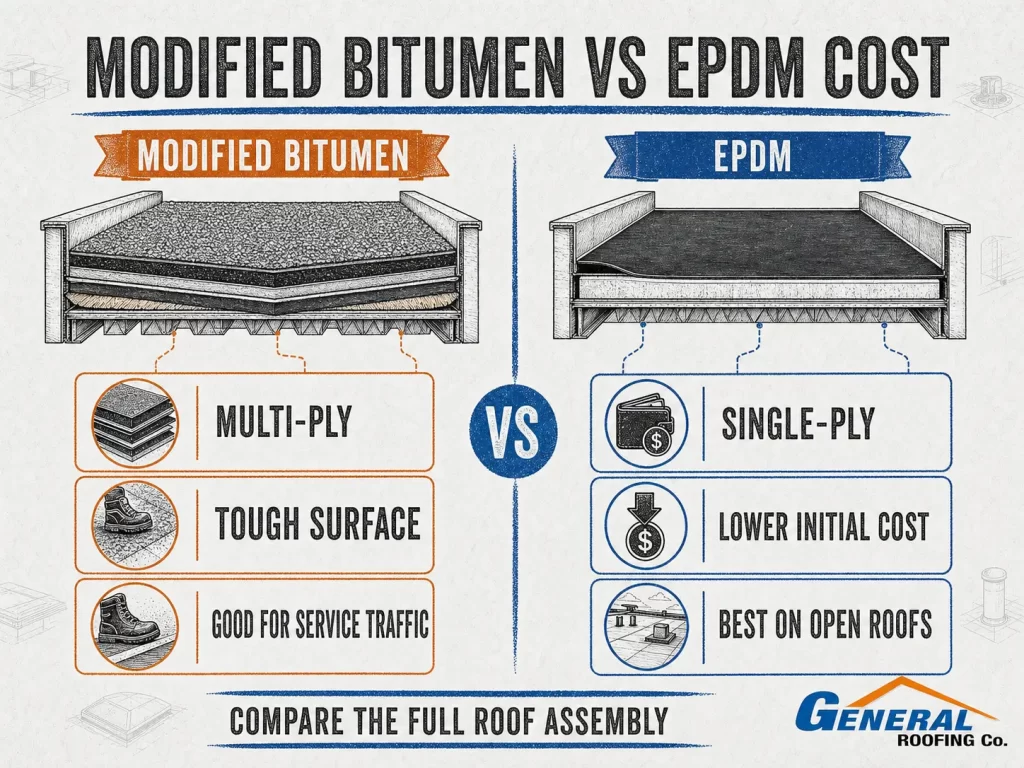
EPDM is another single-ply option. It can have a lower initial flat roof membrane cost, especially on large roofs with few penetrations.
Modified bitumen may cost more upfront because of its multiple layers. In exchange, it has a tough, asphalt-based surface that works well on roofs with regular service traffic or a higher chance of punctures.
The best choice depends on the building. Price matters, but so do drainage, rooftop activity, climate, repair history, and the crew’s experience with the selected system.
The Pacific Northwest National Laboratory’s low-slope roof guide provides a useful overview of modified bitumen, TPO, EPDM, and other low-slope systems.
Our guide to choosing a flat roof material can help narrow the options before you start comparing bids.
Modified bitumen roof lifespan
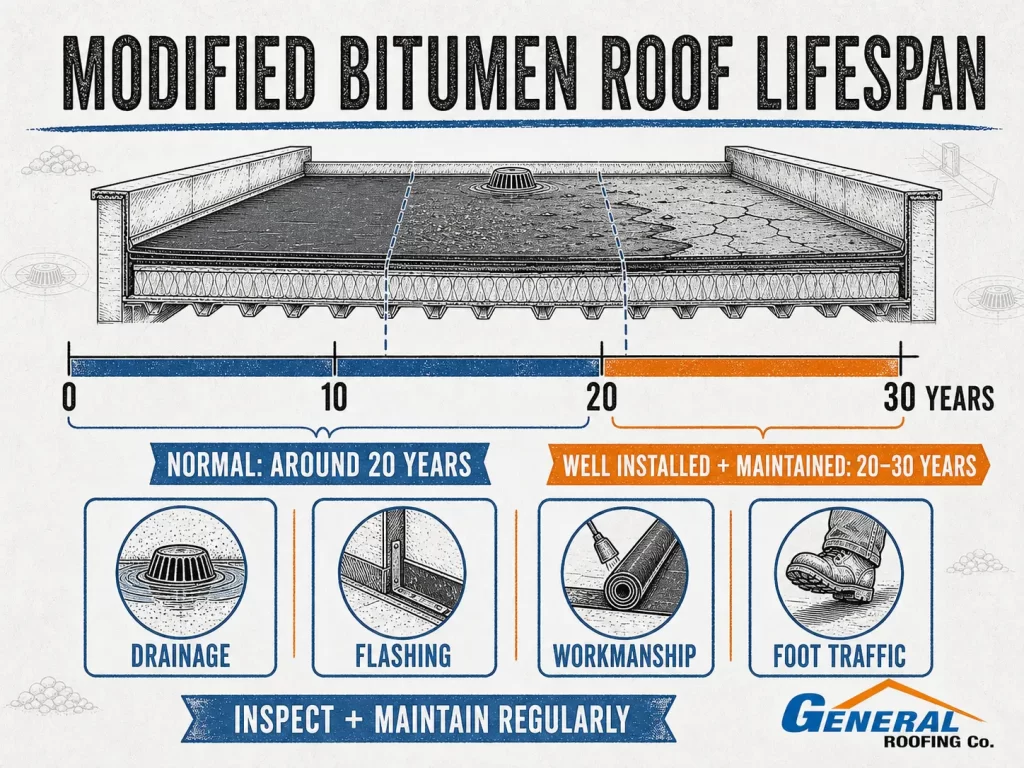
A normal modified bitumen roof lifespan is around 20 years. A well-installed and well-maintained system may last 20 to 30 years, while a poorly drained or neglected roof may need replacement much sooner.
Polyglass guidance on self-adhered roofing gives a typical service-life range of 20 to 30 years when the roof is properly installed and maintained.
Drainage, flashing, workmanship, membrane thickness, sun exposure, and foot traffic all affect the outcome.
A simple roof maintenance checklist can help owners keep drains clear, watch previous repairs, and catch surface damage before water reaches the insulation.
Common problems with modified bitumen roofing
Modified bitumen is durable, but it still develops problems when details fail or maintenance gets ignored.
Common issues include:
- Open seams or poorly bonded laps
- Cracks around flashing and roof penetrations
- Blisters caused by trapped air or moisture
- Granule loss and exposed asphalt
- Punctures from tools or rooftop work
- Ponding water near drains
- Wet insulation beneath an apparently intact surface
- Incompatible patching materials
A surface patch may stop a small leak, but it cannot dry soaked insulation underneath. When leaks keep returning, the roof may need moisture testing or a closer look at the full assembly.
Our roof repair and maintenance services cover leak diagnosis, membrane repairs, flashing work, and ongoing roof care.
Frequently asked questions
How much does a modified bitumen roof cost?
A modified bitumen roof generally costs $8 to $16 per square foot. Bay Area projects often run $10 to $20 per square foot, with complicated replacements reaching $18 to $28 per square foot or more.
How long will a modified bitumen roof last?
Most modified bitumen roofs last around 20 years. A properly installed system with good drainage and regular maintenance may last 20 to 30 years.
How much is a roll of modified bitumen roofing?
A roll commonly costs about $75 to $150 or more. Base sheets and cap sheets have different prices and coverage, so the cheapest roll is not necessarily the cheapest material per square foot.
Is modified bitumen a good roof?
Yes. Modified bitumen is a solid choice for many low-slope residential and commercial roofs. It provides multiple layers, good puncture resistance, and straightforward repair options. Installation quality and drainage still matter.
What are the common problems with modified bitumen roofing?
Common problems include open seams, flashing cracks, blisters, granule loss, punctures, ponding water, and moisture trapped in the insulation.
Can you walk on a modified bitumen roof?
You can walk on a modified bitumen roof for inspections and necessary service work, but it should not be treated like a patio. Frequent routes to HVAC equipment should have designated walk pads. Avoid unnecessary traffic during very hot weather, when asphalt-based surfaces may be softer.
The layered construction used in asphaltic roof systems can provide good resistance to punctures and normal service traffic, but concentrated or careless traffic can still cause damage.
How much is a new roof on a 2,000-square-foot home?
If the actual low-slope roof area is 2,000 square feet, a modified bitumen replacement may cost around $20,000 to $32,000 nationally. In the Bay Area, a reasonable budget is around $26,000 to $40,000 or more.
A 2,000-square-foot home’s roof is not always 2,000 square feet. Overhangs, attached garages, roof shape, and slope can increase the measured roof area. Modified bitumen is also intended for flat and low-slope sections, not most steep-slope roofs.
Final thoughts
Modified bitumen roof cost usually starts around $8 to $12 per square foot for a basic installation and moves closer to $10 to $16 for a full replacement. In the Bay Area, $13 to $20 per square foot is a more practical starting range for many replacement projects.
The useful number is not the membrane price by itself. It is the cost of a dry, properly drained roof assembly that works with the building underneath it.
At General Roofing, we look at the existing layers, insulation, drainage, access, and flashing before putting a number on the project. Property owners planning a replacement can request a roof estimate based on the actual roof rather than a generic square-foot calculator.
Recent Comments