
EPDM has a reputation for being the practical rubber roof. Fair enough. But the rubber sheet is only one part of the bill.
For a typical commercial project, EPDM roofing cost per square foot usually falls between $8 and $14 for a complete installation. In the Bay Area, a more realistic starting range is $10 to $16 per square foot. Replacement projects with wet insulation, damaged decking, difficult access, or a crowded roof can climb above $20 per square foot.
Those numbers are useful for early budgeting, but they are not universal price tags. Roof size, membrane thickness, insulation, attachment method, drainage, labor, and tear-off requirements all affect the final EPDM roofing cost.
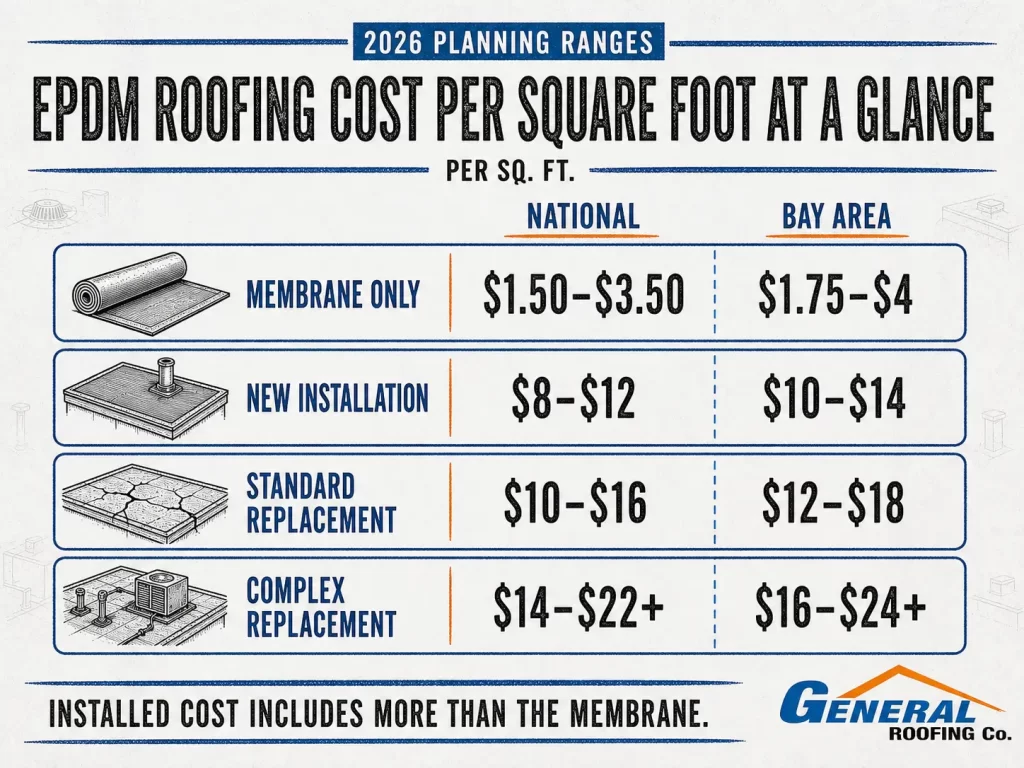
EPDM roofing cost per square foot at a glance
| Project type | Typical national cost | Typical Bay Area cost |
|---|---|---|
| EPDM membrane only | $1.50 to $3.50 per sq. ft. | $1.75 to $4 per sq. ft. |
| New installation over a prepared deck | $8 to $12 per sq. ft. | $10 to $14 per sq. ft. |
| Standard EPDM roof replacement | $10 to $16 per sq. ft. | $12 to $18 per sq. ft. |
| Complex replacement with repairs | $14 to $22+ per sq. ft. | $16 to $24+ per sq. ft. |
The installed ranges above cover more than membrane. A complete EPDM system may include insulation, a cover board, adhesive or fasteners, seam materials, flashing, drains, edge metal, labor, equipment, disposal, and warranty costs.
There is no official nationwide price list for an installed EPDM roof. The EPDM Roofing Association’s cost guidance confirms that costs change by building and system type. It also notes that ballasted systems have historically had the lowest installed cost, followed by mechanically fastened and fully adhered systems.
What does an EPDM roof cost by building size?
For a fairly straightforward installation, these totals provide a workable starting point:
| Roof size | National estimate | Bay Area estimate |
|---|---|---|
| 5,000 sq. ft. | $40,000 to $70,000 | $50,000 to $80,000 |
| 10,000 sq. ft. | $80,000 to $140,000 | $100,000 to $160,000 |
| 20,000 sq. ft. | $160,000 to $280,000 | $200,000 to $320,000 |
| 50,000 sq. ft. | $400,000 to $700,000 | $500,000 to $800,000 |
Large, open roofs often cost less per square foot than small roofs with the same number of drains, curbs, pipes, and rooftop units. A 50,000-square-foot warehouse can be faster to install than five separate 10,000-square-foot buildings.
The opposite is also true. A small roof is not automatically a cheap roof.
What affects EPDM roof installation cost?
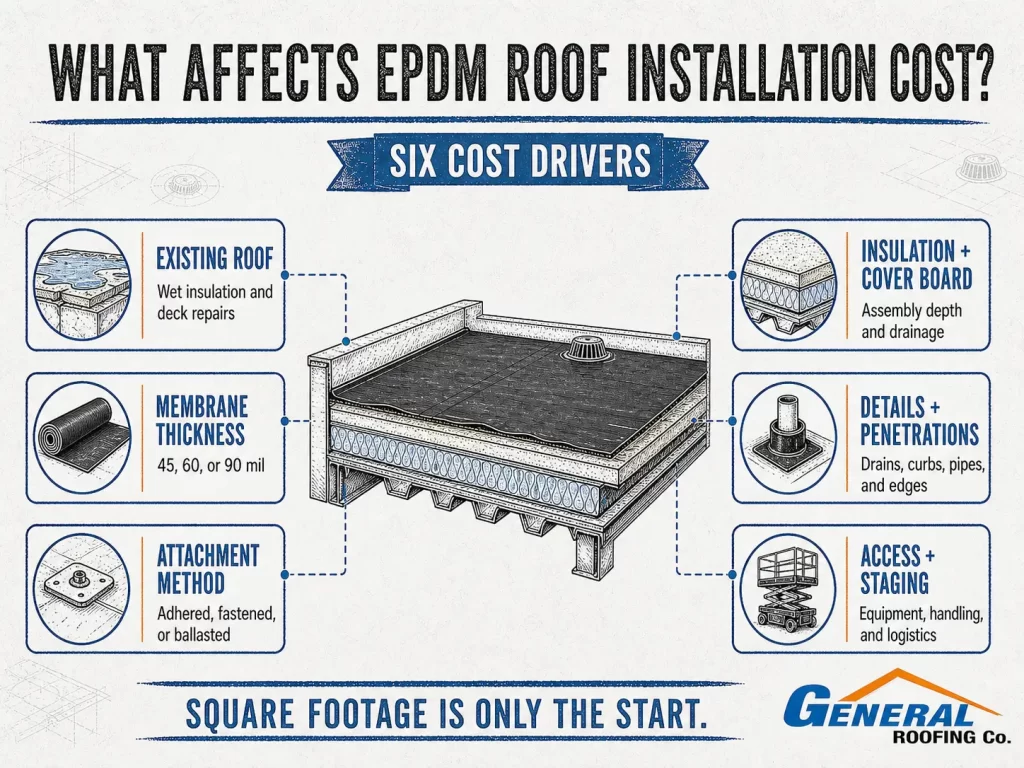
The condition of the existing roof
A replacement estimate may assume that the old roof can be removed without finding widespread damage underneath. Once tear-off starts, wet insulation, rusted metal decking, dry rot, and poorly repaired penetrations can change the scope.
This is why a low quote based on square footage alone deserves a closer look. It may cover the new membrane without accounting for the roof underneath it.
A commercial roof inspection can uncover some of these problems before the replacement is priced. Core samples and moisture testing may also be appropriate on larger buildings.
Membrane thickness
EPDM is commonly available in 45, 60, and 90 mil thicknesses. Thicker membrane costs more, but it may make sense on roofs with frequent foot traffic, demanding warranty requirements, or a higher risk of punctures.
The EPDM Roofing Association’s membrane overview also lists black, gray, and white products in widths ranging from 7.5 to 50 feet. Larger sheets can reduce the number of field seams, although they require more planning and manpower to position.
For many commercial buildings, 60 mil EPDM is the middle-ground choice. The right thickness still depends on how the roof will be used.
Attachment method
EPDM can be fully adhered, mechanically attached, or ballasted.
A fully adhered membrane is bonded to the surface below it. This creates a smooth, stable roof, but adhesive and installation labor tend to push the price up.
Mechanically attached EPDM uses fasteners and plates. It can be quicker to install on suitable roof decks, although the design must account for wind loads and fastening patterns.
Ballasted EPDM uses stone or pavers to hold the membrane in place. It can have a lower initial cost, but the building must be able to support the added weight. Future leak detection and repair work can also take longer because the ballast has to be moved.
Insulation and cover board
The membrane gets most of the attention because it is the part you can see. Insulation and cover board can account for a large chunk of the actual flat roof membrane cost.
More insulation, tapered drainage systems, and high-density cover boards add material and labor. They can also improve drainage, thermal performance, and resistance to damage.
Do not compare two proposals until you know whether they include the same insulation thickness and cover board. A lower EPDM flat roof cost may simply reflect a thinner roof assembly.
Roof penetrations and perimeter details
A wide-open warehouse roof is usually cheaper per square foot than a roof filled with HVAC units, vents, skylights, pipes, drains, and equipment supports.
Every interruption in the membrane needs flashing. Perimeters, inside corners, expansion joints, and unusual transitions also take time. These details are where good installation matters most, so rushing through them to save labor is a poor trade.
Access and staging
Some roofs have clear loading areas and easy crane access. Others sit above busy sidewalks, active storefronts, manufacturing equipment, or narrow city streets.
Equipment setup, material handling, parking restrictions, fall protection, and work-hour limits can all raise the EPDM roof installation cost. On occupied buildings, crews may also need to sequence the work around tenants or business operations.
Bay Area EPDM roofing cost
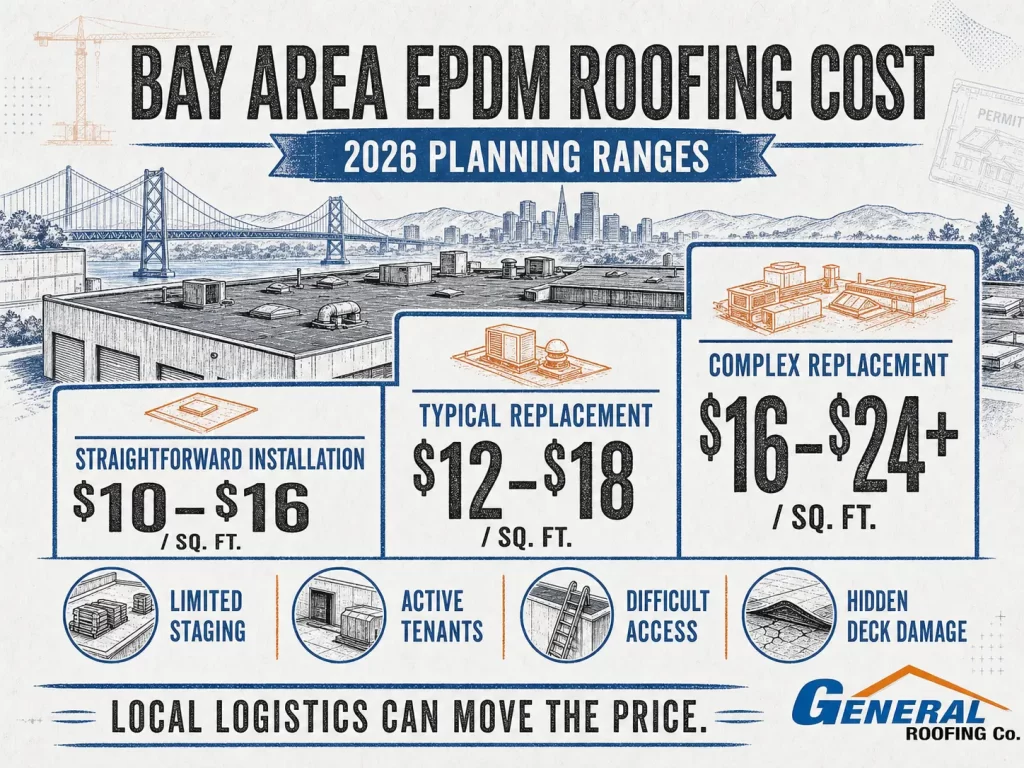
Commercial EPDM roofing cost in the Bay Area generally starts around $10 to $16 per square foot for a straightforward installation. A typical replacement is more likely to land between $12 and $18 per square foot.
Projects involving structural deck repairs, several roof layers, extensive tapered insulation, or difficult San Francisco access may reach $16 to $24 per square foot or more.
National online calculators often miss local labor and staging conditions. The Bureau of Labor Statistics publishes separate wage data for the San Francisco-Oakland-Fremont metro area rather than treating it like the rest of the country. In practice, roof access and jobsite logistics can move a Bay Area quote just as much as labor rates.
Several things commonly push Bay Area pricing higher:
- Limited space for dumpsters, cranes, and material storage
- Parking or street-use restrictions
- Work around active commercial tenants
- Higher disposal and equipment costs
- Complex permitting or scheduling requirements
- Older buildings with hidden deck damage
- Insulation and roof assembly upgrades
Our guide to commercial roof replacement cost per square foot covers the broader costs that apply across EPDM, TPO, PVC, and other low-slope systems.
How much does EPDM roof replacement cost?
A standard EPDM roof replacement usually costs $10 to $16 per square foot nationally. In the Bay Area, $12 to $18 per square foot is a safer planning range.
Replacement costs more than a new installation over a clean deck because the crew may need to remove and dispose of the old roof, inspect the deck, replace damaged insulation, correct drainage, and rebuild flashing details.
An old roof does not always have to be removed completely. The EPDM Roofing Association notes that an existing assembly may sometimes remain in place when the roof and deck are structurally sound and the new system meets the manufacturer’s substrate requirements.
A recover can save money, but only when the existing roof is dry and suitable. Covering wet insulation usually delays the problem rather than solving it.
Buildings with isolated damage may still be candidates for repair. Our flat roof repair cost guide explains how repair pricing compares with replacement.
EPDM vs. TPO roofing cost
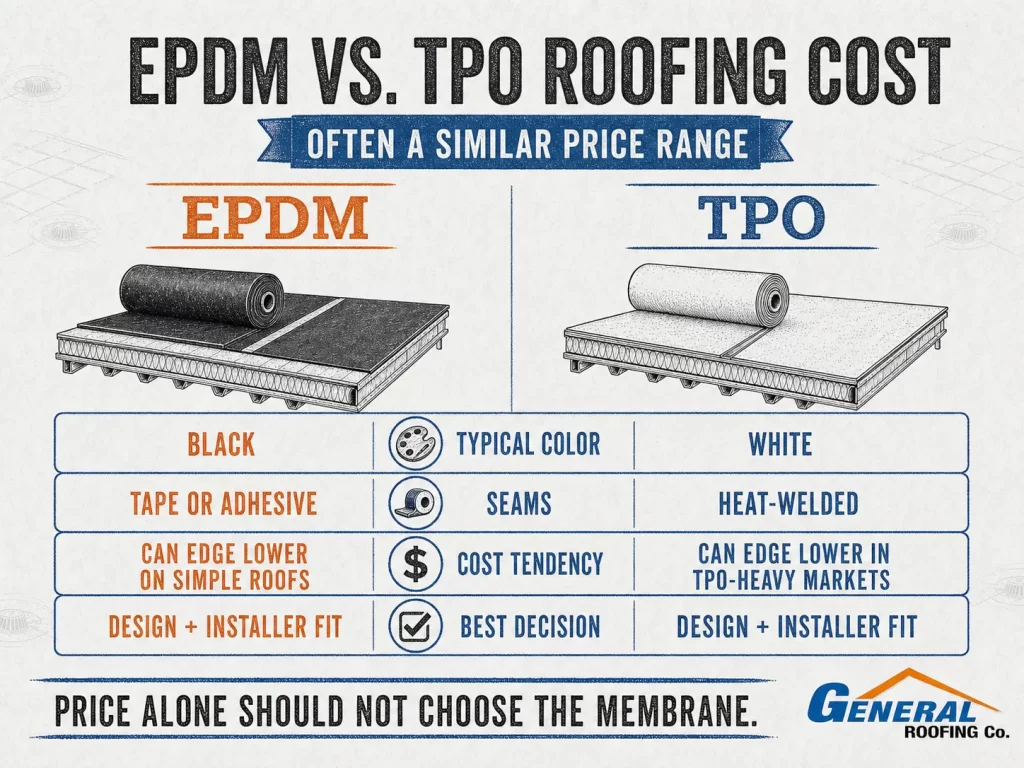
EPDM and TPO often land in a similar price range. EPDM may be slightly cheaper on a large, simple roof, while TPO may price lower when local contractors and suppliers install more of it.
Price should not be the only deciding factor.
Traditional black EPDM absorbs more heat, although white EPDM is available. TPO is commonly installed as a white membrane with heat-welded seams. Roof design, climate, building use, installer experience, and warranty requirements matter more than a small difference in the initial quote.
For a closer look at current numbers, read our TPO roofing cost per square foot guide.
EPDM vs. PVC roofing cost
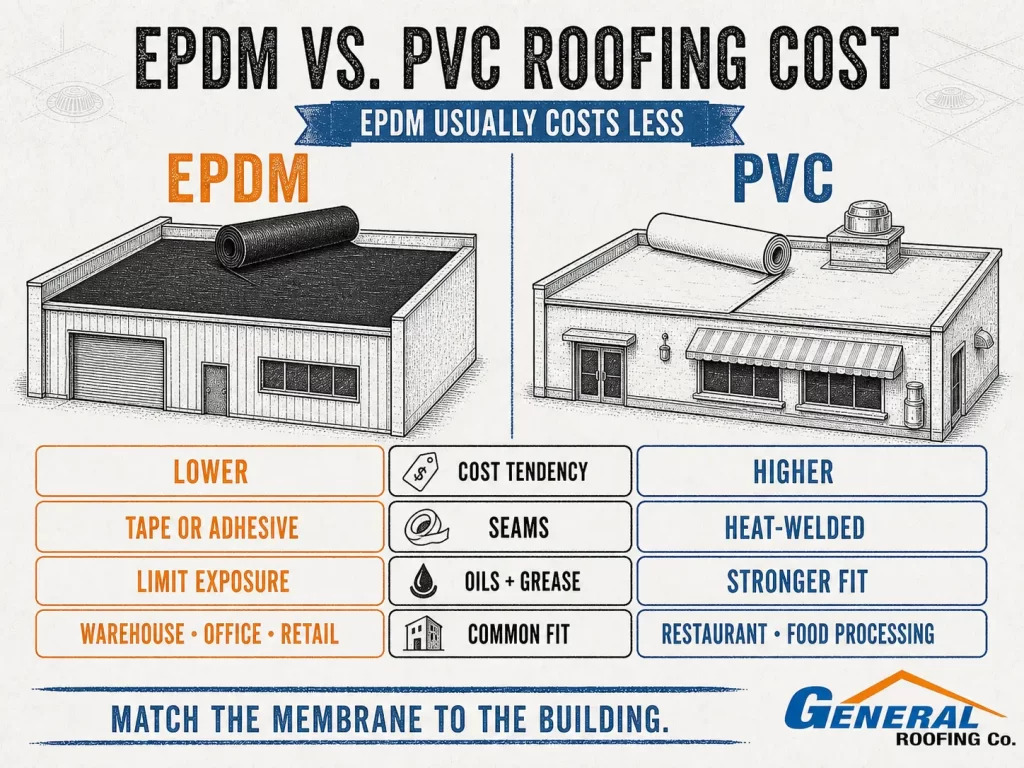
EPDM usually costs less than PVC.
PVC membranes are often selected for restaurants, food processing buildings, and properties where the roof may encounter grease, oils, or certain chemicals. PVC also uses heat-welded seams. Those features generally come with a higher material cost.
EPDM can be the better value for a straightforward warehouse, office, retail, or multifamily roof that does not need PVC’s chemical resistance.
Our PVC roofing cost per square foot guide has a fuller price comparison.
Is EPDM roofing expensive?
EPDM is not unusually expensive for a commercial single-ply roof. It normally sits in the lower-to-middle part of the flat-roof price range.
The confusion comes from comparing the membrane price with the installed price. The rubber itself might cost a few dollars per square foot. The finished roof also needs insulation, flashing, attachment materials, edge details, labor, equipment, and warranty coverage.
You are paying for a functioning roof assembly, not a roll of rubber.
What are the disadvantages of an EPDM roof?
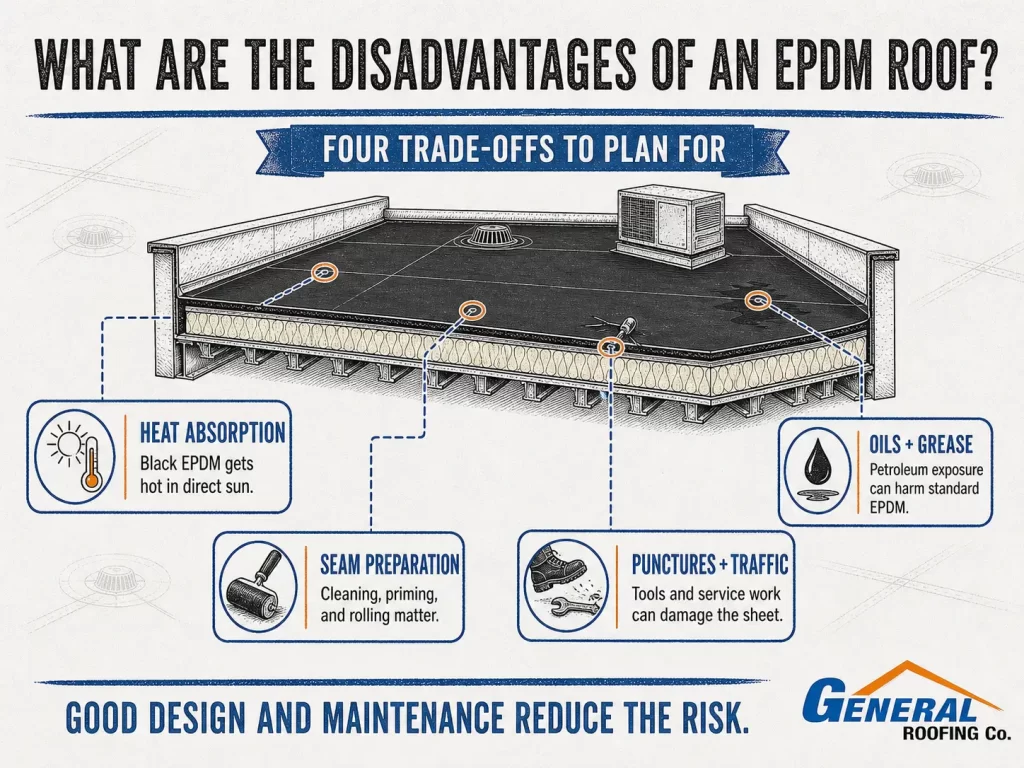
EPDM is durable, but it is not the right answer for every building.
Black EPDM can become hot in direct sun. White EPDM is available, but TPO or PVC may still be a better fit when a white reflective surface is a major design priority.
EPDM seams are usually joined with tape or adhesive rather than being heat welded. The seams can perform for decades when the installer cleans, primes, and rolls them correctly. Sloppy preparation causes trouble.
The membrane can also be punctured by dropped tools, sharp equipment, or frequent service traffic. Walk pads and a suitable cover board help protect busy areas.
Prolonged contact with petroleum-based oils can damage standard EPDM. Restaurants and industrial properties should discuss possible roof contaminants before choosing a membrane.
How long does an EPDM roof last?
A properly designed, installed, and maintained EPDM roof can last about 25 to 40 years. Some roofs remain in service longer.
In its 2025 review, the EPDM Roofing Association reported an expected service life of 38 years for properly designed, installed, and maintained membranes. Roofing professionals surveyed for the review reported expected lifespans from about 25 years to more than 40 years, depending on membrane thickness and attachment method. Some had encountered working EPDM roofs that were 40 to 50 years old.
A long life is not automatic. Drainage, seams, flashing, foot traffic, maintenance, and repair quality all affect how long the roof stays useful.
How much does a roll of EPDM cost?
A commercial roll of EPDM can cost roughly $1,500 to $7,000 or more, depending on its width, length, thickness, brand, and freight charges.
A more useful material budget is about $1.50 to $3.50 per square foot for the membrane alone. For example, a 10-by-100-foot roll covering 1,000 square feet may cost around $1,500 to $3,500. A wider or thicker roll costs more because it contains far more material.
Be careful with roll comparisons. EPDM is manufactured in widths from 7.5 to 50 feet, so two products described as “one roll” may cover completely different areas. Adhesive, seam tape, flashing, fasteners, insulation, and waste are separate.
Is EPDM 100% waterproof?
The EPDM membrane itself is waterproof when it is intact and properly installed. The finished roof can still leak at damaged seams, punctures, drains, penetrations, or flashing.
No responsible contractor should promise that any roof will remain 100% leak-proof forever.
EPDM is relatively straightforward to repair. The manufacturer’s approved process generally involves cleaning and priming the damaged area before installing a compatible patch. Good drainage also matters. The EPDM Roofing Association’s technical FAQ recommends placing drains in low areas and using crickets, saddles, or tapered insulation where needed to limit ponding.
Frequently asked questions
How much does it cost per square foot to install an EPDM roof?
EPDM roof installation costs about $8 to $14 per square foot nationally. Bay Area installations commonly cost $10 to $16 per square foot, with replacements and complex projects costing more.
Is EPDM roofing expensive?
EPDM is usually a lower-to-mid-priced commercial membrane. It often costs less than PVC and falls close to TPO, depending on the roof design and attachment method.
Which is cheaper, EPDM or TPO?
Neither is always cheaper, but EPDM can have a slight cost advantage on large, uncomplicated roofs. TPO may cost less when it is more readily available or commonly installed in the local market.
Why is EPDM roofing so expensive?
The installed price covers the whole roof assembly, not just the rubber membrane. Labor, insulation, cover board, adhesive or fasteners, flashing, metal, tear-off, repairs, equipment, disposal, and warranty coverage make up much of the cost.
What are the disadvantages of an EPDM roof?
Black EPDM absorbs heat, the membrane can be punctured, and seams require careful surface preparation. Standard EPDM is also a poor choice where it will have prolonged contact with petroleum-based oils.
What is the lifespan of an EPDM roof?
A well-installed EPDM roof commonly lasts 25 to 40 years. The EPDM Roofing Association currently gives properly designed, installed, and maintained membranes an expected service life of 38 years.
How much does a roll of EPDM cost?
A commercial EPDM roll may cost around $1,500 to $7,000 or more. Roll size and thickness vary widely, so comparing the membrane price per square foot is more useful.
Is EPDM 100% waterproof?
An intact EPDM sheet is waterproof. A complete roof can still leak at seams, flashing, penetrations, drains, or punctures if those areas are damaged or installed incorrectly.
Final thoughts
EPDM roofing cost per square foot gives you a starting point, not a final proposal. For a straightforward Bay Area project, $10 to $16 per square foot is a sensible early budget. Replacement work with wet insulation, deck repairs, difficult access, or complicated flashing can cost considerably more.
The useful question is not simply, “How much is EPDM?” It is, “What roof system does this building need, and what is included in the price?”
Our team can inspect the existing assembly, check the drainage and deck condition, and compare EPDM with other suitable systems. You can request a roof estimate when you are ready for project-specific numbers.
Recent Comments