

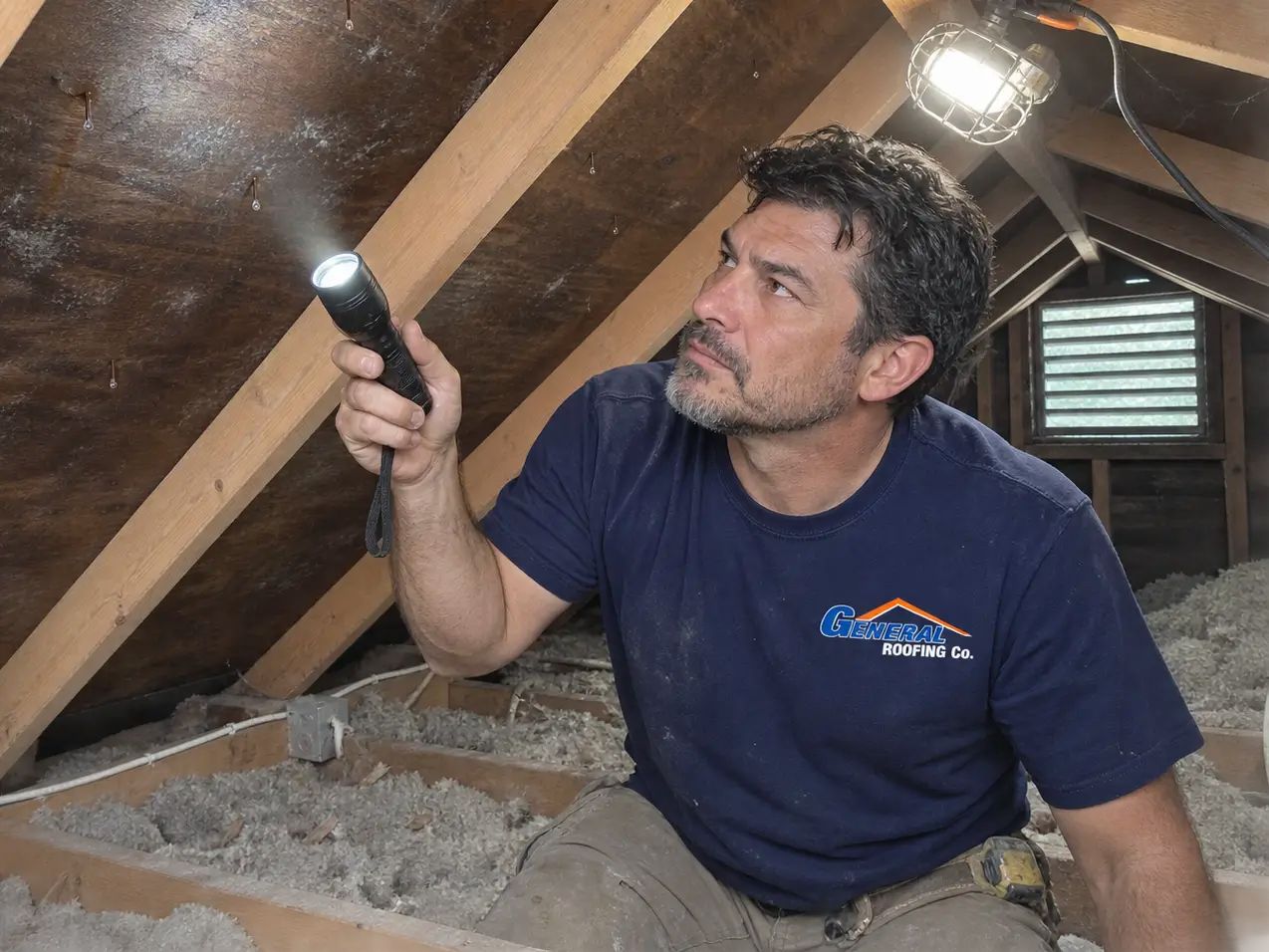
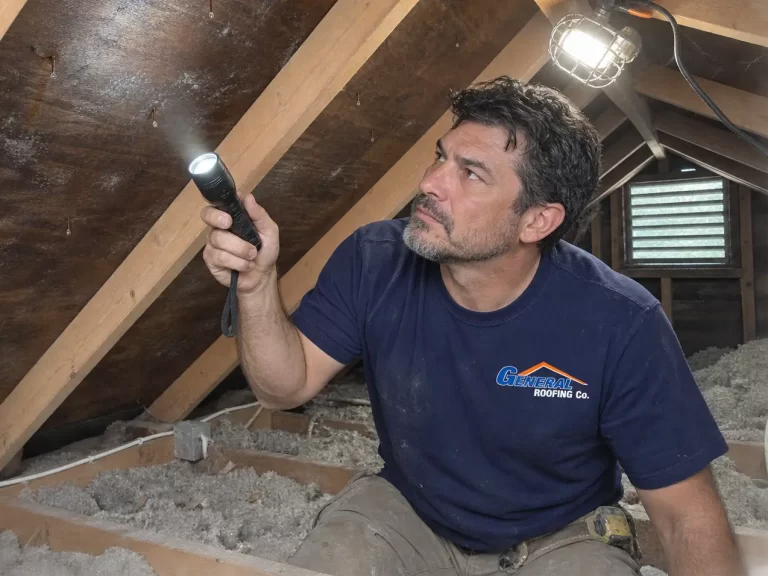
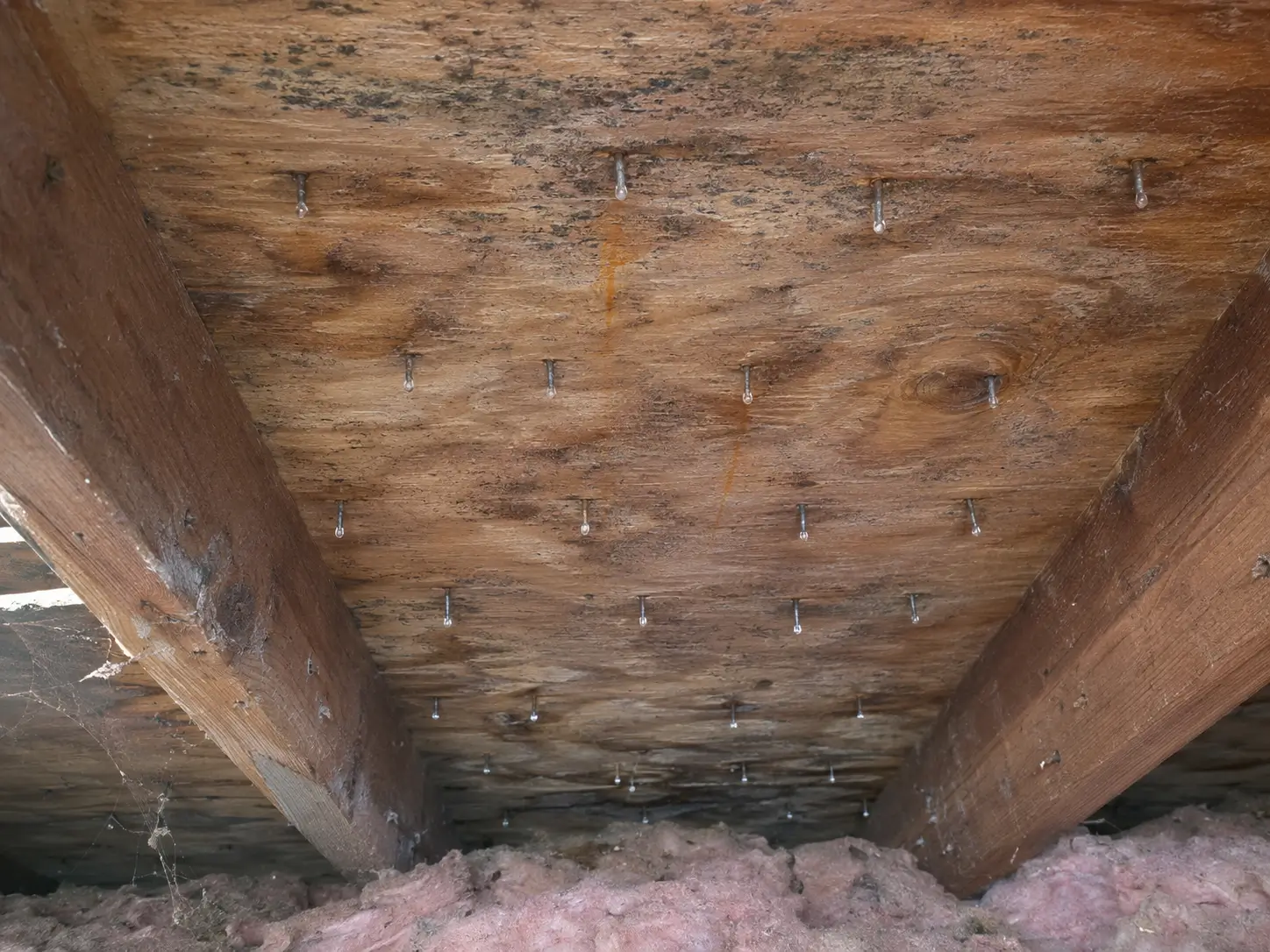
You head up into the attic after a dry week and find water. Beads on the nails, damp spots in the insulation, maybe a dark patch on the wood overhead. It hasn’t rained in days, so where’s it coming from? A lot of the time the answer is attic condensation: moisture from inside the house settling on the cold underside of the roof. It looks enough like a leak that people have paid for roof work that didn’t fix a thing.
The two leave different clues, though, and with a flashlight you can usually tell which one you’ve got in a few minutes. We handle roof leak diagnosis and repairs in Oakland or elsewhere in the Bay Area, and if you’d rather have someone else squint at those nail tips, we’re glad to come take a look.
What is attic condensation?
Indoor air carries moisture from showers, cooking, laundry and plain old breathing. When that air drifts up into the attic and touches a surface colder than its dew point, the moisture turns back into water. In a vented attic, the coldest surfaces are the roof sheathing (the plywood or boards under your shingles) and the nail tips poking through it.
Clear nights make it worse. A roof loses heat to an open sky, so on a still, cloudless night the sheathing can cool below the dew point even when the air outside doesn’t feel that cold.
Attic condensation vs. a roof leak: how to tell
| Clue | Attic condensation | Roof leak |
|---|---|---|
| When it shows up | Dry mornings after cold, clear nights, often once the sun warms the roof | During or after rain |
| Where | Spread across a whole slope, often worst on the north side and up near the ridge | One area, usually below a pipe, chimney, skylight, valley or wall |
| Nail tips | Wet, frosty or rusty on many nails at once | Mostly the nails along the water’s path |
| Stains | Even darkening or speckles across the sheathing | A tide-line stain running downhill along a rafter or board |
| Insulation | Rows of small drip marks under the nail lines | One soaked spot |
A leak has a source, so you can trace it uphill, and our guide on how to find a roof leak walks through it. Roof condensation has no single source. It shows up wherever the sheathing is coldest.
Mix-ups go both ways. Wet nail tips get sold a new roof, and real flashing leaks get written off as “just condensation.” On older houses you can have both at once, so rule each one out instead of stopping at the first answer.
What condensation in the attic looks like in the Bay Area
Thick frost and ice dams are rare here. Around the Bay it’s quieter: beads of water on nail tips, damp or darkened sheathing, droplets on metal flues, ducts and skylight wells, and a gray-black mildew bloom on the north-facing slope. Inland valleys run colder, and you might find light frost on the nail tips that melts and drips once the morning sun hits the roof.
In the fog belt and near the water, the outside air is already damp, so cutting off moisture from the house does more than adding vents.
What causes condensation in the attic?
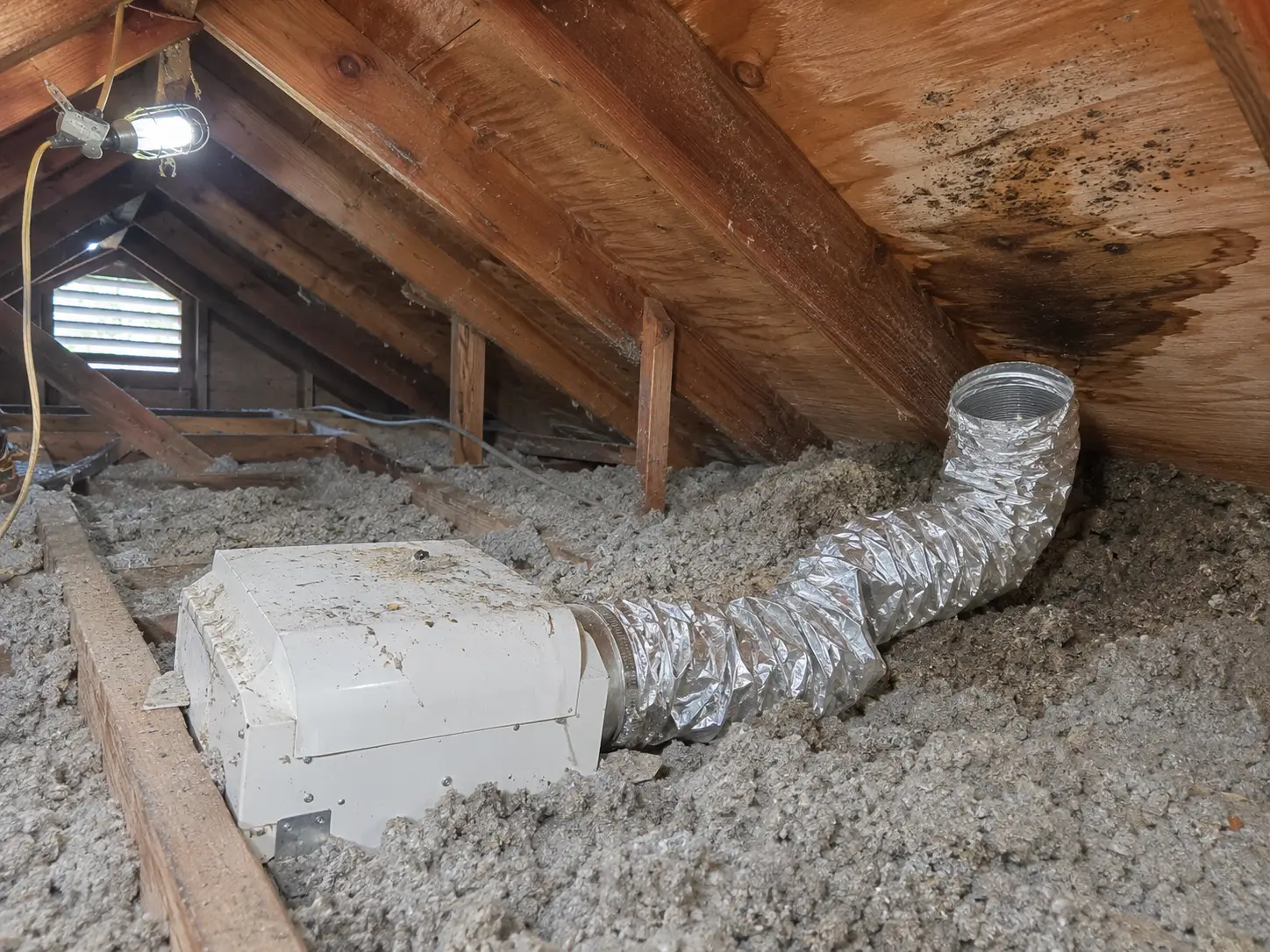
Bath and dryer fans that end in the attic
This is the big one. We find bathroom fan ducts that stop in the attic, flex duct that’s slipped off its roof cap, and ducts aimed at a vent without being connected to it. It happens a lot after bathroom remodels where nobody went upstairs. Every hot shower then sends steam straight at the sheathing. Bath fans should vent outdoors, not into an attic or crawlspace, with a damper at the outside cap. A dryer venting into the attic is worse, since it adds lint along with the water.
Blocked or missing intake vents
Plenty of older homes have boxed eaves with no vents at all. Where soffit vents (the vents under the eaves) do exist, they’re often painted over or buried under blown-in insulation. The 2025 California Residential Code says insulation can’t block eave vents and calls for at least 1 inch of air space between the insulation and the roof sheathing at the vent. Without intake low on the roof, air can’t move through the attic and carry moisture out.
Warm air leaking up from the house
Older recessed lights, gaps around pipes and wiring, an attic hatch with no weatherstripping, and the framed shafts around flues all let humid house air rise into the attic. ENERGY STAR’s attic air sealing guide covers how those gaps get sealed.
A damp crawlspace
On hillside lots, moisture from a wet crawlspace can work its way up through old framing and wall cavities. In some houses, fixing the drainage down there does more for the attic than anything on the roof.
Attic ventilation problems we see most
Code requires vent openings totaling at least 1/150 of the attic floor area, but hitting the number doesn’t help if the vents fight each other. What we see most:
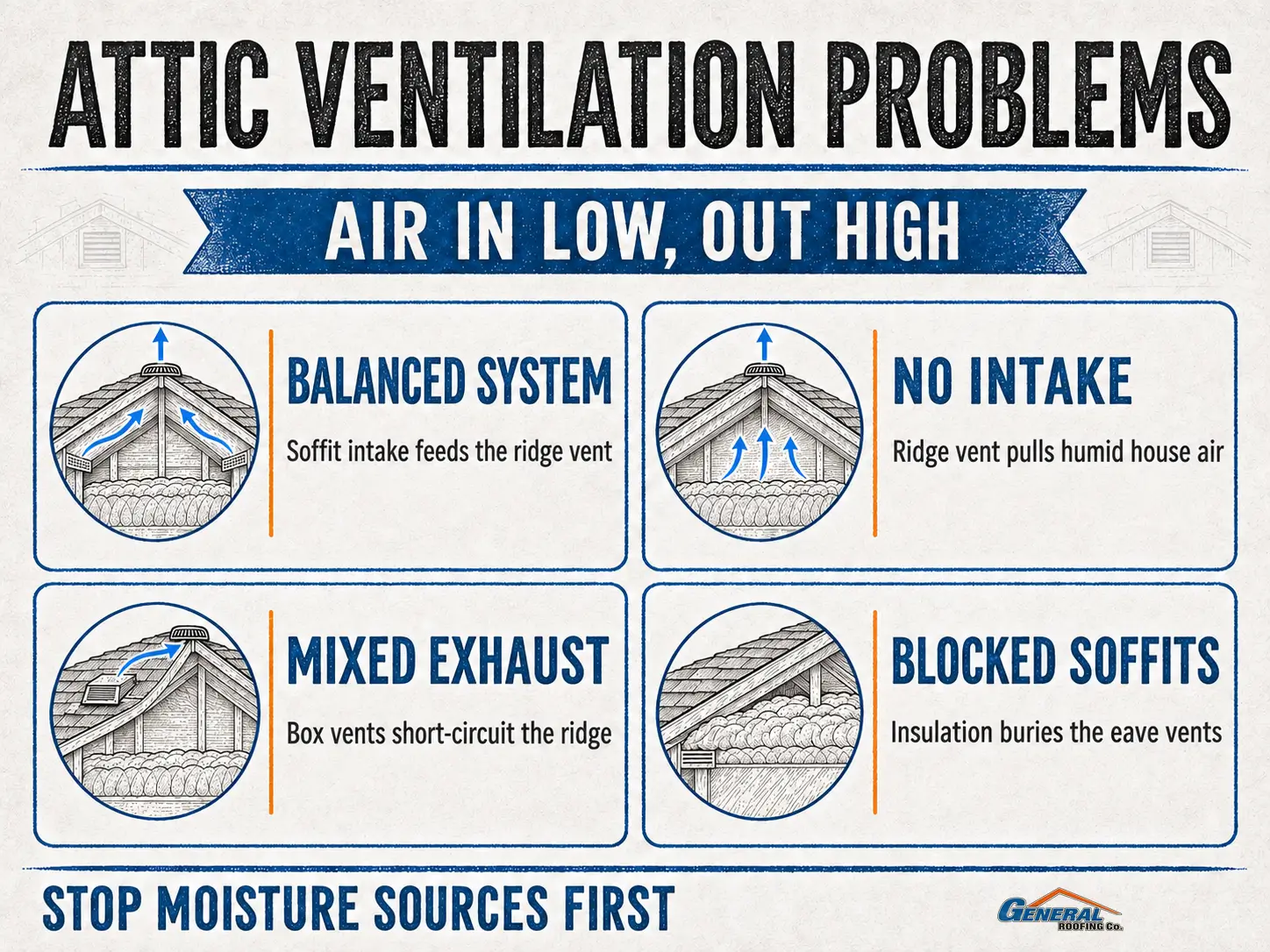
- A ridge vent with no intake. It still pulls air from somewhere, and that’s often the living space below, humidity included.
- Two kinds of exhaust on one attic, like a ridge vent plus old box vents or gable vents. The lower vent becomes the ridge’s air supply, so air never gets pulled in at the eaves.
- Counting on an attic fan alone. A powered fan can pull humid air up from the house, and a solar fan mostly runs in daylight, when the roof is already drying. Fans have their place, just not as the whole fix.
On houses with no soffits, roof-edge intake vents or vented blocks between the rafters can add the missing intake. We design ridge, soffit and low-profile vents into our roof replacements, and in wildland-urban interface areas those vents also have to meet California’s ember-resistance rules.
How to stop condensation in the attic
- Stop the sources. Vent every bath fan and dryer outdoors through a proper cap, and deal with a wet crawlspace.
- Air seal the attic floor at the leaks listed above. Ventilation only carries off moisture that’s already up there, while air sealing keeps it from getting there.
- Balance the ventilation, with real intake low and one type of exhaust high.
- Then insulate, with baffles (simple channels at the eaves) holding the insulation back from the soffit vents.
Not all of that is roof work. We handle the roof side: vents, soffit openings and roof caps with dampers. Air sealing and wet insulation go to an insulation or weatherization contractor, ducts and attic furnaces to HVAC, and significant mold to a mold specialist. Start with whoever can rule out a leak, which for most people is a roofer. Re-routing a fan duct or opening up blocked soffit vents is usually a far smaller job than a new roof.
If you’re unsure where your fans end or whether your attic has any real intake, we can check the roof side and tell you which fixes are ours and which belong to another trade. Request an estimate and we’ll get in touch to set up a visit.
Found water in the attic? What to do this week
Step only on the joists, and wear gloves and a dust mask around old insulation. Grab a flashlight and your phone and photograph the nail tips, the stains and where every duct ends. Have someone run each bath fan while you feel for air at the end of its duct. Pull back the insulation at the eaves to see if the soffit vents are open, and remove any soaked insulation sitting on the drywall before it stains or sags the ceiling. The EPA’s mold guide says to dry wet materials within 24 to 48 hours.
Downstairs, run the bath fans longer, use the kitchen hood and skip drying laundry indoors.
A few things to avoid:
- Covering or closing vents. That traps the moisture.
- Piling on more insulation. It usually buries the eaves and blocks the intake.
- Running a dehumidifier in a vented attic. That attic trades air with the outdoors, so you’d be trying to dry out the neighborhood.
- Bleach. EPA doesn’t recommend it as a routine part of mold cleanup, and painting over mold doesn’t work either.
- Caulk or tar on the roof. If it’s condensation, the water isn’t coming from outside, and if it’s a leak, it needs a real repair.
When attic moisture turns into roof damage
Black or gray staining on the sheathing is often surface growth. The damage that matters is structural: nails that rust and sometimes back out after many wet-dry cycles, plywood that separates into layers, and OSB (the chip-style panels on newer homes) that swells at the edges, goes soft and stops holding nails. Over time, that can loosen the shingles above.
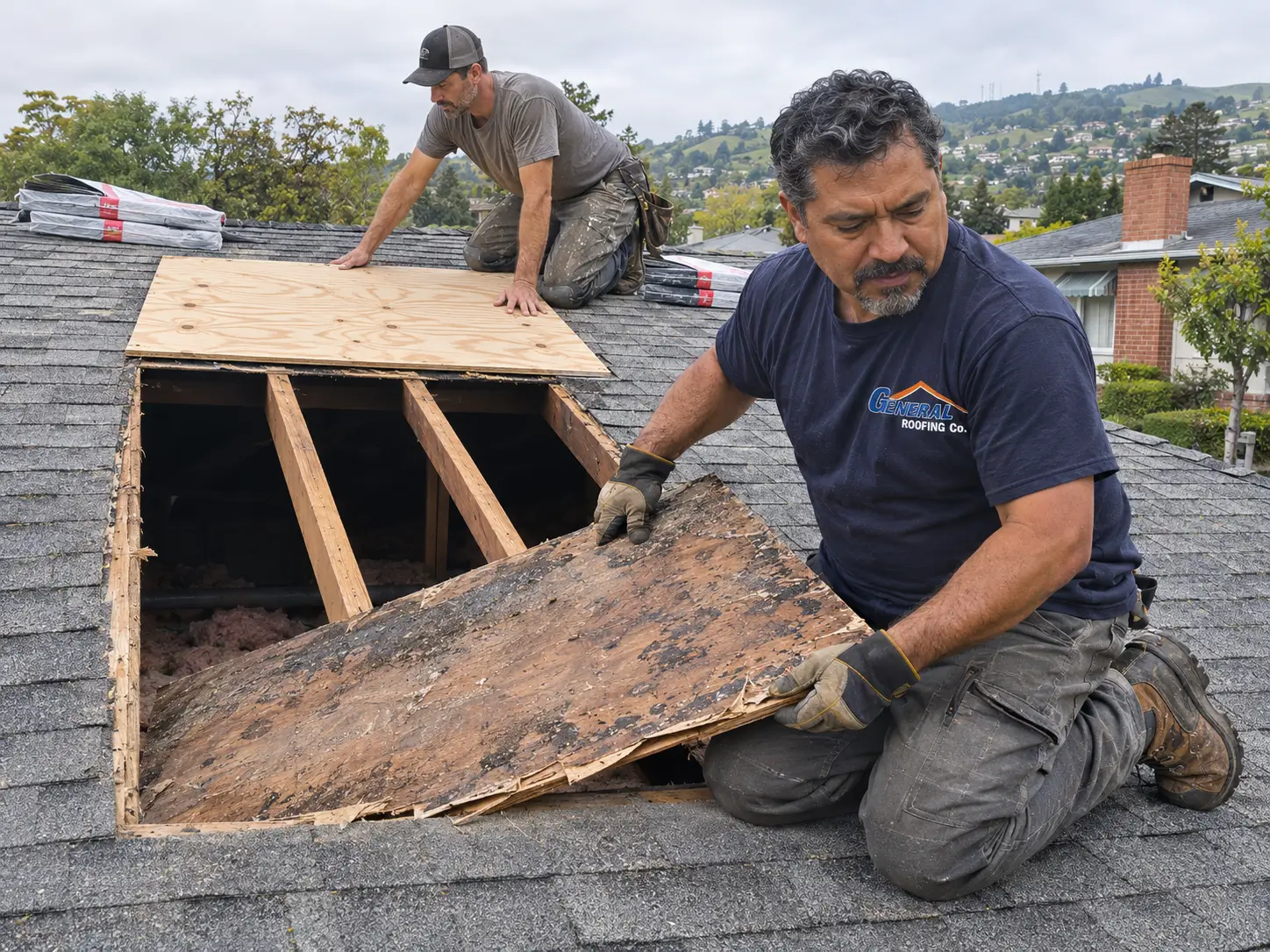
We check it with an awl from below and by walking the roof deck. Wood that’s spongy or splitting apart gets replaced, which our roof deck repair guide covers in more detail. Decking can only come out from above, so a newer roof with a few bad sheets means lifting and relaying the roofing over those spots. On an older roof with widespread damage, a tear-off and new deck usually makes more sense.
If you’re replacing the roof anyway, that’s the best time to fix the ventilation: work out where intake can go before choosing exhaust, and plan a proper roof cap with a damper for each bath fan duct. GAF’s ventilation bulletin says its warranty stays in effect, but damage caused by inadequate ventilation isn’t covered.
Frequently asked questions
Is it normal to have condensation in the attic in winter?
A little dew on a few nail tips on the coldest mornings isn’t unusual. Wet sheathing, dripping, rusty nails across a whole slope or damp insulation week after week means too much moisture is getting up there and not drying out.
How do I get rid of condensation in my attic?
Follow the order above: stop the moisture sources, seal the attic floor, then balance intake and exhaust.
Is mold from attic condensation harmful?
Mold means moisture has been sitting too long. Small patches can often be cleaned up, but mold covering more than about 10 square feet calls for a more thorough approach, usually from a mold remediation professional. If anyone in the house has health concerns, EPA suggests talking to a health professional before cleanup starts.
What should attic humidity be?
A vented attic doesn’t have a fixed target. The number to watch is indoors, where EPA recommends staying below 60 percent, ideally between 30 and 50. If the house sits in that range and the attic is still wet, look for a fan or an air leak sending moisture upstairs.
Final thoughts on attic condensation
Most attic condensation is a moisture problem, not a roof problem, so find out where your fans end before anyone quotes you a new roof.
If you can’t tell whether it’s condensation, a leak or a bit of both, we’re happy to give you a second opinion and handle any roof repairs it turns up. Get in touch and we’ll find a time to check it.
Recent Comments