
Plenty of Bay Area homeowners believe they have a Class A roof. Fewer could prove it. The rating comes from a lab test on a specific stack of materials, so the shingle brand alone doesn’t settle it. And fire resistant roofing only covers part of the risk, because embers usually get in through vents, gutters and roof edges.
We do roof replacements across Oakland, the East Bay hills and the rest of the Bay Area, and we’re glad to look at your roof and tell you what you’re working with.
What is a Class A fire rated roof?
A Class A roof passed the toughest level of the standard roof fire test, UL 790 (the same test as ASTM E108). The test hits a roof sample with flame spreading across the surface, a flame that comes and goes, and a burning block of wood set on top to stand in for a flying ember. UL sorts the results into three classes: Class A holds up against severe fire exposure, Class B against moderate and Class C against light. Anything that didn’t pass is unrated. A Class A roof also meets any code that only asks for Class B or C.
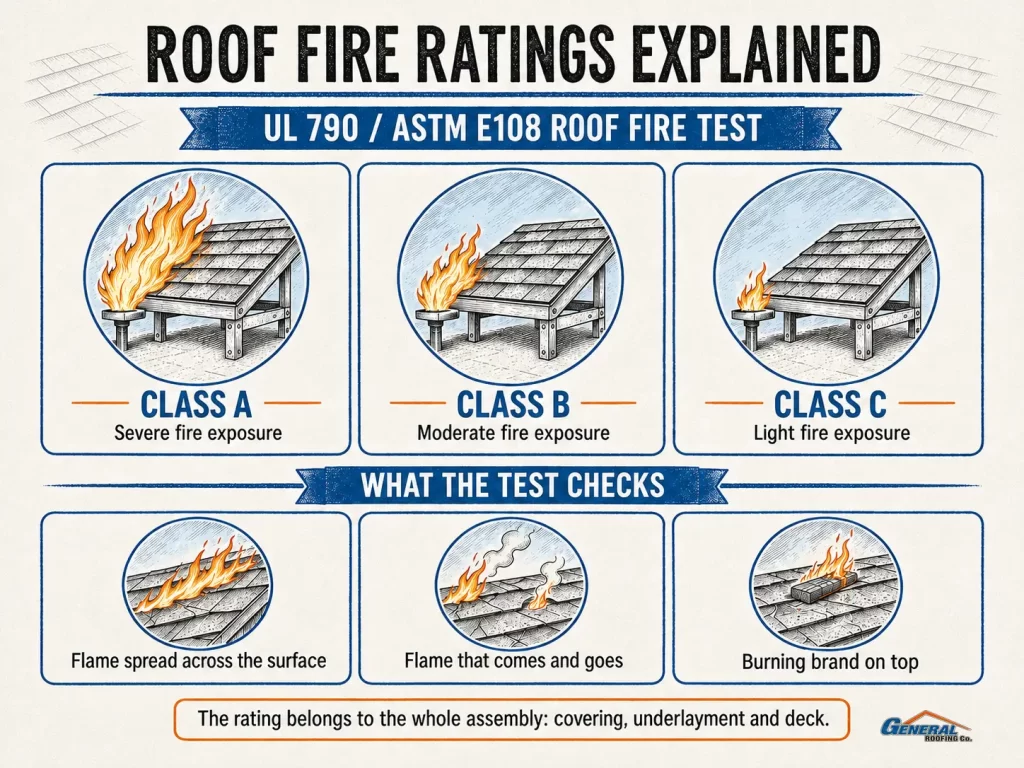
The test only measures fire hitting the outside of the roof. Embers blowing into an attic vent or leaves burning in a gutter are a separate problem, and we’ll get to those.
Class A by assembly vs. Class A on its own
Some roof coverings earn Class A on their own over a normal underlayment. Others only get there as part of an “assembly”: the covering plus a specific underlayment or fire barrier sheet and the deck under it. The manufacturer’s listing is the lab’s record of exactly which layers earned the rating, and the rating belongs to that whole stack.
This trips up real jobs. The listing calls for a particular fire barrier sheet, someone swaps in a cheaper underlayment that’s already on the truck, and the finished roof looks the same. It just isn’t the assembly that passed the test, so the rating doesn’t carry over, and the swap can cause manufacturer warranty problems too (see our roof warranty guide).
When you compare quotes, ask each roofer which listed assembly their price is based on, including the underlayment and deck it calls for. A good roofer answers that in one sentence.
Which roofing materials are Class A?
Most common roof types come in a Class A version. The difference is how each one gets there.
| Material | Fire rating | Weight | Relative cost | Good to know |
|---|---|---|---|---|
| Composition shingles (fiberglass) | Most are Class A | Light | Lowest | Easy fit for most homes; shorter life than tile or metal |
| Concrete or clay tile | Usually Class A | Heavy | Mid to high | Needs a framing check on conversions; open eaves need closing |
| Metal (standing seam or shingles) | Class A, sometimes by assembly | Light | Mid to high | Doesn’t burn and sheds leaves well |
| Synthetic slate or shake | Class A in the listed assembly | Light to medium | Upper end | The most assembly-dependent option |
| Untreated wood shake | Unrated | Light | N/A | Not something we’d put back on in a fire zone |
Composition shingles
Fiberglass shingles are one of the most common Class A roofs on Bay Area homes. Most fiberglass architectural shingles qualify over a standard underlayment, so if you’re shopping for fire resistant shingles, you’re mostly choosing on looks and wind rating.
Concrete and clay tile
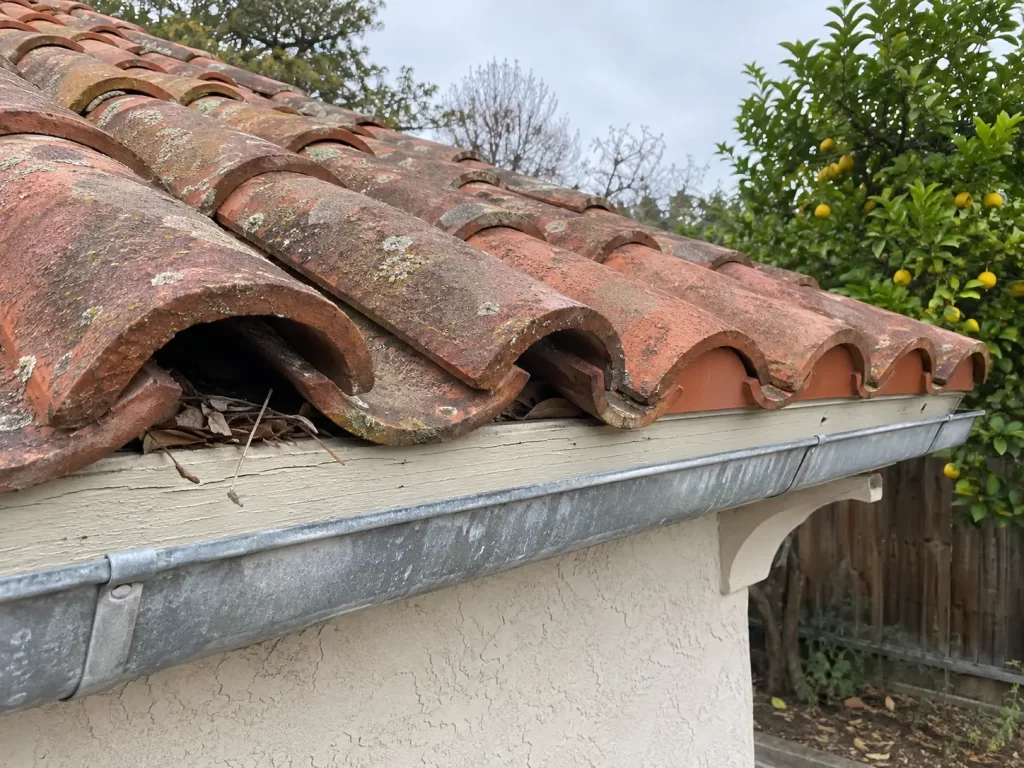
Tile doesn’t burn, and most of it is Class A. The weak spot is the space underneath. Barrel and S-tile leave open ends along the eave and ridge, and leaves and nesting birds move in over the years. Fire Safe Marin points out that this nesting material can catch embers and carry fire into the roof. Bird stops, the closures that plug the open ends of the first tile row, fix most of it. Tile is also heavy, so switching to it from a lighter roof means checking the framing first.
Metal and synthetic slate
Steel standing seam and metal shingles don’t burn and shed leaves easily. Some panels are Class A on their own, while lighter ones, aluminum especially, need a specific underlayment to get there.
Synthetic slate and shake give you the old slate or cedar look, which matters where an HOA protects it. They can reach Class A, but only in the assembly the manufacturer lists, and the same product line can carry different ratings over different underlayments. On a synthetic roof, ask to see that listing.
Wood shake
Untreated shake is generally unrated. California law says wood roofing can’t be sold or installed unless the State Fire Marshal has approved and listed it and it has passed at least five years of a 10-year outdoor weathering test. Even then, decades of weather make it hard to know how much fire retardant is left, and Fire Safe Marin advises treating shakes without documentation as untreated.
So which roof is the most fire resistant?
Comp, tile, metal and synthetics can all be Class A, so the rating alone doesn’t crown a winner. Tile and metal don’t burn at all. The bigger differences show up at the edges: how well the roof keeps embers and debris out of its gaps, and how much its rating depends on the right underlayment. A properly closed tile roof or a clean metal roof does well on both. Our California roof lifespan guide compares how long comp, tile and metal roofs last.
What California requires in fire hazard zones
If your address is in a very high fire hazard severity zone and you replace more than half of your roof within a year, state law (Health and Safety Code 13132.7) generally requires the new roof covering to be at least Class A. The same goes for new roofs and for roofing applied in a repair. The installer also has to certify the roof’s fire class to you, so keep that paperwork with your house records.
Since January 1, 2026, California’s wildfire building standards have their own book, the California Wildland-Urban Interface Code, and cities can add rules on top. Oakland, for example, requires a Class A roof, fire-resistant siding and ember-resistant metal mesh vent covers on new construction in its Wildland-Urban Interface Fire Area, which is drawn wider than the state map.
To check your address, start with the state’s Fire Hazard Severity Zone map viewer, then your city’s map, since the two don’t always match. Our estimators work with the city so the job meets code for your zone.
How to tell if your roof is Class A
Start with the paperwork. A permit record often names the product, and leftover bundles in the garage or attic are even better, because the wrapper lists the product line and its fire rating.
With no paper trail, the material is a decent first guess. A fiberglass comp roof from the last couple of decades is very likely Class A, most tile is too, and old shake is a no. Watch for these traps:
- Comp shingles laid over old shakes, or over spaced “skip” sheathing (boards with gaps between them instead of a solid deck). That isn’t the assembly that was tested.
- Treated shakes with no record of the treatment, or ones that have weathered for decades.
- Synthetic or metal roofs where nobody knows which underlayment went down.
If you’re still unsure, a roofer can lift an edge, look at the deck and underlayment, and match them to a listing.
Embers find the weak spots: vents, gutters, edges and tile gaps
The City of Oakland says embers are the most common way homes catch fire, and that they can travel miles ahead of a fire. They don’t burn through a Class A roof; they get in through gaps. On older Bay Area homes, we check these spots first:
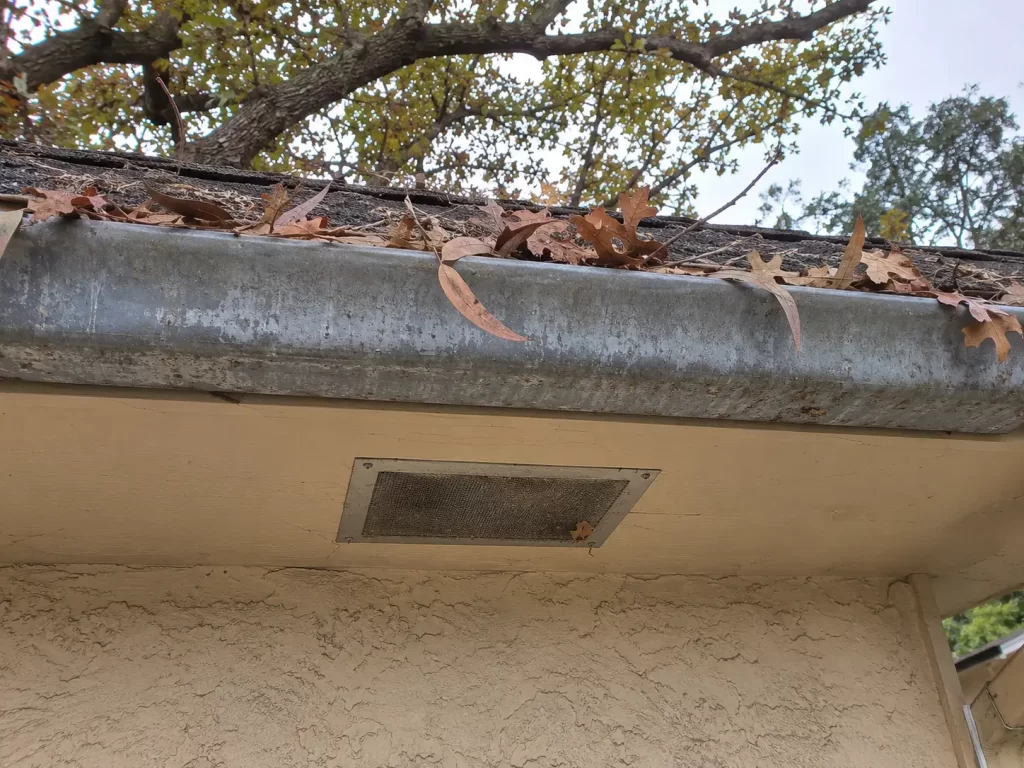
- Attic and soffit vents. Oakland recommends replacing standard 1/4-inch screens with 1/8-inch or 1/16-inch metal mesh, and that costs far less than a roof. On a replacement, we design the roof ventilation in from the start.
- Gutters. Oak and eucalyptus litter packed against the fascia is a fuel line along the roof edge. Vinyl gutters can melt or catch fire, and metal mesh guards resist embers much better than plastic covers.
- Valleys, roof-to-wall lines and the backs of chimneys, where debris piles up, often right against wood siding.
- Open tile eaves and ridges without bird stops.
- Old plastic skylight domes, which are worth upgrading during a reroof.
Vents and gutters usually come first, then the metal trim along the roof edges and the flashing where the roof meets a wall. We can walk the roof with you, point out which of these gaps need attention now, and put together an estimate for a full Class A reroof if that’s where it’s headed.
Replacing a wood shake roof: what changes once it’s off
If you have an aging shake roof in the hills, we’d replace it rather than keep patching a material nobody can verify as fire rated.
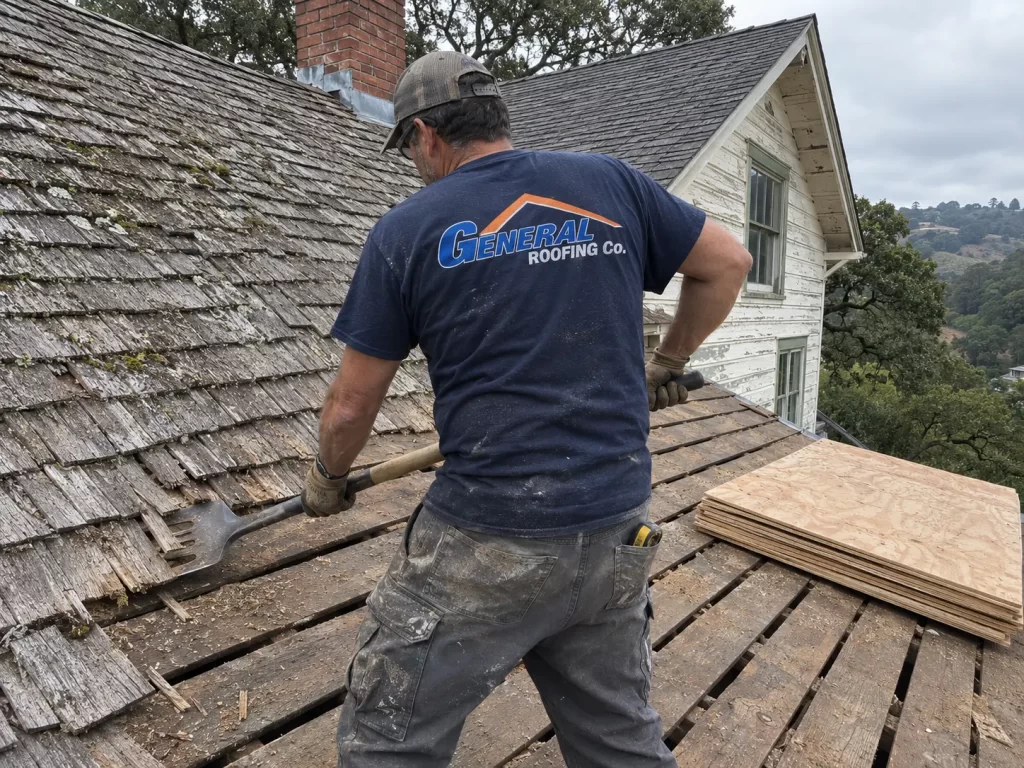
Once the shakes come off, the job usually grows. Shake roofs typically sit on skip sheathing, so the new roof needs a solid deck installed over it or in its place. Rotted rafter tails and fascia often turn up at the eaves. Edge metal, flashing and vents usually get replaced too, since the old pieces were sized for shake. Plan a contingency for wood repair, and expect a steep lot to add staging time to the price.
The framing matters as much as the look when you pick the new roof. Framing built for shake usually wasn’t designed for tile’s weight, so tile comes only after a framing check. Comp, standing seam and synthetic shake are the usual lighter choices.
Fire resistant roof maintenance
Once a year, before fire season, clean the valleys, the gutters, the backs of chimneys and skylight curbs, and every spot where the roof meets a wall. Do it more often under eucalyptus, pine or oak, and trim branches that hang over the roof.
If you have solar panels, have someone check under the array for leaves and nests. After painters or HVAC crews have been up there, check for plastic vents or unflashed holes they left behind. Our roof maintenance checklist covers the rest of the yearly routine.
Frequently asked questions
What is the most fire resistant roofing material?
Tile and metal don’t burn, and both are commonly Class A. But a Class A comp or synthetic roof installed in its listed assembly carries the same rating, so closing the ember gaps matters as much as the material.
Are asphalt shingles fire resistant?
Most modern fiberglass asphalt shingles are Class A. Older organic felt shingles usually aren’t.
Are wood shake roofs allowed in California?
Only wood roofing approved and listed by the State Fire Marshal, and in very high fire hazard zones the roof generally still has to meet Class A. Some communities restrict wood roofing further.
What does a Class A rating get me?
A roof surface that holds up to severe outside fire exposure in testing, and a roof that meets California’s fire zone requirement. It doesn’t cover embers entering through vents or gutters.
Final thoughts on fire resistant roofing
Good fire resistant roofing means two things: a real Class A assembly installed the way it was tested, and no easy way in for embers. You can’t judge either one from the street.
If you’re in the Oakland hills or anywhere else in a fire zone, our team can check what’s on your roof and the ember gaps around it, then lay out repair and roof system replacement options side by side. Request an estimate to get on the schedule.
Recent Comments