

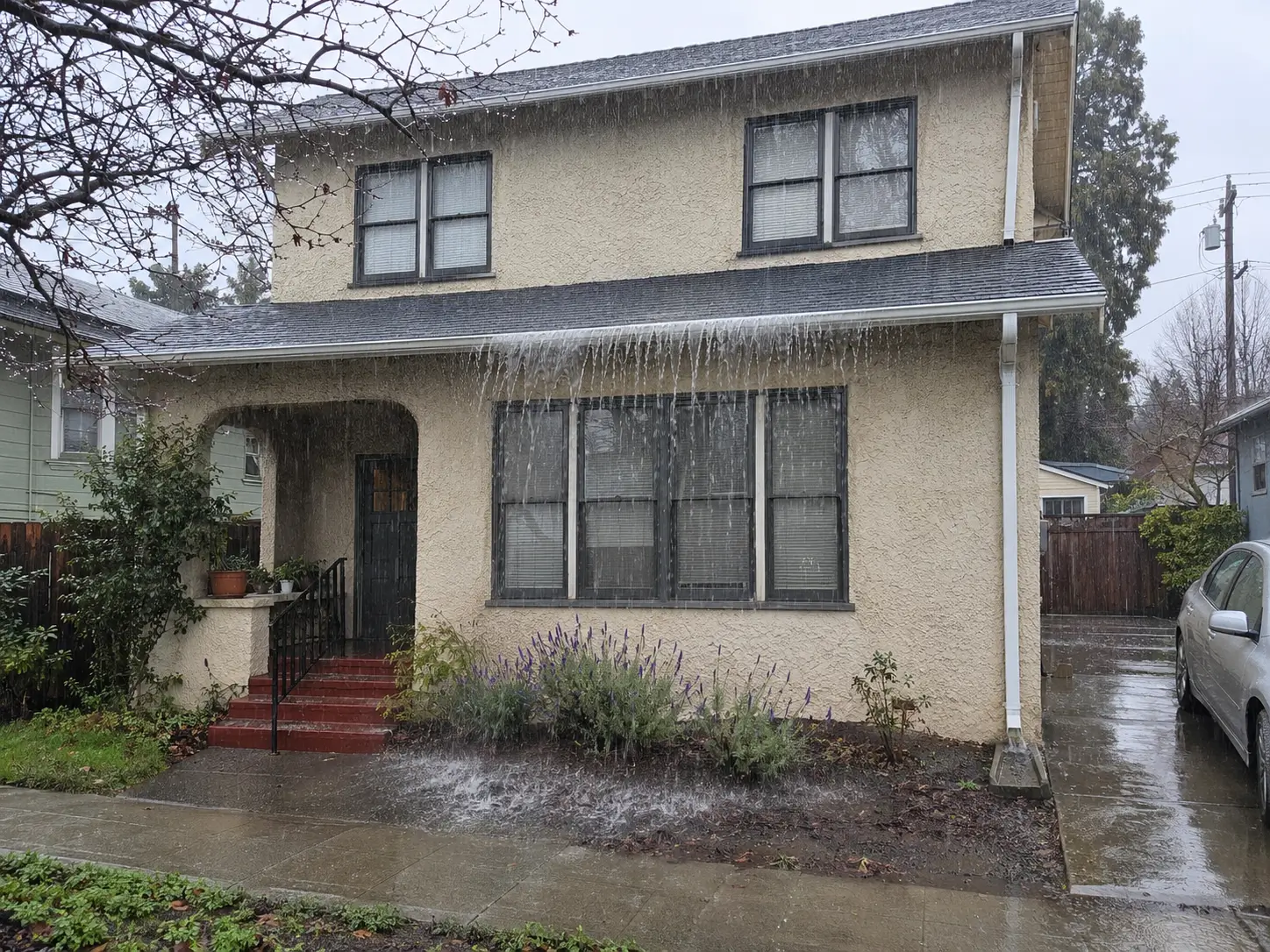
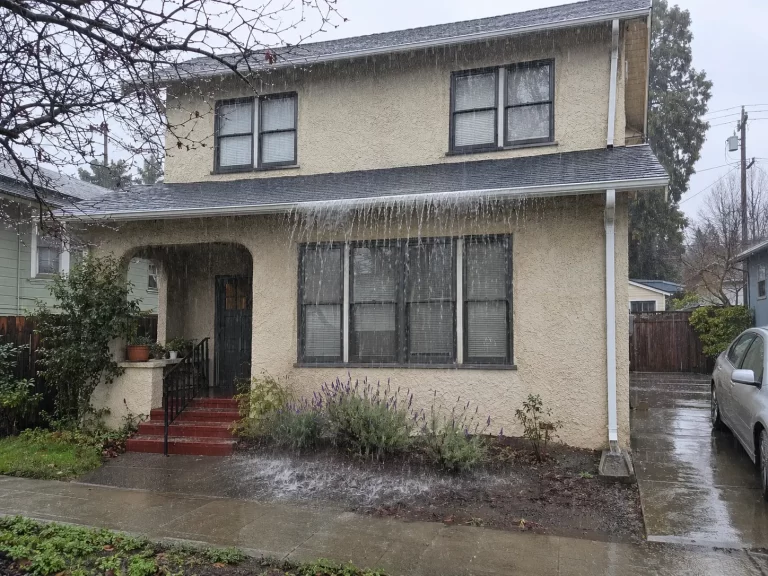
The first real storm of the season rolls in, and instead of draining down the downspout, the rain pours over the front of your gutter in a sheet. Maybe you had them cleaned last month. Maybe they spill at the same corner every year. Gutters overflowing in a storm are easy to shrug off until the fascia goes soft or a stain shows up over a window.
Where the water spills tells you a lot about why it’s spilling, and most of the fixes cost less than new gutters. We install gutters with our roof systems and look after roofs across Oakland and the rest of the Bay Area, and we’re happy to check the roof edge with you if you’d like another set of eyes on it.
Is it normal for gutters to overflow in heavy rain?
Sometimes. No house gutter is built to swallow every cloudburst, and a lot of our heaviest winter rain comes with atmospheric rivers, long plumes of Pacific moisture that can drop a great deal of rain in a short time. During the worst few minutes of a storm like that, even a clean, well-sized system can spill.
Overflow in every moderate rain is a different story. So is overflow in the same spot every time, or water that keeps coming over long after the downpour eases. Those point to something you can track down and fix.
Where the water spills tells you why
Next time it pours, grab a jacket and watch from the ground for a few minutes. A phone video helps later, for you or whoever comes out to fix it.
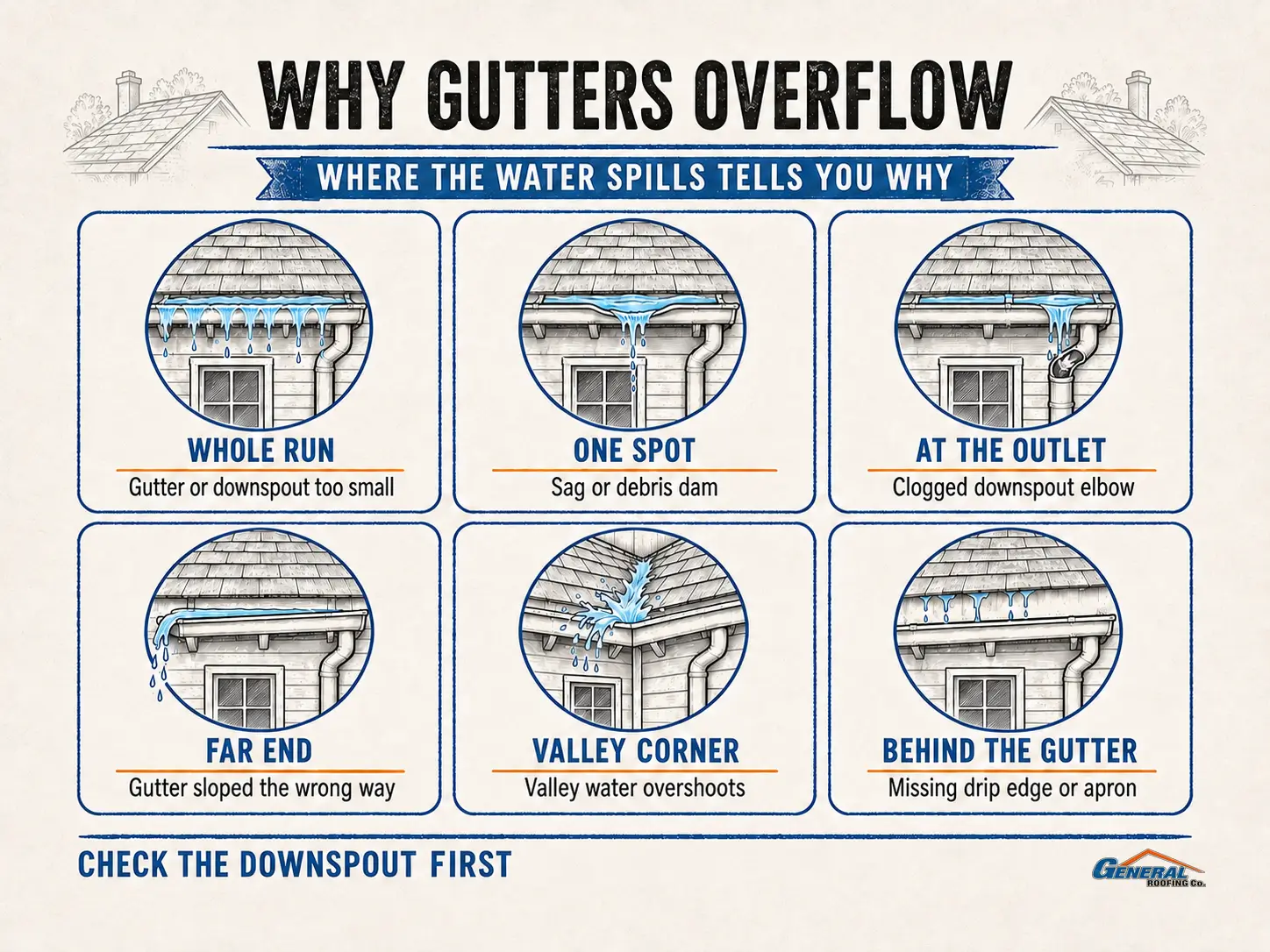
| Where it spills | Most likely cause | Quick check |
|---|---|---|
| Along the whole run, over the front lip | Gutter or downspout too small for the roof draining into it | How many downspouts serve that run, and how big are they? |
| Shooting clear over the whole gutter on a steep roof | Water coming off the roof too fast for the gutter to catch | Does it fly past the gutter rather than fill it? |
| One spot in the middle of a run | A sag or a local clump of debris | Sight down the gutter from the corner and look for a dip |
| Right over the downspout outlet | Clogged downspout, usually at the top elbow | Is water coming out the bottom? |
| The far end, away from the downspout | Gutter sloped the wrong way | Look for standing water there after the rain stops |
| An inside corner under a roof valley | Valley water shooting past the gutter | Does the water jump the corner? |
| Behind the gutter, down the fascia | Not overflow: water slipping behind the gutter | Look up at the back edge for streaks and peeling paint |
Why gutters overflow even when they’re clean
“We just had them cleaned” is one of the most common things we hear. Plenty of clean gutters still overflow, and the cause rarely has anything to do with leaves sitting in the trough.
A clogged downspout (usually the top elbow)
Downspouts clog more often than most people expect. A wad of oak leaves or redwood debris catches in the first elbow under the outlet, everything behind it packs in, and from the ground the gutter looks spotless.
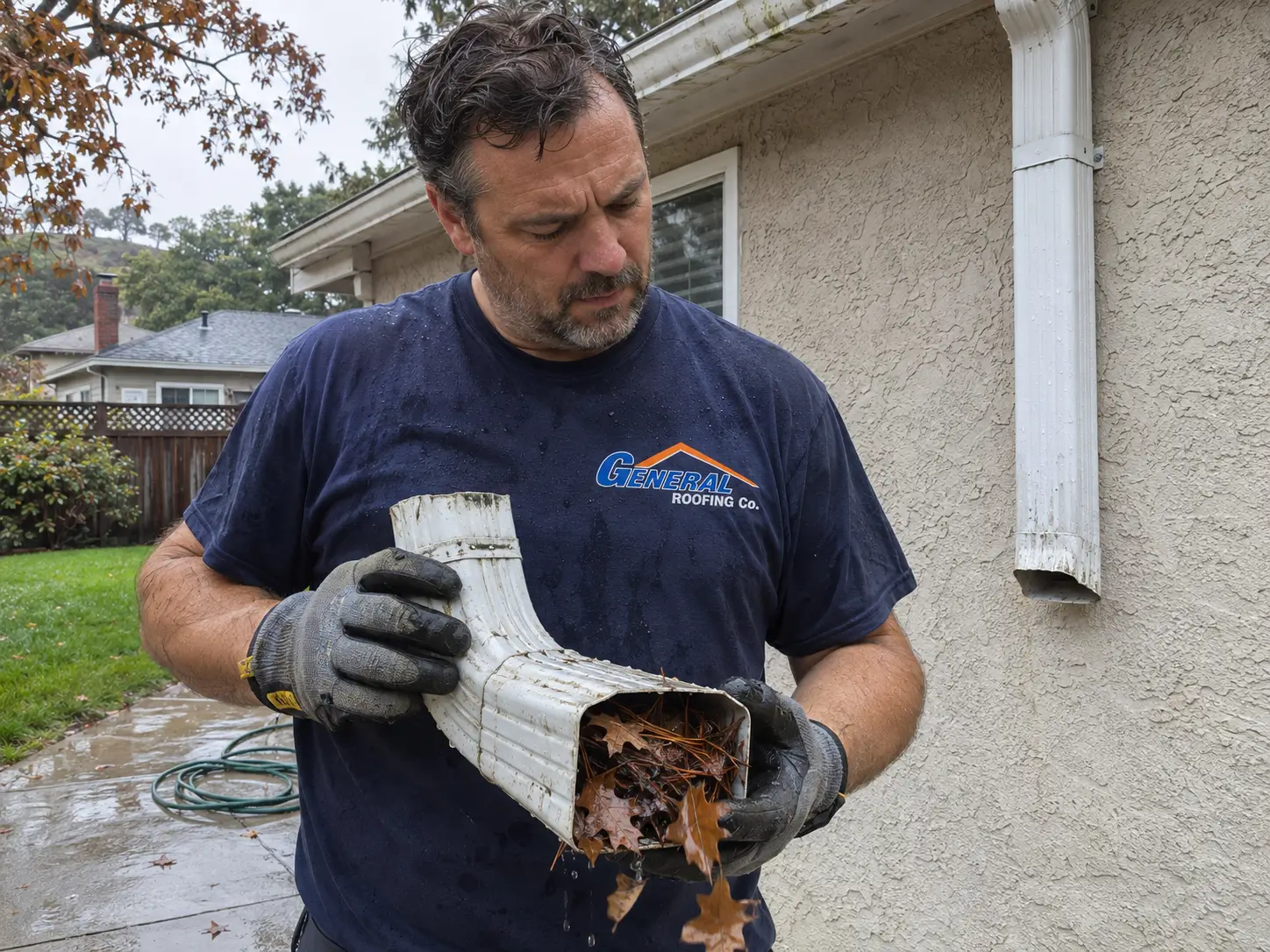
To check, run a garden hose into the far end of the gutter and watch the bottom of the downspout, or just tap the pipe: a dead, solid sound means it’s packed. Pull the bottom elbow and work the clog out from below with the hose or a plumber’s snake.
Too few downspouts, or ones that are too small
A long run draining to a single corner is a common setup on older homes, and so are small 2×3-inch downspouts. A 3×4 downspout has twice the opening (12 square inches against 6), and switching to one or adding a second downspout can do more than replacing the whole gutter.
Watch for an upper roof’s downspout emptying onto the lower roof, too. Water pounding the same strip of shingles every storm scrubs the granules off, so run it into the lower gutter instead and make sure that gutter and its downspout can take the extra water.
Gutters that lost their slope
Gutters need a slight, steady fall toward each downspout, and installers commonly aim for about a quarter inch of drop over every 10 feet. Over the years, spikes back out of drying fascia, ladders and branches bend sections down, and hillside houses shift, leaving a low spot that holds water. Sight down the gutter line from a corner and look for a dip, a gap opening between the gutter and the fascia, or one seam that always drips.
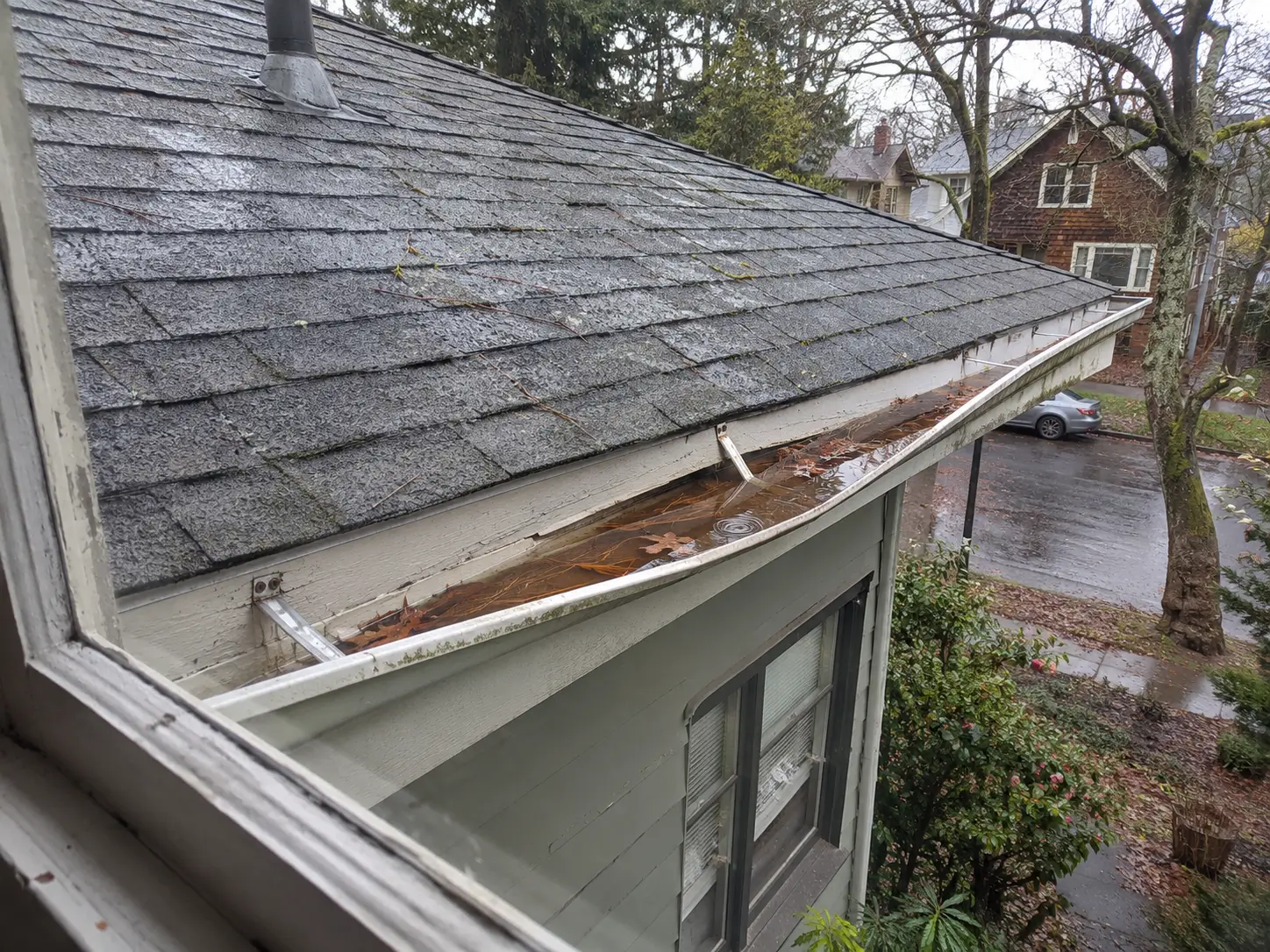
When the metal is sound and the seams are tight, re-hanging the run with screwed-in hidden hangers fixes it.
Gutters that are rusted through, crushed or leaking at several seams are better replaced, and soft fascia gets repaired before anything goes back on it.
Valley water overshooting the corner
A roof valley funnels water from two slopes into one channel, and in a hard rain it comes off fast enough to jump the gutter corner. Cleaning won’t help. A splash guard or diverter at the corner, or a downspout placed close to it, will.
The drain line you can’t see
On a lot of older East Bay and San Francisco homes, the downspouts feed a buried drain line, often old clay or early plastic pipe. Roots crack it and silt fills it, so water backs up the downspout and over the gutter while everything you can see looks fine.
Disconnect the downspout where it meets the ground pipe. If water drains freely while it’s loose and backs up once it’s reconnected, the problem is underground and calls for someone with a sewer camera. Some older homes also have downspouts tied into the sewer line, which many East Bay cities don’t allow. Emeryville, for one, requires downspouts (the city calls them roof leaders) to be disconnected from the sewer lateral. Find out where yours goes before you hook anything back up.
Gutter guards in a downpour
Guards help with big oak leaves, and fine stainless micro-mesh handles redwood and pine needles better than coarse screens. Eucalyptus bark and seed pods can mat down on top of many guards, though, and pollen can form a skin over fine mesh that heavy rain skates right across. Guards at valley corners and curved-lip guards on steep roofs are where we see the most overflow.
If you’re shopping for guards, ask how you clean the guard itself, because you still will. In fire-prone hill neighborhoods, pick metal: metal gutters hold up in a fire, while plastic ones can burn or melt and fall. Whatever guard you choose, get the downspouts and slope right first.
Box gutters on older homes
Built-in box gutters on Victorians and older Oakland homes play by different rules. When one overflows or its lining fails, the water goes into the cornice and walls rather than onto the lawn. That’s a relining job, not something to cover up with a new hung gutter.
Water behind the gutter isn’t overflow
True overflow sheets over the front lip. Water getting behind the gutter runs down the face of the fascia and onto the soffit and wall, sometimes even in a light rain. Look up from under the eave: dark streaks, peeling paint along the bottom of the fascia and drips behind the downspout give it away.
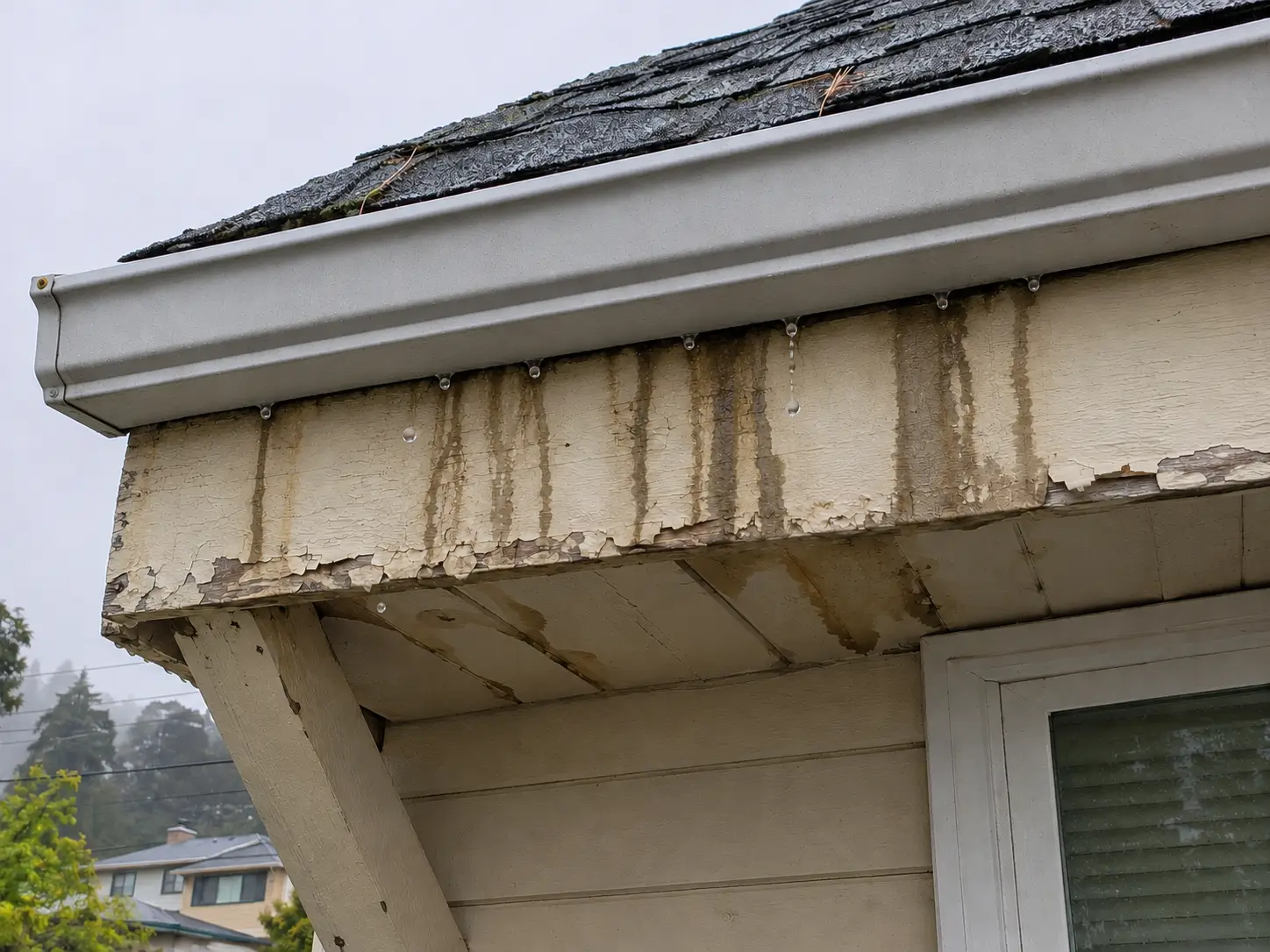
The usual causes are a missing or short drip edge, a missing gutter apron (a strip of metal that tucks under the shingles and laps into the gutter), shingles trimmed short of the roof edge, or a gutter hung so low that water falls into the gap behind it. For asphalt shingle roofs, the California Residential Code requires a drip edge at the eaves and rakes that reaches at least 1/4 inch below the roof sheathing. If that metal is missing, no amount of gutter work will stop the drips. The fix belongs at the roof edge, the same territory as roof flashing repair.
How to fix overflowing gutters, in the right order
- Clear the downspouts, top elbow first, and confirm water runs out the bottom. (From the ground, mostly.)
- Clean the gutters and outlets, including any strainer or guard choking an outlet. (Ladder work on a one-story house; a pro above that.)
- Re-hang low spots and correct the slope. (Pro.)
- Add a splash guard or diverter at valley corners. (Pro.)
- Add a downspout on long runs, or go from 2×3 to 3×4. (Pro.)
- Move up to 6-inch gutters if steps 1 through 5 don’t do it. (Pro.)
- If water is getting behind the gutter, fix the roof edge: drip edge, gutter apron and any soft fascia. (Roofer.)
If you can’t tell which of these your house needs, we can look at the roof edge and drainage together and point you to the right fix before anything gets ordered.
When overflowing gutters turn into a roof problem
Over a few wet winters, water that spills or runs behind the gutter rots the fascia and the ends of the rafter tails (rough on Craftsman homes with exposed tails) and softens the first row of roof sheathing at the eave. That damage can stay hidden until the roof is stripped, and if the wood has given out, our guide to roof deck repair walks through the options.
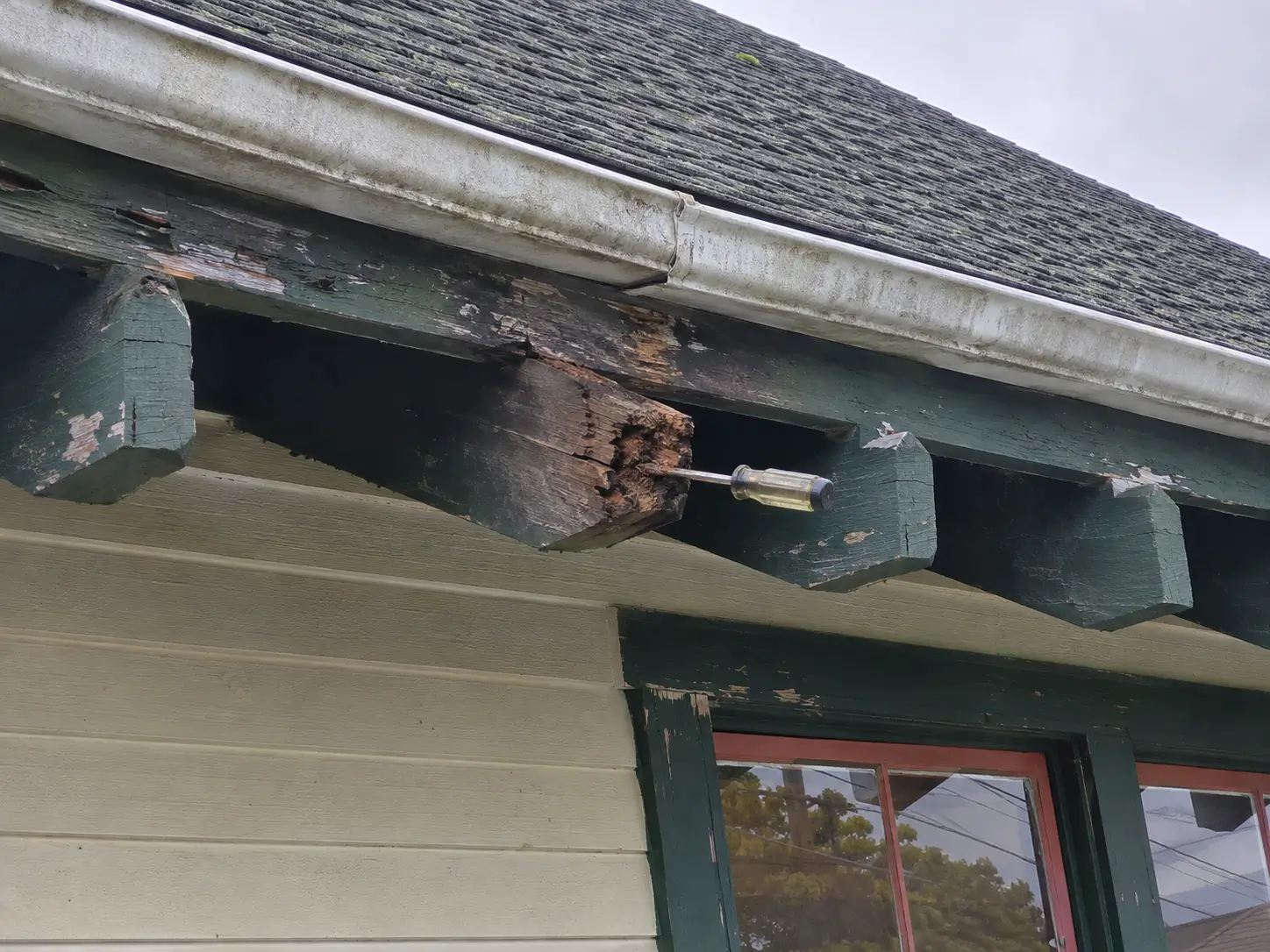
It’s turned into a roofing job when you see any of these:
- A screwdriver sinks into the fascia or a rafter tail.
- Stains show up at the top of an exterior wall or over a window.
- The shingle edge along the eave feels soft or sags.
- Heavy granules show up in the gutters of an older roof, which can mean the shingles are wearing out. Our post on roof granule loss explains what’s normal and what isn’t.
Spilled water also lands right against the house, so carry downspout water well away from the foundation with an extension or splash block. On expansive or collapsible soils, the California Residential Code wants roof water discharged at least 5 feet from foundation walls or into an approved drainage system.
What you can safely do before the next storm
Most of the checks above happen from the ground: filming the spill, watching the bottom of each downspout, clearing splash blocks and ground-level cleanouts, testing the drain line.
If you clean gutters yourself, stick to a one-story house on a dry day and follow OSHA’s ladder basics:
- Set the base out from the wall a quarter of the ladder’s working length.
- Keep three points of contact.
- Use it only on stable, level ground, and never lean it on the gutter.
- Check for overhead power lines before you raise it.
Leave two-story houses, steep lots and anything that means walking the roof to a pro, and never walk on a wet, mossy or tile roof.
Frequently asked questions
Why is my gutter full of water?
Standing water after the rain stops means the gutter can’t drain to its downspout. The downspout may be clogged, the gutter may have a low spot, or the run may slope away from the outlet. Check the downspout first, then sight along the gutter for a sag.
How much slope should gutters have?
Enough to keep water moving toward the downspout without the tilt showing from the street, about a quarter inch of drop per 10 feet. On very long runs, a downspout at each end with the gutter sloping both ways from the middle keeps the drop from getting too steep.
Should I get 5-inch or 6-inch gutters?
A standard 5-inch K-style gutter (the common flat-front profile) handles most simple, single-story roofs. Six-inch gutters, usually paired with 3×4 downspouts, make sense for steep or large roofs, long runs, corners under valleys and lower gutters that take an upper roof’s water.
Do gutter guards stop gutters from overflowing?
They cut down on clogs, but they won’t fix undersized gutters, bad slope or a blocked drain line, and some designs shed water over the front in a heavy rain. They still need cleaning.
Can overflowing gutters cause a roof leak?
Yes. Clogged gutters are one of the common leak causes we run into: water backs up at the eave and can work its way into the roof edge, walls and window frames.
Final thoughts on gutters overflowing
Film the next storm and check the bottom of every downspout, and you’ll know which section above applies to you. Gutters overflowing in every storm usually trace back to something fixable, and the cheap checks come first.
When the roof itself is due, we install new gutters with it as part of our roofing accessories: seamless aluminum rolled right on site (or seamed where a run is too long), plus galvanized and copper profiles. Our roof maintenance programs include cleaning gutters and flushing downspouts. Request an estimate and we’ll set up a time to take a look.
Recent Comments