

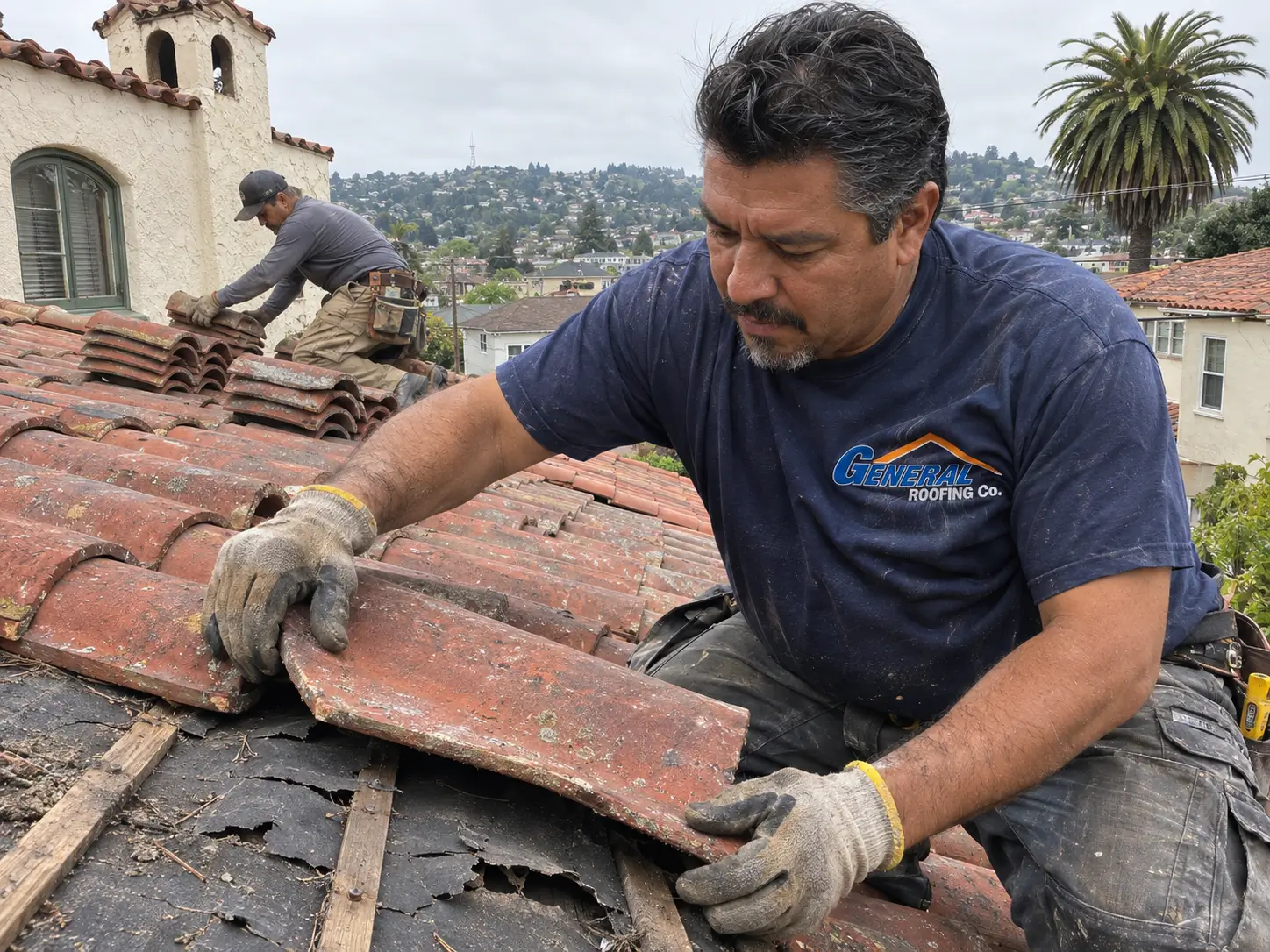
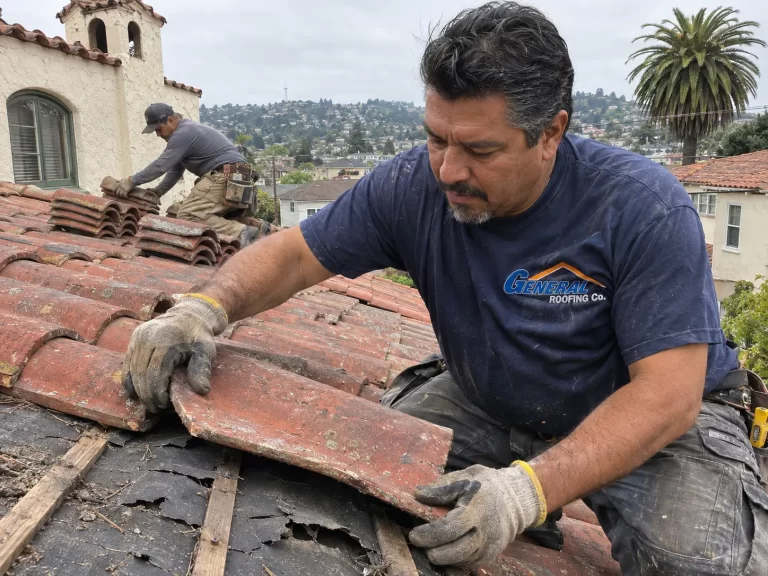
Tile roofs have a reputation for lasting forever, and the tiles themselves often come close. The weak spot is the layer you never see. Tile roof underlayment sits on the deck under the tile and does most of the waterproofing, and on a lot of older homes it gives out decades before the tile does. That’s how you end up with a ceiling stain under a roof that looks perfect from the street.
Worn-out underlayment often doesn’t mean you need new tile, though. Usually the tiles come off, everything under them gets replaced, and the same tiles go back on. We install and replace tile roof systems in Oakland and elsewhere in the Bay Area, and we’re happy to come take a look if your tile roof has started leaking.
What does tile roof underlayment actually do?
Tile sheds water, but it doesn’t seal it out. Wind pushes rain under the edges, water wicks through the overlaps, and some of it usually reaches the deck. The underlayment catches that water and carries it down and off at the eave. On a tile roof, it’s the layer keeping your house dry, while the tile mostly shields it from sun and weather. The 2025 California Residential Code requires one under clay and concrete tile for exactly that reason.
Why underlayment wears out long before the tile
It’s hot and dark under tile. The underlayment gets soaked and dried out every winter, and each nail and batten fastener punches a hole through it. Asphalt felt slowly loses the oils that keep it flexible, then turns brittle and cracks, one of the failure modes in InterNACHI’s guide to underlayment types. Flat battens (the wood strips the tiles hang on) nailed straight to the deck can hold water against the felt and rot it where the sheets overlap.
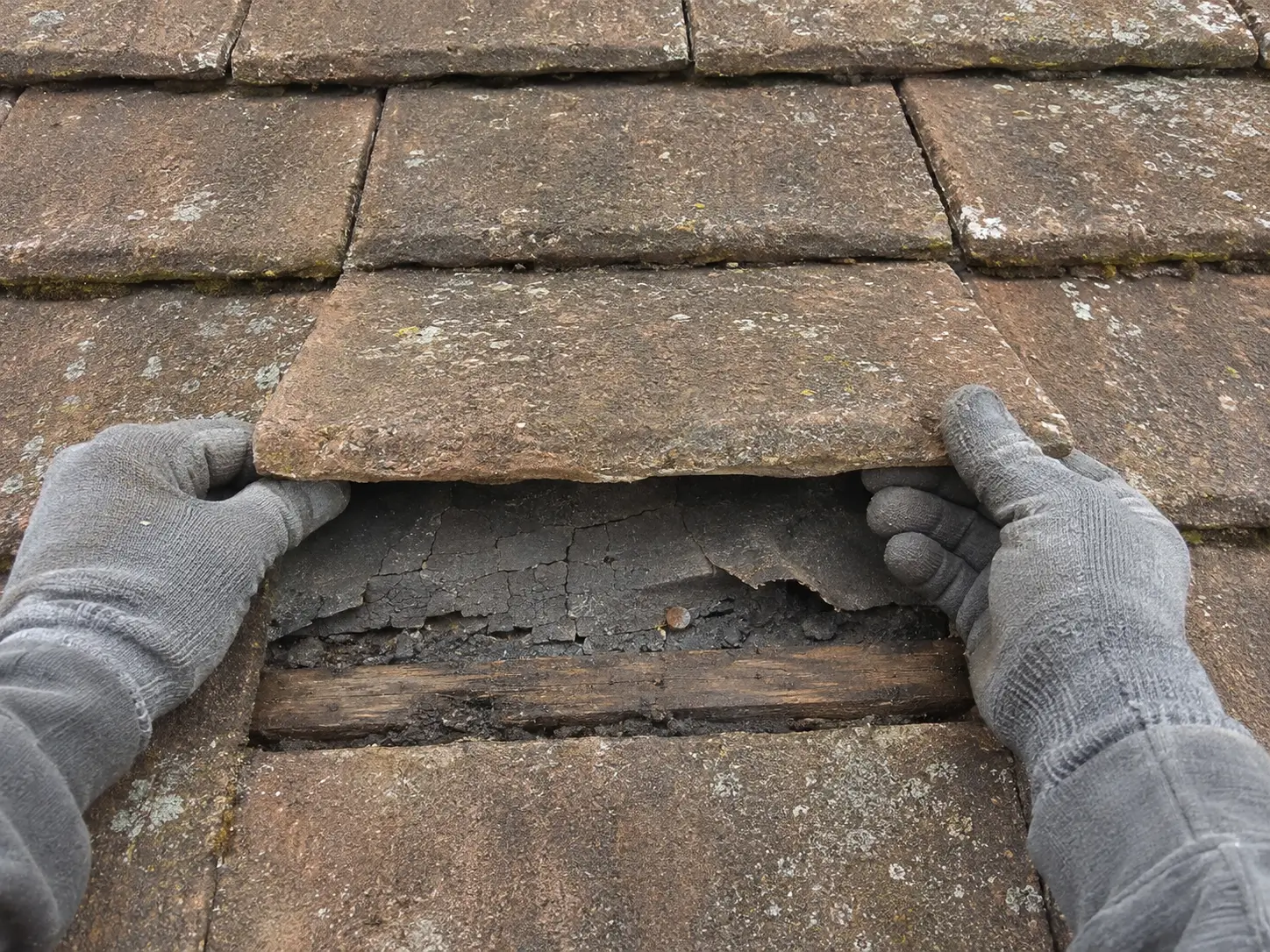
The tile, meanwhile, can shrug off the same conditions for a very long time. InterNACHI’s life-expectancy chart lists clay and concrete roofs at 100-plus years. So a tile roof that still looks great from the street can be sitting on felt that’s finished.
Under the tile on older East Bay houses, we often find felt that snaps like a cracker, worn through along the eaves and batten lines, with rusted nails and soft battens. Some older Spanish-style homes have a single ply of felt over spaced board sheathing (boards with gaps instead of solid plywood), which never left much margin.
Signs your tile roof underlayment is failing
Water that gets past the tile is supposed to ride the underlayment down to the eave. When that layer fails, stains tend to show up low on the slope and near exterior walls, often in more than one place, and they get worse after long, soaking storms.
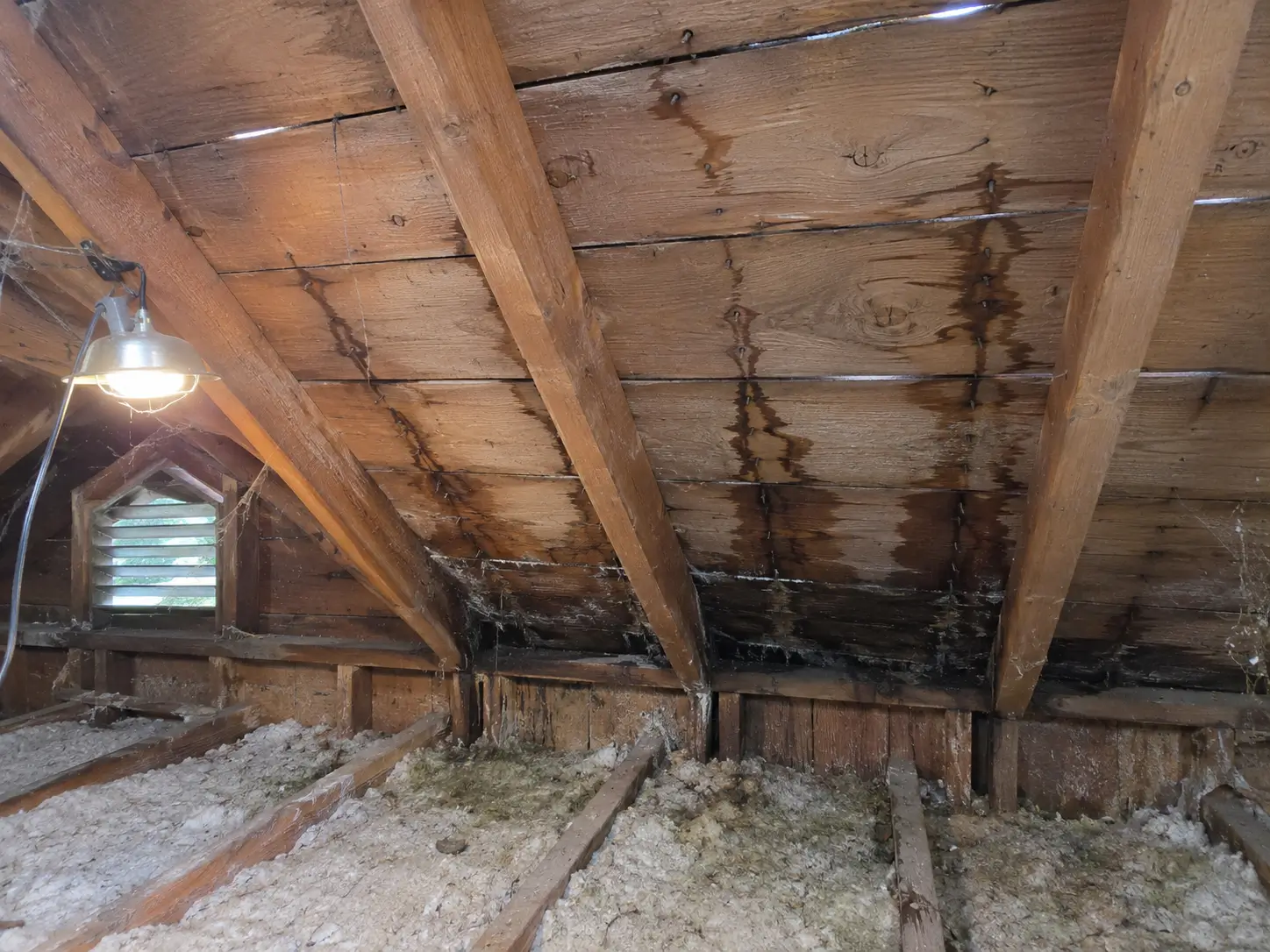
A single stain right below a chimney, skylight, valley or sidewall points somewhere else first. Those are flashing spots, and our guide to roof flashing repair covers what goes wrong there.
You can check a few things yourself from inside:
- Ceiling stains near outside walls, or in several rooms on the same slope
- Attic stains that run along nail lines or batten lines, or damp wood along the eaves
- Pinpoints of daylight through spaced boards, which means the felt over them has torn or worn through
- Leaks that come back after cracked tiles have already been replaced
Up top, the surest check is having a roofer lift a few tiles above the stain. If the felt crumbles when it’s touched, you have your answer. If not, a controlled water test worked up the slope beats guessing, and our guide on how to find a roof leak covers the basics. Please don’t walk the tile yourself. It cracks easily underfoot.
Which underlayment is best for a tile roof?
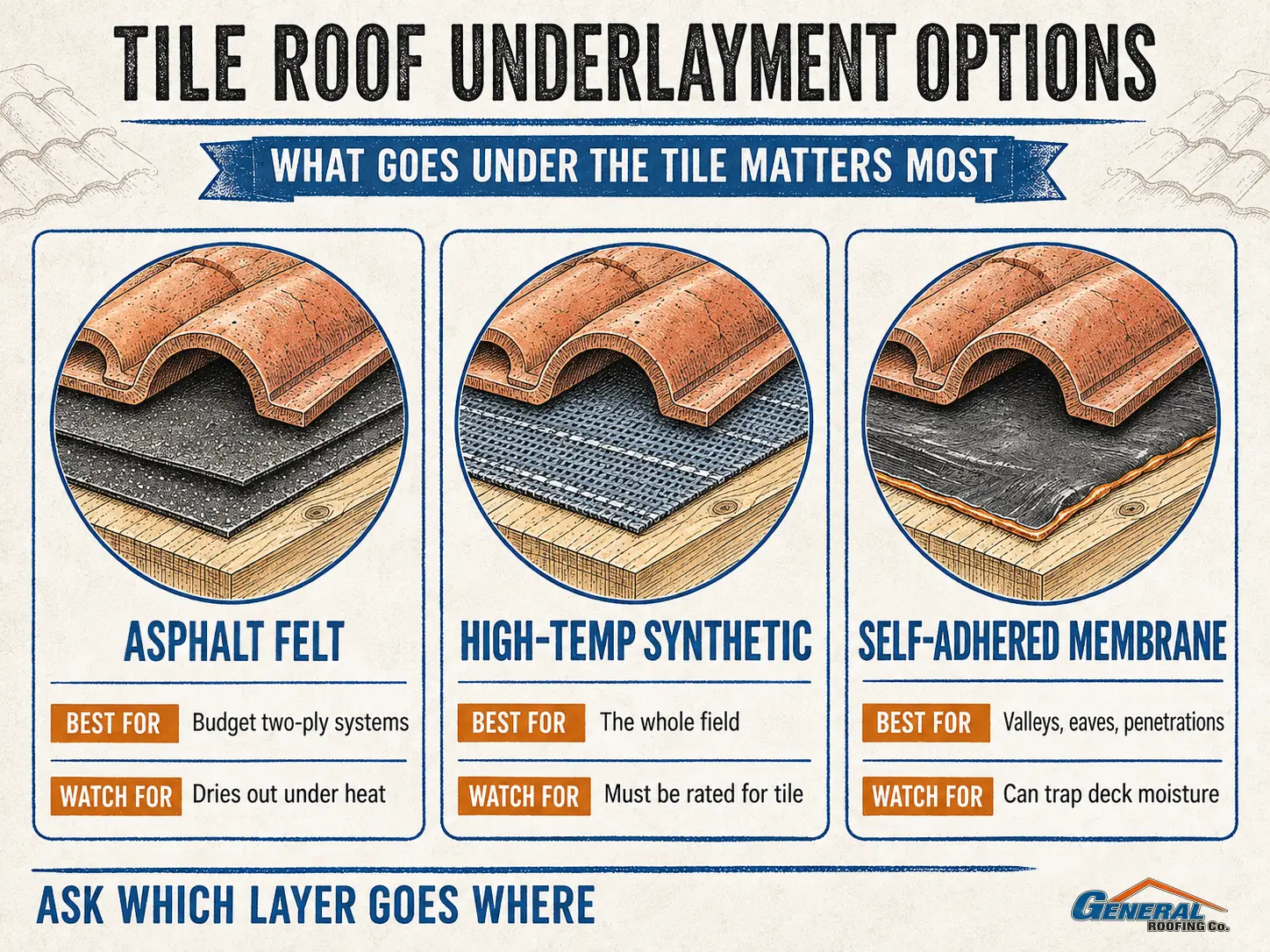
| Type | What it is | Where it fits | Watch out for |
|---|---|---|---|
| Asphalt felt (two plies) | Traditional felt, organic or fiberglass mat | Budget jobs; meets the double-layer rule on lower slopes | Heat and age dry it out, so it’s usually the shortest-lived choice under tile |
| High-temperature synthetic | Polymer sheet built for heat | The whole field of the roof | Make sure the product is rated for use under tile |
| Self-adhered membrane | Peel-and-stick modified bitumen, such as Westlake Royal’s TileSeal HT | Problem spots, or the full deck | Costs more and is hard to remove later |
On Bay Area homes, our usual approach is a tile-rated high-temperature synthetic or a solid two-ply system over the field, plus self-adhered membrane in the valleys, at the eaves, around penetrations and on any low-slope sections. We’re cautious about full-deck peel-and-stick on older houses with weak attic ventilation, since a damp marine climate can trap moisture against the sheathing. On windy hillsides, we pay extra attention to fastening and overlaps.
What a tile roof underlayment replacement involves
Roofers call this a lift and relay, or remove and reset. Get the paperwork in place before anything comes off. In Oakland, re-roofing work is certified through the city’s Re-Roofing Certificate, filed by the owner or a licensed contractor in the Online Permit Center. Other cities have their own rules, and our estimators work with the city on code compliance. Then the job runs roughly like this:
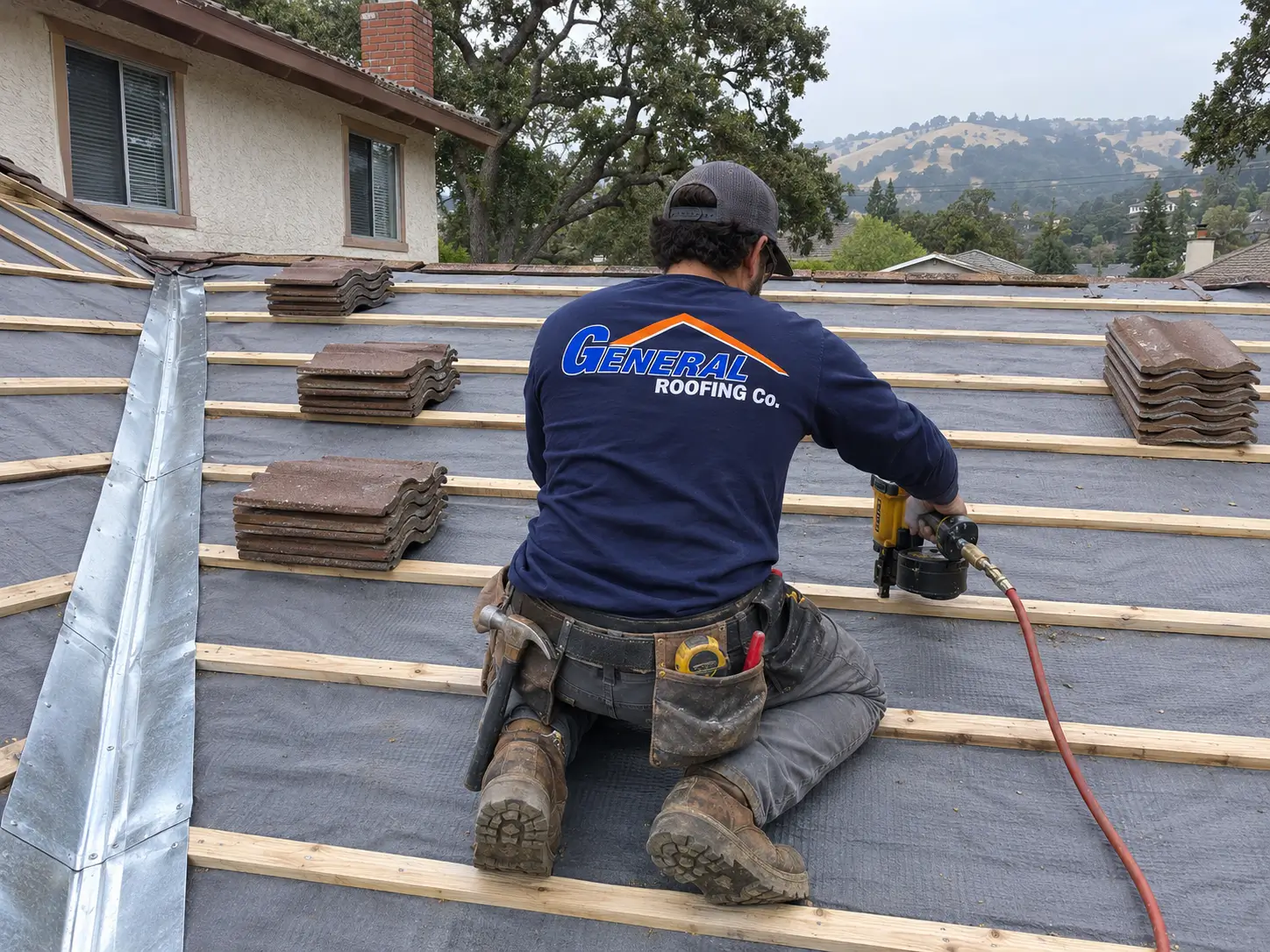
- Hip and ridge pieces come off first, then the field tile from the top down, stacked and sorted by slope.
- Old felt, battens and flashings are torn off so the crew can see the deck. Rotted boards get replaced. In most of the Bay Area, code calls for solid sheathing under tile, so spaced boards usually get covered with structural panels.
- New drip edge and underlayment go down. On slopes between 2½ and 4 inches of rise per foot, California code requires a double layer of underlayment.
- New valley metal, wall and chimney flashings, pipe flashings and battens go in.
- Eave closures or bird stop (the pieces that block the open ends of the tile at the eave) go in, the tile goes back on with new corrosion-resistant fasteners, and the hips and ridge are finished last.
California’s reroofing rules don’t allow cracked or broken tile to go back on, and rusted, damaged or deteriorated flashings, edgings and vents have to be replaced. We’d swap the old metal anyway, because nobody gets under that tile cheaply again. Expect some breakage, especially with old clay or brittle concrete, and line up matching replacement tile before the job starts.
Spot repair, underlayment replacement or a new tile roof?
If the leak is local and the felt a few feet away is still flexible, a spot repair or relaying one section can make sense.
If the felt is brittle everywhere, patching just moves the leak around.
Clay tile is usually worth saving. It’s durable, costly to replace and often hard to match. Older concrete tile is a closer call. If tiles snap when they’re handled or crumble at the nail holes, the breakage and labor of a relay can make new tile the better deal.
Discontinued profiles are the other wild card. Salvage tile, or tiles borrowed from a garage or back slope, can fill gaps. If there still isn’t enough, a full tile roof replacement or a different material moves onto the table, and our roof repair vs. replacement guide covers that bigger decision.
Leaking right now, in the middle of the rainy season? A temporary repair can usually get you through the storms while the permanent work is planned. When a relay does happen in winter, crews open only what they can dry in the same day.
If you can’t tell which of these your roof needs, request an estimate. Every job we take on starts with an assessment of the tile, deck, flashings and drainage, and we’ll walk you through each option.
What drives tile roof underlayment replacement cost
Ask for a contract that lists unit prices for extra sheathing and replacement tile up front, so a surprise under the tile doesn’t turn into an argument mid-job. Beyond that, every tile gets handled twice, so labor is a big share of the bill. These factors move it most:
| Factor | Why it matters |
|---|---|
| Roof size, pitch and access | More area, steeper slopes, extra stories and hillside lots mean more labor and staging |
| Hips, valleys and penetrations | Each one needs new metal and careful tile cutting |
| Tile type | Mortar-set clay takes longer to remove and reset than nailed concrete |
| Deck condition | Rotted or spaced sheathing adds wood and labor |
| Replacement tile and solar | Broken or discontinued tile means hunting for salvage, and solar panels have to come off and go back on, which owners arrange with their solar company |
Habits that shorten underlayment life
A lot of the cracked tile we find traces back to someone walking on it. Painters, cable installers and owners cleaning gutters crack tiles, and a cracked tile sends water straight onto aging felt. If someone has to walk the roof, they should step on the lower part of each tile, where it overlaps the one below, rather than the middle.
High-pressure washing can damage tile and push water where it shouldn’t go. Sealers and coatings change how tile looks but do nothing for the underlayment. Clean the valleys and gutters every fall, since packed leaves back water up over the valley metal. And if you’re buying a house with an original tile roof, ask for an inspection that looks under the tile, not just at it.
Solar deserves its own warning. If your tile roof still has its original underlayment, replace it before panels go on. Pulling an array later to chase a leak costs far more than doing the roof first.
Frequently asked questions
How long does tile roof underlayment last?
Not nearly as long as the tile. Felt usually wears out decades sooner, while modern high-temperature and self-adhered products are built for a longer run. If your decades-old roof still has its original felt and leaks in more than one spot, assume the underlayment is near the end, even if the tile looks fine.
What is the best underlayment for a tile roof?
For most Bay Area homes, a tile-rated high-temperature synthetic or two-ply system over the field, with self-adhered membrane in the valleys, at the eaves and around penetrations, because those are the spots where water concentrates and fasteners crowd together.
What goes underneath tiles on a roof?
From the bottom up: the roof deck, the underlayment, often wood battens, flashing metal at valleys, walls and penetrations, and then the tile. Eave closures fill the open space at the bottom edge.
Can you replace tile roof underlayment without buying new tiles?
Usually, yes. Cracked or broken tiles can’t be reinstalled under California’s reroofing rules, though, so plan on buying some replacement tile.
Do you need a permit to replace the underlayment on a tile roof?
California’s code treats reinstalling tile as part of reroofing, so check with your city before work starts. In Oakland, most re-roofs go through a Re-Roofing Certificate in the city’s Online Permit Center, and the city can tell you if your scope needs a full building permit instead. Homes in the hills may also fall under extra wildfire rules for the roof.
Final thoughts on tile roof underlayment
If your tile roof still has its original felt, the next long storm will find the weak spots before you do. Get someone to look under the tile before you approve another patch or a whole new roof.
If you’re in Oakland or anywhere in the Bay Area, we can diagnose the leak and handle the repair, or take on a full tile roof replacement as a factory-authorized installer for Boral tile. When you want a second opinion, send us your project details.
Recent Comments