
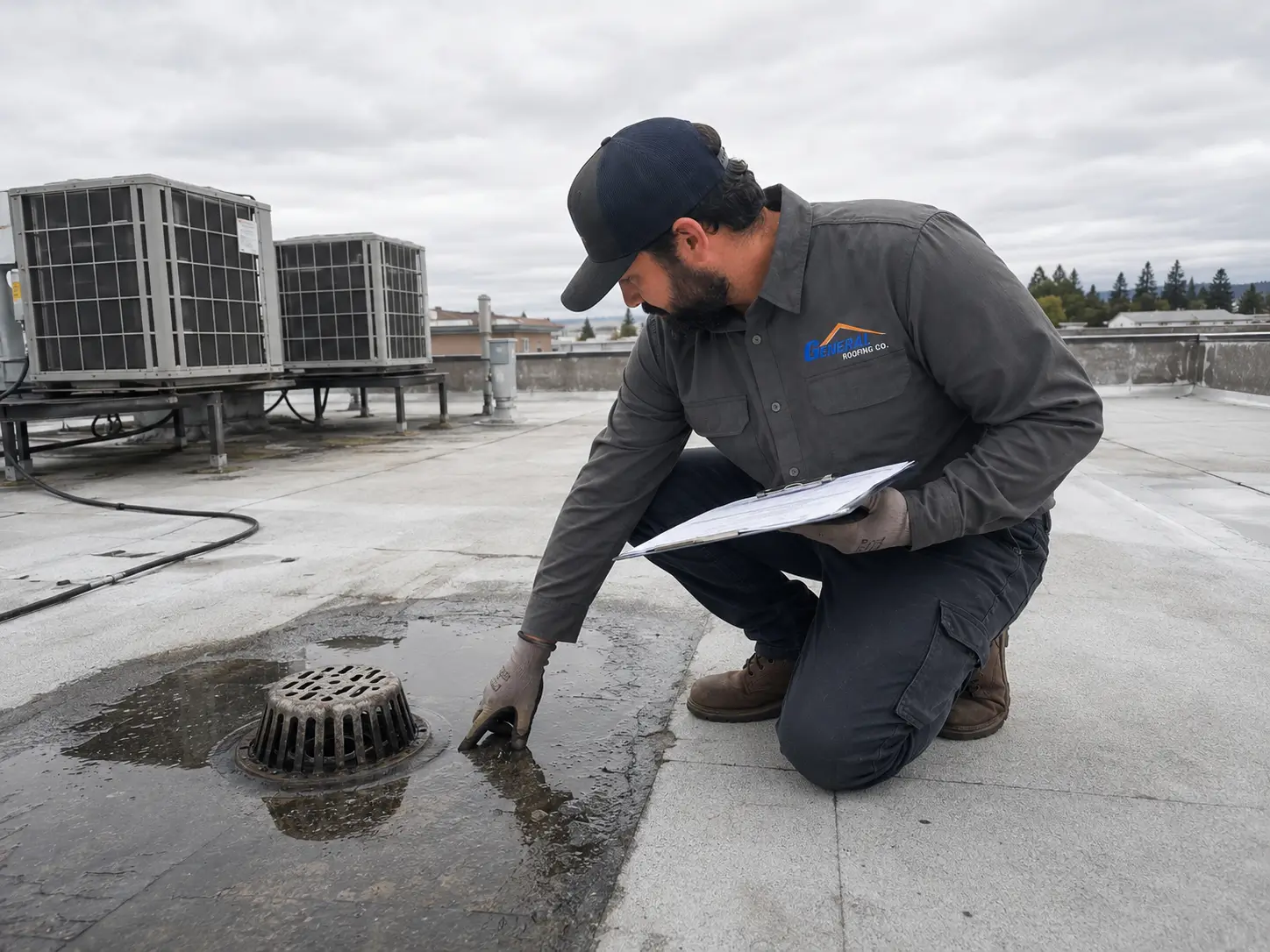
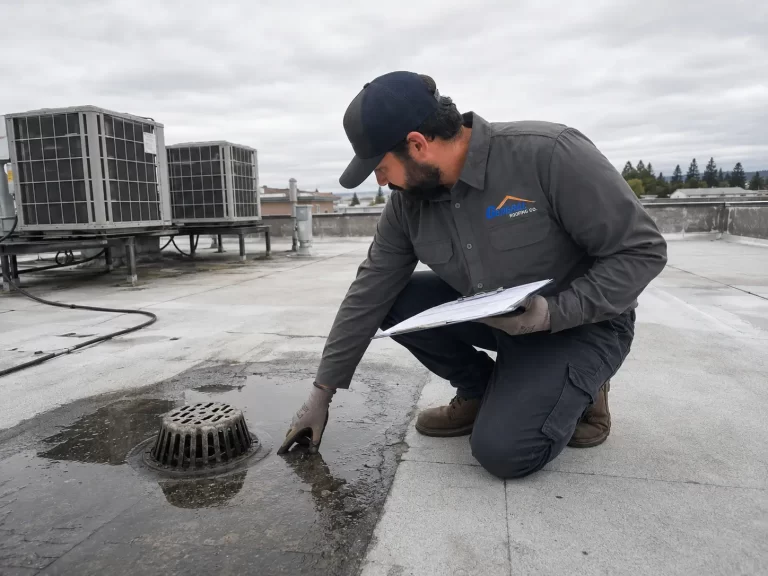
A commercial roof inspection is one of those things that feels easy to push off until the roof starts making noise for you. Usually that noise is water dripping into a tenant space, a stain spreading across ceiling tile, or someone calling because the back corner of the building smells damp after a storm.
A good inspection helps you catch the boring stuff early: clogged drains, open seams, cracked sealant, loose flashing, punctured membrane, ponding water, and old repairs that are starting to fail. Boring is good here. Boring is cheaper than emergency leak work.
What is a commercial roof inspection?
A commercial roof inspection is a professional review of the roof system on a commercial, industrial, multifamily, or mixed-use building.
The inspector looks at the roof surface, drainage, flashing, penetrations, rooftop equipment, previous repairs, roof edges, interior leak signs, and the general condition of the system.
For flat and low-slope roofs, this matters a lot. Water does not run off the same way it does on a steep roof. If a drain is clogged or a low spot keeps holding water, the roof can quietly get worse for months before anyone inside notices.
For existing leaks or recurring problem areas, our repair and maintenance services are focused on finding the actual roof issue, not just patching the stain location and hoping for the best.
How often should a commercial roof be inspected?
A commercial roof should usually be inspected at least twice a year, once in spring and once in fall. You should also schedule an inspection after major storms, high winds, heavy rain, rooftop HVAC work, solar work, or any leak report.
The National Roofing Contractors Association has long recommended biannual roof inspections, and ASHI’s summary of NRCA roof inspection guidance notes that inspections help catch loose seams, deteriorated flashing, and indoor signs of roof damage before the problem becomes obvious.
For Bay Area buildings, fall inspections are especially useful. You want drains clear, flashings checked, and small repairs handled before the wettest stretch of the year.
Commercial roof inspection checklist
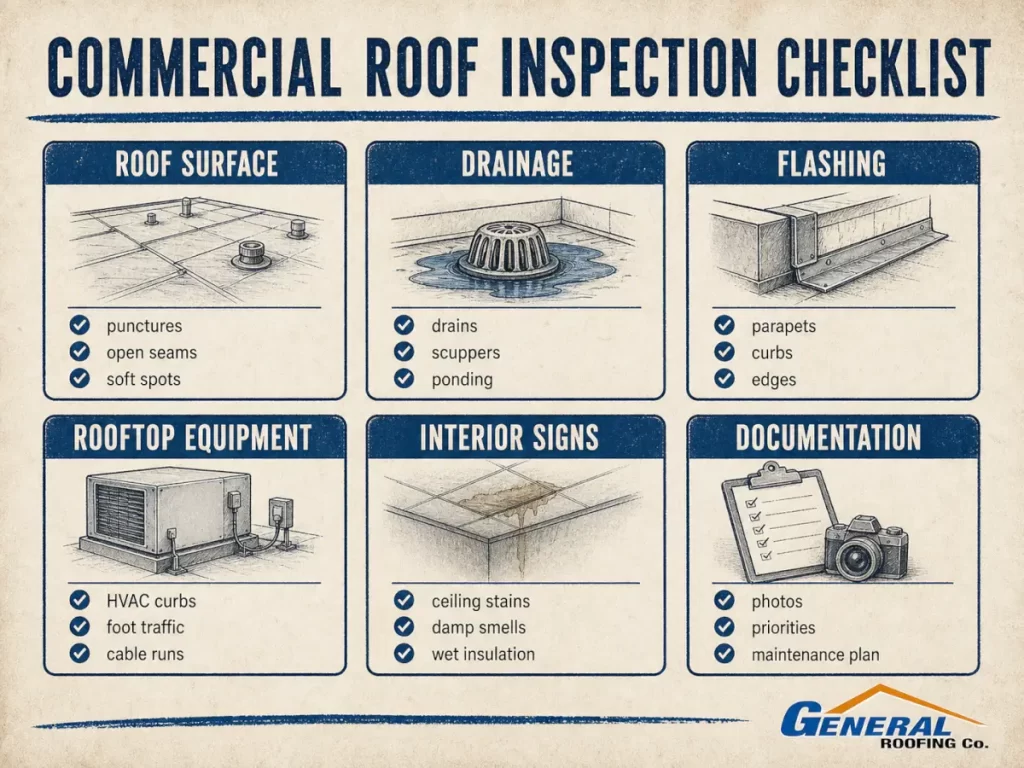
A real commercial roof inspection checklist should cover the full roof, not just the place where water showed up inside. Leaks travel. The ceiling stain is not always directly below the roof opening.
| Inspection area | What gets checked |
|---|---|
| Roof surface | Cracks, punctures, open seams, blisters, worn coating, loose material, soft spots |
| Drainage | Roof drains, scuppers, gutters, downspouts, debris, ponding water |
| Flashing | Parapet walls, curbs, skylights, vents, pipes, edge metal, wall transitions |
| Rooftop equipment | HVAC curbs, service panels, duct supports, cable runs, grease exposure, foot traffic damage |
| Interior signs | Ceiling stains, damp smells, peeling paint, wet insulation concerns, recurring leak areas |
| Old repairs | Failed sealant, patches, coated areas, areas that keep reopening |
| Roof access | Hatch condition, ladder access, walking paths, safety concerns |
| Documentation | Photos, notes, repair priorities, maintenance recommendations |
If the roof has been patched again and again, the inspection should also answer a bigger question: are repairs still worth it? Our guide on roof repair vs. replacement breaks down that decision in plain terms.
What does a roof inspection include?
A roof inspection includes the roof surface, seams, flashing, drains, gutters, penetrations, rooftop equipment, roof edges, previous repairs, and interior signs of water entry.
For commercial buildings, it may also include photos, a written condition report, repair recommendations, maintenance planning, and replacement budgeting. If the roof has repeated leaks or suspected wet insulation, the inspection may include moisture testing or infrared scanning.
City inspections are different from contractor inspections. A city inspector is usually checking code-related items during permitted work. For example, Hayward’s reroofing requirements say the first inspection is a “pre-roof” inspection where the inspector checks for dry rot, damaged sheathing, flashing, and underlayment placement.
A roofing contractor’s inspection is more about roof condition, leak risk, repair needs, maintenance planning, and whether the system still has useful life left.
What to expect during a commercial flat roof inspection
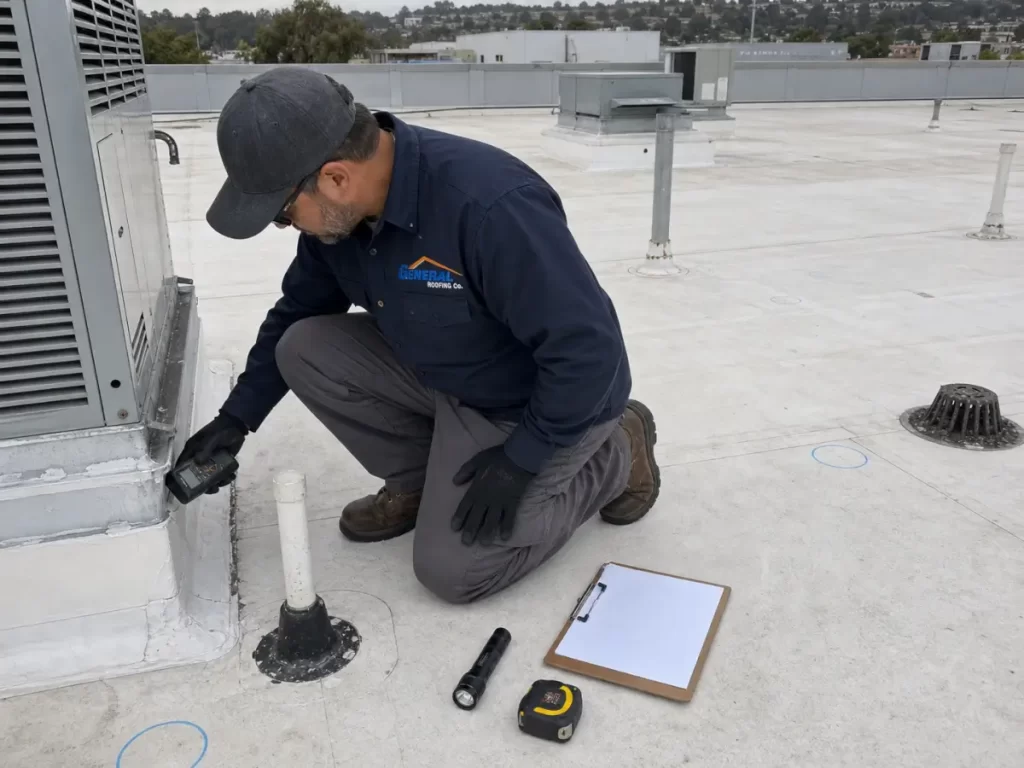
A commercial flat roof inspection usually starts with roof access and leak history.
The inspector will want to know where water has shown up, when it happens, what repairs have already been done, and whether anyone has recently worked on the roof. HVAC techs, solar crews, plumbers, electricians, and sign installers can all leave behind damage without realizing it.
Once on the roof, the inspector usually checks the roof in sections. On a flat roof, the biggest trouble spots are usually:
- drains and scuppers
- ponding areas
- seams and laps
- parapet walls
- flashing
- pipe penetrations
- skylights
- HVAC curbs
- roof edges
- old patches
- areas with heavy foot traffic
A commercial flat roof inspection may also include a written report. That is especially helpful if you manage multiple properties, need repair budgeting, are preparing for a sale, or want a record for ownership, tenants, or insurance.
Commercial roof inspection cost
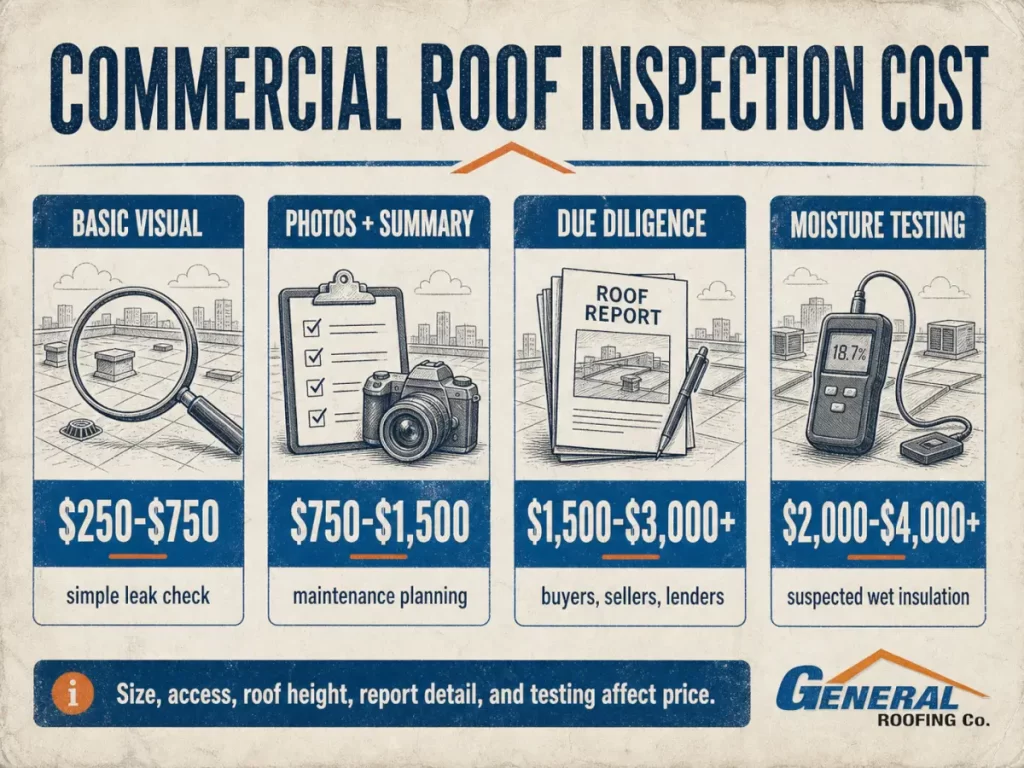
Commercial roof inspection cost depends on roof size, roof height, access, slope, roof type, report detail, travel time, safety requirements, and whether specialty testing is needed.
For planning purposes, many commercial property owners can expect a basic paid inspection to land somewhere around $250 to $750. A more detailed inspection with photos and a written report often falls around $750 to $1,500. Large buildings, multi-building properties, due diligence reports, moisture scans, or infrared testing can run $1,500 to $4,000 or more.
| Inspection type | Typical planning range | Best for |
|---|---|---|
| Basic visual roof inspection | $250 to $750 | Smaller buildings, simple leak checks, general condition review |
| Standard commercial inspection with photos | $750 to $1,500 | Property managers, maintenance planning, repair budgeting |
| Detailed report or due diligence inspection | $1,500 to $3,000+ | Buyers, sellers, lenders, larger buildings |
| Inspection with moisture scan or specialty testing | $2,000 to $4,000+ | Older flat roofs, repeated leaks, suspected wet insulation |
Free inspections may be available when you are requesting repair or replacement pricing, but make sure you know what “free inspection” means. A quick visual check is not the same as a detailed written roof condition report.
If the inspection shows the roof is getting close to replacement, our commercial roof replacement cost guide can help with early budgeting.
Bay Area commercial roof inspection cost
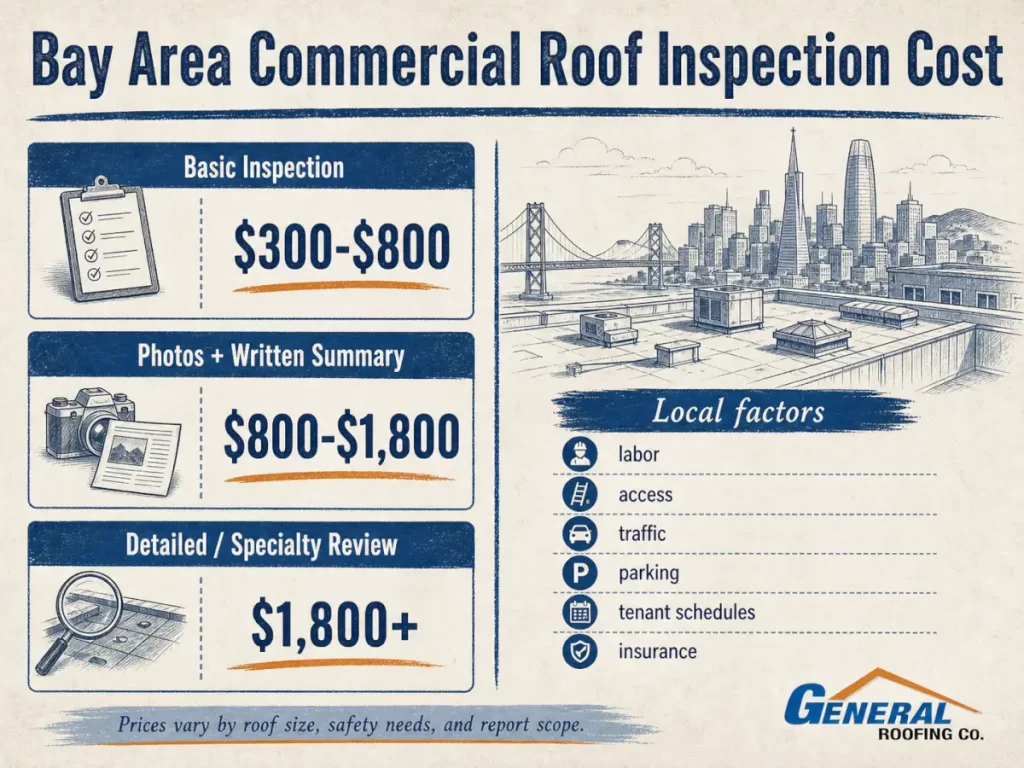
In the Bay Area, commercial roof inspection pricing usually leans higher than the national average. A basic commercial roof inspection may start around $300 to $800, while a standard inspection with photos and a written summary often runs $800 to $1,800. More detailed work can go higher.
That is not because the roof is magically different here. It is because Bay Area work often comes with higher labor costs, tighter access, traffic, parking issues, older buildings, complicated tenant schedules, and more expensive insurance and operating costs.
The local cost environment matters. The U.S. Bureau of Labor Statistics reported that the San Francisco-Oakland-Hayward CPI-U was up 3.8% year over year in April 2026, and BLS also publishes current wage data through its Occupational Employment and Wage Statistics tables. Those costs do not set roof inspection prices by themselves, but they do help explain why Bay Area service work often costs more than the same work in lower-cost markets.
Local rules can also affect the scope of roof work after an inspection. Hayward’s reroofing requirements say a permit is required when more than 200 square feet of roof covering is installed, repaired, or replaced. The same document says safe roof access must be provided to the inspector, and that commercial cool roof requirements may apply when 50% or 2,000 square feet, whichever is less, of roofing is replaced over conditioned spaces.
Rules vary by city, so Oakland, San Francisco, Berkeley, Hayward, San Leandro, Fremont, Walnut Creek, and other Bay Area jurisdictions may not handle every project the same way.
What is the 25% rule in roofing?
The 25% rule in roofing usually means this: if more than about 25% of your roof surface needs repairs, it is often smarter to consider full replacement instead of continuing to patch the roof.
That does not mean every roof with 26% damage must be replaced. It means you are probably past the point where small repairs are giving you good value.
There is also a code-related version of the 25% rule in some roofing conversations. In certain jurisdictions and insurance situations, replacing or repairing more than a set percentage of the roof can trigger current code requirements. The exact rule depends on the local code, the building type, and the scope of work, so it is worth checking with the local building department before assuming anything.
For commercial buildings, the practical version is simple: if a large portion of the roof needs work, look at replacement pricing before approving another round of patches.
What is the first thing an inspector wants to see?
The first thing an inspector wants to see is safe roof access.
If the roof cannot be accessed safely, the inspection may stop before anyone gets a real look at the roof. Hayward’s reroofing requirements say safe roof access must be provided to the inspector and that the inspection may fail without safe access.
After access, the inspector wants leak history. That includes where water showed up inside, when it happened, tenant photos, past repair invoices, warranty documents, and notes about recent rooftop work.
California safety rules also matter. Cal/OSHA’s roof hazard rule covers roofing operations and points to employee training and related safety requirements.
Signs your commercial roof needs an inspection soon
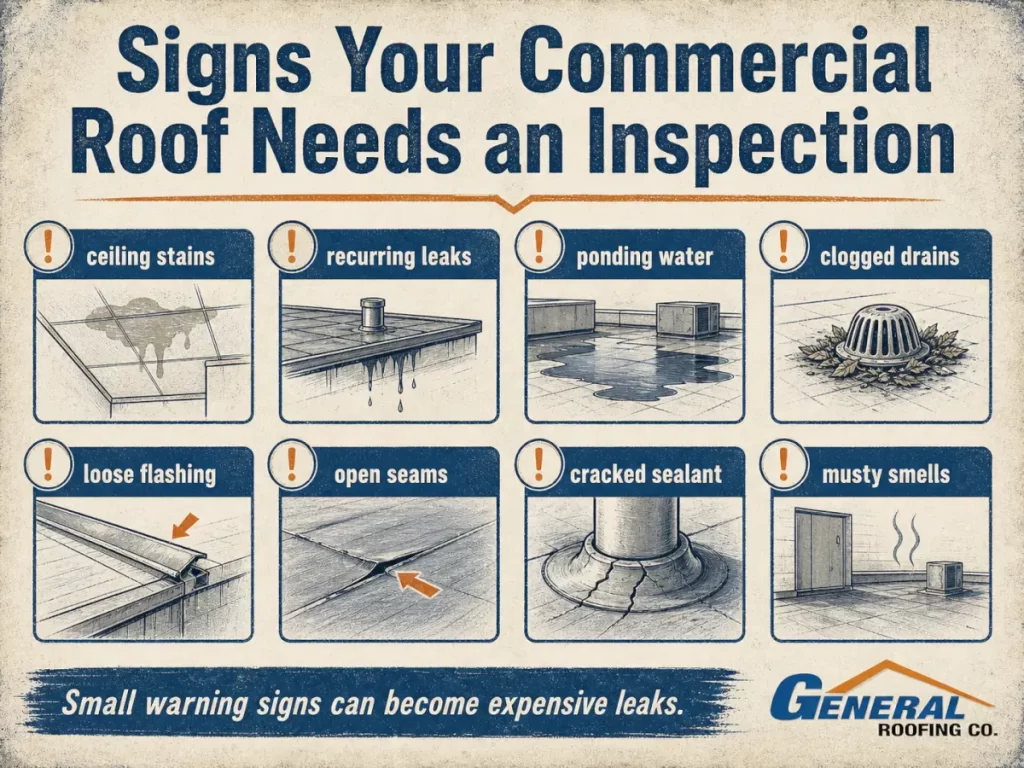
Schedule a preventative roof inspection if you notice any of these:
- water stains on ceiling tiles or walls
- recurring leaks in the same area
- ponding water more than a day or two after rain
- clogged drains or overflowing gutters
- loose flashing
- open seams
- cracked sealant
- blistering or bubbling membrane
- rusted metal details
- musty smells near the roof deck
- heavy rooftop foot traffic
- recent HVAC, solar, electrical, or plumbing work on the roof
A commercial roof maintenance inspection is especially important when the building has tenants, inventory, servers, machinery, medical equipment, or anything else that really should not meet rainwater.
For ongoing planning, our roof asset management programs can help track roof condition over time instead of waiting for leaks to set the schedule.
Preventative roof inspection vs. leak inspection
A preventative roof inspection is done before there is an active problem. The goal is to catch weak spots early and plan repairs around your schedule.
A leak inspection is more urgent. The goal is to find where water is getting in and stop it.
Both are useful, but they are not the same. Preventative inspections usually give you more control. Leak inspections usually happen when the building is already telling you something has gone wrong.
For most commercial buildings, the best setup is a maintenance schedule with clear documentation. That way, when something changes, you can compare the roof to previous inspection notes instead of starting from scratch every time.
How to prepare for a commercial roofing inspection
You do not need to overthink it. A little prep helps, though.
Gather roof plans, warranty documents, past inspection reports, repair invoices, leak logs, tenant complaints, and photos of any interior stains. Clear access to the roof hatch or ladder area. If the leak is inside a tenant space, make sure someone can let the inspector in.
Do not send an untrained employee onto the roof to “take a quick look.” Flat roofs can still be dangerous, especially near edges, skylights, wet membrane, soft spots, or areas with poor access.
For seasonal upkeep, our roof maintenance checklist is a useful starting point.
FAQ
How often should a commercial roof be inspected?
A commercial roof should be inspected at least twice a year, usually in spring and fall. You should also inspect it after major storms, high winds, heavy rain, rooftop service work, or any leak report.
What is the 25% rule in roofing?
The 25% rule means that if more than about 25% of the roof surface needs repairs, it is often smarter to consider full replacement instead of continuing to repair the roof in pieces. Local code rules can also use percentage thresholds, so check your city requirements before starting larger roof work.
How much does it cost to have someone inspect your roof?
For commercial buildings, a basic inspection often costs about $250 to $750. In the Bay Area, a basic commercial inspection is more likely to land around $300 to $800. A detailed inspection with photos, reporting, moisture scans, or due diligence documentation can cost $1,500 to $4,000 or more.
What does a roof inspection include?
A roof inspection includes the roof surface, seams, flashing, drains, gutters, penetrations, rooftop equipment, roof edges, previous repairs, and interior signs of water damage. A commercial inspection may also include photos, a written report, repair recommendations, and maintenance planning.
What is the first thing an inspector wants to see?
The first thing an inspector wants to see is safe roof access. After that, they want leak history, repair records, warranty information, tenant photos, and the interior areas where water has shown up.
What is a flat roof inspection?
A flat roof inspection is a close review of a flat or low-slope roof system. It focuses on drainage, ponding water, seams, membrane damage, flashing, penetrations, parapet walls, HVAC curbs, and signs of wet insulation.
Is a commercial roof inspection worth it?
Yes, especially if the roof protects tenants, inventory, equipment, or daily operations. A commercial roof inspection can catch small problems before they turn into leaks, interior damage, emergency repairs, or early replacement.
Final thoughts
A commercial roof inspection gives you a clearer picture of what is happening above the ceiling before the roof forces the issue.
If the roof is in good shape, document it and stay on schedule. If the inspection finds clogged drains, open seams, wet insulation, failing flashing, or too many old patches, you can plan the next step instead of reacting during the next storm.
For Bay Area buildings, the smart move is simple: inspect the roof regularly, keep records, and fix the small stuff before it starts acting expensive. If you need help with a commercial roof inspection, repair plan, or maintenance program, you can request an estimate from General Roofing.
Recent Comments